






































































Overview
“Journey to Italy” (original title: Viaggio in Italia) is a 1954 Italian-French co-production film directed by Roberto Rossellini. It depicts a few days spent in Naples and its surroundings by a British couple in a period of marital fatigue who have traveled by car from England to sell a villa near Naples that they inherited from a deceased uncle, portraying the crisis in their marital relationship and signs of reconciliation that resist explanation.
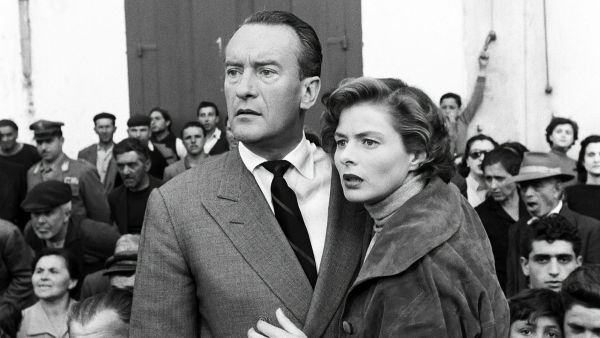
The lead actress Ingrid Bergman was Rossellini’s wife at the time, and this is a collaborative work following “Stromboli” (1950) and “Europe ’51” (1952). Although it was a commercial and critical failure, it was later reevaluated by critics associated with the French film magazine Cahiers du Cinéma and came to be positioned as a forerunner of modern cinema.
Trailer
Film Data
- Production: Sveva Film, Junior Film, Italia Film, Les Films Ariane, Francinex, Société Générale de Cinématographie, and others. Producers: Adolfo Fossataro, Alfredo Guarini, Roberto Rossellini
- Director: Roberto Rossellini
- Screenplay: Roberto Rossellini, Vitaliano Brancati (Antonio Pietrangeli provided uncredited collaboration. The original concept was inspired by Colette’s novel “Duo” (1934), but rights could not be obtained, resulting in a substantially altered original screenplay)
- Cinematography: Enzo Serafin
- Editing: Jolanda Benvenuti
- Music: Renzo Rossellini
- Principal cast: Ingrid Bergman (Katherine Joyce), George Sanders (Alexander “Alex” Joyce), Maria Mauban (Marie), Paul Muller (Paul Dupont), Anna Proclemer (prostitute), Leslie Daniels (Tony Burton), Natalia Ray (Natalia Burton), Jackie Frost (Judy), and others
- Language: English (as shot; the Italian release version was dubbed into Italian)
- Format: 35mm black-and-white, Academy ratio 1.37:1
- Distribution: Italy: Titanus. Japan: December 9, 1988, distributed by Daiei
- Running time: Varies by version. Approximately 85 minutes (Italian version), approximately 97 minutes (English international version), approximately 80 minutes (U.S. release version “Strangers”), approximately 70 minutes (U.K. version “The Lonely Woman”), etc.
Plot Summary
Alexander and Katherine, a British couple married for eight years, drive to Naples to sell a villa inherited from Uncle Homer. From the journey onward their conversation does not connect, and the emotional distance between them becomes apparent.
Once in Naples the two spend increasing amounts of time apart. Alexander distracts himself with relationships with other women, while Katherine, touring museums and volcanic areas alone, is drawn back to the memory of a young poet who had once loved her and died young.
After completing the sale of the villa the two strain their relationship to the point of speaking of divorce. But on the way back, after witnessing an excavation at the ruins of Pompeii and then being swept up in the crowd of a procession of the Madonna in a town near Naples (Maiori), the two reaffirm their feelings for each other.
Commentary
Production Background
This film is counted among the collaborative works made after Rossellini and Bergman married in 1950. In this series of films the pattern is repeated in which a foreign woman played by Bergman is shaken inwardly when confronted with the climate and religious environment of an unfamiliar land. In “Stromboli” the setting was a volcanic island off Sicily, in “Europe ’51” the social reality of Rome, and in this film the city of Naples became the stage.
The concept of adapting Colette’s novel “Duo” was the starting point of the project. However, rights could not be obtained, and while incorporating elements from Antonio Pietrangeli’s unused screenplay “New Vine” and others, it was shot as a largely original project.
Filming took place from February to April 1953. Without relying on a fixed screenplay prepared in advance, it proceeded by an improvisational method in which Rossellini wrote down the content of that day’s shooting just beforehand or gave oral instructions. George Sanders was perplexed by this method and felt dissatisfaction, as is related in his memoir “Memoirs of a Professional Cad” (1960) and in the testimonies of Bergman and others. After completion it took approximately 18 months to find a distributor.
Characteristics
The greatest characteristic of this film is that it takes as its subject “nothing happening,” rather than driving the narrative through a chain of dramatic incidents. The couple’s relationship is not broken by a decisive incident but is revealed through the accumulation of everyday conversational mismatches and silences. And the reconciliation at the end also arrives almost abruptly, lacking psychological explanation. This elliptical narration differs clearly from the causal narrative structure of classical Hollywood films of the same period.
Another characteristic is that the inner lives of the characters are shown indirectly through the observation of landscapes and objects. The streets of Naples, the ancient sculptures in the museum, the volcanic fumaroles, the remains at Pompeii, and the religious procession function as symbols of the characters’ psychology while at the same time being depicted in a matter-of-fact way in themselves.
Locations
This film was shot in Naples and its surroundings. The main places appearing in the film are the National Archaeological Museum of Naples, the Solfatara of Pozzuoli, the Cave of the Sibyl at Cumae (Cuma), the island of Capri, the ruins of Pompeii, and Maiori where the procession of the Madonna takes place at the end. The actual locations and the settings in the film largely coincide, and the excavation scene at Pompeii incorporates real work.
Directorial Method
Rossellini continuously captures the relationship between the actors’ performances and space through camera movement and pans. Especially in the scenes inside the car and the scenes in which Katherine walks alone through ruins and museums, characters and environment are linked within a duration close to a long take, and the movement of the gaze itself carries meaning.
In the Pompeii sequence, the process of pouring plaster into the cavities left by the bodies of a man and a woman who died buried in volcanic ash and taking molds is unfolded before the couple’s eyes at the excavation site. The figures of the two who died embracing each other at the moment of death contrast with the couple’s chilled relationship. This scene functions as the decisive trigger that shakes Katherine’s emotions.
Thematic Analysis
The theme of this film is both the loss and recovery of love and the confrontation between the isolation of the modern individual and the ancient, religious, and natural time that surrounds it. The refined yet empty conversation of the British couple is contrasted with the vitality of the people of Naples, the reality of death presented by the ancient ruins, and the collective exaltation produced by the faith of the populace.
In addition, the procession of the Madonna at the end and the accidental reunion in the crowd repeat the theme of the “miracle” on a secular level. Regarding this ending, there is criticism that the couple’s reconciliation lacks necessity, as well as evaluation that precisely this inexplicability indicates the possibility of recovery beyond reason in human relationships.
Within Rossellini’s body of work it is often discussed as a representative work of the period when interest shifted from the recording of social reality in the era of neorealism to the inner and spiritual crisis of the individual.
Release
This film had its premiere in Milan on September 7, 1954, and was released generally in Italy the following day, the 8th. In the United States a substantially shortened version was given a limited release in 1955 under the title “Strangers,” and in the United Kingdom an approximately 70-minute version was released in 1958 as “The Lonely Woman.” In France it was screened under titles such as “L’Amour est le plus fort.”
Reception
Contemporary evaluation was unfavorable, and it was a commercial as well as critical failure. In Italy it was often criticized as a “nothing happens” story that departed from the norms of neorealism.
The situation changed from the mid-1950s onward. Critics of Cahiers du Cinéma, especially Jacques Rivette, Jean-Luc Godard, and François Truffaut, highly evaluated this film. In Rivette’s “Letter on Rossellini” (1955) he wrote, “If there is a modern cinema, this is it” and “With the appearance of ‘Journey to Italy,’ all films have suddenly aged ten years,” and Godard later recalled, “Once I had seen ‘Journey to Italy,’ I knew that, even if I were never to make movies, I could make them” (this remark is known as one that indicates the sense of liberation felt upon realizing that cinema does not require special means).
Thereafter this film is said to have exerted a great influence on filmmakers of the generation after the Nouvelle Vague. Roberto Rossellini’s works are also taken up in Martin Scorsese’s documentary “My Voyage to Italy” (1999), and Scorsese positions this film as “the first modern film.”
In critics’ polls it ranked 41st in the 2012 Sight & Sound all-time best and tied for 72nd in 2022. On Rotten Tomatoes it has a critics’ score of 96% (average 8.6/10), and on Metacritic it has recorded a score of 100.
Historical Positioning
This film is positioned as a work that bridges neorealism and the subsequent modern cinema. Its attitude of emphasizing the duration of time, the relationship between characters and space, and ambiguity and fragmentariness rather than narrative causality is often referred to as one of the starting points of the lineage that continues to the works of Michelangelo Antonioni, Godard, and others.
Home Media
In 2012 a joint restoration by Cinecittà Luce, the Cineteca di Bologna, the CSC National Film Archive, and others was carried out, and a 4K digital restoration based on the original negative was completed. The Criterion Collection released the Bergman–Rossellini trilogy as a box set (Blu-ray/DVD) in 2013, including extensive special features centered on the English version.
In Japan, DVDs and Blu-rays have been released by IVC and others.
A new 4K restored version was screened in the Classics section of the 2026 Venice Film Festival.
Search Links
Cross-Search for “Roberto Rossellini Journey to Italy” on JustWatch
Search for “Roberto Rossellini Journey to Italy” on Amazon.com
Synopsis (Contains Spoilers)
On the Road to Naples
The British couple Alexander (Alex) and Katherine Joyce drive to Italy to sell the villa near Naples left by Katherine’s deceased Uncle Homer. The conversation of the couple, married for eight years, does not connect from the journey onward.
Katherine is visiting Italy for the first time and shows curiosity about the scenery, but Alexander returns only ironic responses.
Katherine brings up the story of a young poet who had once stayed at Uncle Homer’s villa. The young man who had loved her died young of illness. Alexander shows open jealousy and irritation at that topic.
The Villa and Separate Activities
Arriving in Naples, the two set about sorting out the villa and the procedures for its sale. In their life in Naples the time they spend apart increases. Alexander tries to distract himself through associations with the couple’s friends and relationships with local women, while Katherine tours the city alone as if left behind.
Katherine’s Sightseeing
Katherine views ancient sculptures at the National Archaeological Museum of Naples, visits the volcanic area with fumaroles at the Solfatara of Pozzuoli, and tours the Cave of the Sibyl at Cumae. Furthermore, the everyday life of the people she encounters in the streets—weddings and funeral processions, pregnant women and children—evokes various emotions within Katherine. At times she confronts the memory of the deceased poet while holding back tears.
Capri and Alexander’s Days
Meanwhile Alexander spends time keeping his distance from his wife by going out to Capri with friends and so on. Words of mutual blame and at times contemptuous irony fly between them, and the crack in their relationship becomes decisive.
Decision to Divorce
At last the two settle on the direction of selling the villa and divorcing after returning home. It is shown not as the result of a violent quarrel but as a quiet agreement as if exhausted.
Pompeii and Reconciliation
Before returning home the two visit the ruins of Pompeii. Excavation work is being carried out there, and through the work of pouring plaster into the cavities remaining in the volcanic ash, molds of the bodies of a man and a woman who once died buried in ash are taken out. Confronted with the figures of the man and woman who met death while embracing each other, Katherine is violently disturbed.
Afterward, on the road back to Naples by car, the two come upon a procession of the Madonna in Maiori and are swept up in the wave of the crowd and separated. Amid the people’s fervent prayers and voices seeking a miracle, Katherine calls her husband’s name, and Alexander also finds his wife. Katherine confesses while weeping that although she pretended to accept the divorce she was actually afraid, and Alexander acknowledges his love for her. The two embrace in the crowd, and the story ends without indicating the subsequent fate of the two.