














































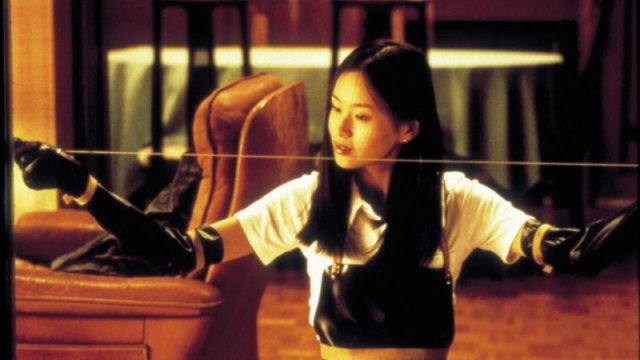

- Overview
- Trailers
- Plot Summary
- Commentary
- Production Background
- The Spirit World and the Internet as a Subject
- The Direction of Fear: An Aesthetics of Restraint
- Locations and Filming Sites
- Cinematography and Special Effects
- Music and Sound Design
- The Substantialization of Ghosts in J-Horror
- Shots Through Glass
- Thematic Analysis and Interpretation
- Loneliness as Existential Anxiety
- The Fear of Death and the Fear of Loneliness
- From Horror to Science Fiction: The Transformation of Genre
- The Motif of Contagion
- The Motif of the Forbidden Room and the Symbolism of the Red Tape
- Interpreting the Disappearance of Human Beings and the Black Stain
- Mirrors Reflect Loneliness
- Interpretations of Harue’s Embrace
- Interpretations of Harue’s Appearance at the Abandoned Factory
- Release
- Awards
- Home Media
- Streaming Availability
- Reception
- Reappraisal in English-Speaking Markets
- Reappraisal in the 2020s
- Novel
- Remakes
- Operas
- Influence
- Search Links
- Synopsis (Spoilers)
- Prologue (The Large Ship)
- Taguchi’s Suicide
- Connecting to the Ghost Site
- Kawashima and Harue Meet
- Yabe Encounters a Ghost
- Connecting to the Ghost Site Again
- Michi Witnesses a Suicide by Jumping
- Yoshizaki’s Hypothesis
- Strange Occurrences Among Michi’s Circle
- Harue and Kawashima Talk
- Junko’s Disappearance
- Kawashima and Harue’s Flight
- Harue’s Embrace
- Kawashima and Michi Meet
- The Abandoned Factory
- The Deserted City
- Epilogue (The Large Ship)
- Notes
Overview
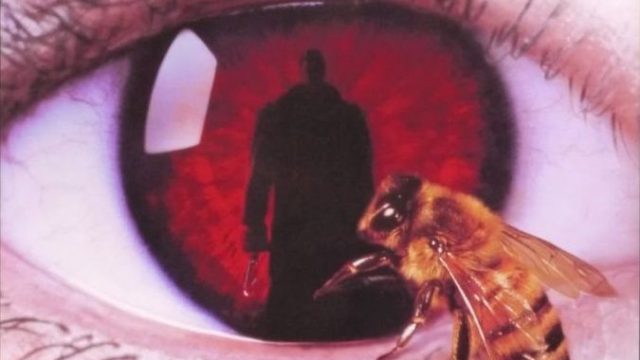
“Pulse,” Japanese title “Kairo” (Circuit) is a 2001 Japanese techno-horror film directed and written by Kiyoshi Kurosawa. It runs 118 minutes.
Centered on two perspectives — Michi Kudo, a woman who works for a company that sells houseplants, and Ryosuke Kawashima, a university student who has just begun using the internet — the film depicts the collapse of the world as people disappear one after another, triggered by a mysterious website that asks, “Would you like to meet a ghost?”
Production: Daiei, Nippon Television Network, Hakuhodo, Imagica.
Executive producer: Yasuyoshi Tokuma.
Producers: Takashi Shimizu, Seiji Okuda, Ken Inoue, Atsuyuki Shimoda.
Production: Hiroshi Yamamoto, Toshio Hagiwara, Seiji Ono, Chikara Takano.
Distribution: Toho.
Cinematography: Junichiro Hayashi.
Music: Takefumi Haketa (composer), Toru Wada (music producer).
Theme song: Cocco, “Hane: Lay Down My Arms.”
Principal cast: Principal cast: Haruhiko Katō as Ryosuke Kawashima, Kumiko Asō as Michi Kudo, Koyuki as Harue Karasawa, Kurume Arisaka as Junko Sasaki (Junko Sasano in the novel version), Masatoshi Matsuo as Toshio Yabe, Shinji Takeda as Yoshizaki, Jun Fubuki as Michi’s mother, Shun Sugata as the company president, Show Aikawa as the construction worker, and Kōji Yakusho as the ship’s captain.
Language: Japanese.
Trailers
Original
Remastered HD
Plot Summary
Michi Kudo, an employee at the houseplant retailer Sunny Plant Sales, visits the apartment complex of her coworker Taguchi, who has failed to show up for work, and discovers that he has hanged himself. A floppy disk he left behind includes strange photo data of his dark room.
Yabe and Junko, colleagues of Michi’s, also succumb to fear after entering a sealed-off “forbidden room” marked with red tape, and vanish, leaving black stains on the walls behind them.
When Ryosuke Kawashima, a university student, tries to connect to the internet at home, his computer connects on its own to a mysterious website that asks, “Would you like to meet a ghost?” Suspicious, Kawashima consults Harue Karasawa, a science and engineering student at his university. Harue’s senior, Yoshizaki, proposes a hypothesis: the spirit world’s capacity to hold souls is finite, and once it reaches its critical limit, the ghosts that overflow begin to encroach on the world of the living. Harue tells Kawashima that ghosts try to keep people alive forever by trapping them in loneliness.
The phenomenon of people vanishing spreads through the circles around Michi, Kawashima, and Harue, until Tokyo as a whole, and eventually the world itself, becomes an emptied ruin devoid of human presence.
Commentary
Production Background
After establishing his reputation both domestically and internationally with his previous film “Cure” (1997), Kiyoshi Kurosawa returned to the horror genre with this film. It is said that from the planning stages, there was a concept of linking the motif of “ghosts” with the internet, a new medium that was then spreading rapidly.
Kurosawa has said, in a 2016 interview for Arrow Video, that in the mid-1990s he discussed with screenwriter Chiaki Konaka an idea for “an invasion by alien-like ghosts.” This concept went unrealized as a work at the time, but later became one of the foundations of this film.
The project began in earnest after a producer approached Kurosawa with a request to “do something like ‘Ring.'” In place of videotape, Kurosawa started from the idea that “the internet is frightening,” and deliberately excluded the kind of personal grudge or motive for revenge common to conventional ghost films. By portraying the ghosts as uncanny entities devoid of human emotion, this approach, in turn, opened the path by which the story would transform from horror into apocalyptic science fiction.
The Spirit World and the Internet as a Subject
The film was released in 2001, a period when the internet was beginning to spread widely in Japanese households. Dial-up connections, floppy disks, CRT monitors, and early internet-enabled mobile phones are vividly reflected in the film’s depiction of the internet environment of the time.
Behind the subject of “the spirit world and the internet” lies a historical backdrop: an affinity between early internet culture and spiritual mysticism during the 1990s. As the American cultural critic Erik Davis has observed,[1] the cyberculture of the West during this period was steeped in a mystical imagination rooted in hippie rave culture and New Age thought, with the concept of “cyberspace” frequently linked to disembodied consciousness or a transcendent realm.
In Japanese pop culture as well, from the late 1990s through the early 2000s, an imagination that connected the internet, as a new medium, to the afterlife or to the spiritual realm enjoyed considerable currency.
It is against this backdrop that the film has sometimes been compared to the television anime series “serial experiments lain” (1998), which portrays the boundary between the real world and a networked space — conceived as a realm akin to the spirit world — growing increasingly uncertain. Chiaki Konaka, who wrote the screenplay for “lain,” was involved, as noted above, in the conception of this film as well.
The Direction of Fear: An Aesthetics of Restraint
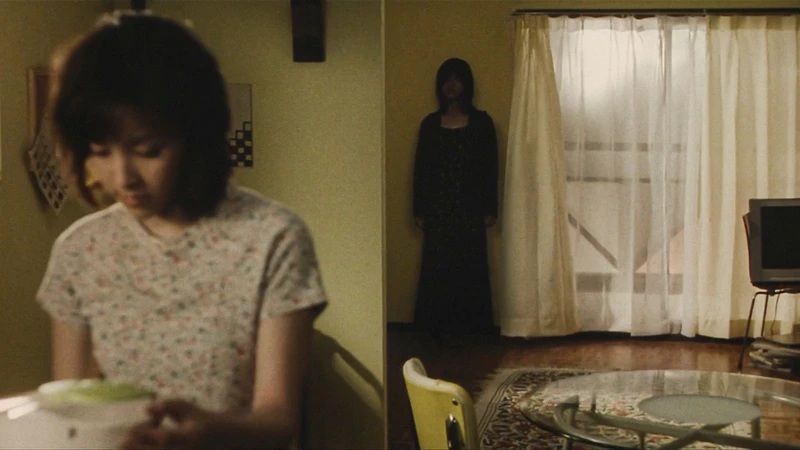
In depicting the ghosts and the unfolding disturbances, the film largely avoids CGI and jump scares, instead emphasizing atmosphere and unease: prolonged stretches of stillness and silence, the emptiness of a space in which nothing happens, the unnatural physical movements of the actors, and the uncanny sight of a depopulated city evoke fear and sustain a persistent sense of dread.
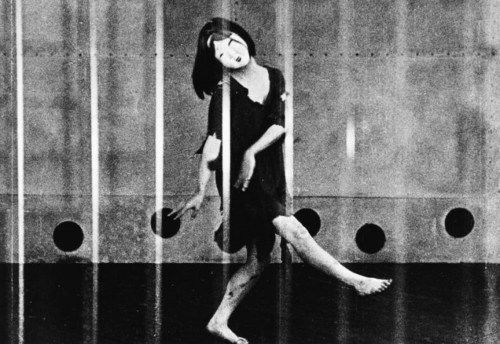
In particular, the scene in which Yabe encounters a ghost in the forbidden room has been widely praised for generating fear without relying on jump scares or loud sound effects; Scott Tobias, writing for “The A.V. Club,” described it as “arguably the signature sequence in all of J-horror.”[2] The ghost in this scene was played by the contemporary dancer Akiko Kitamura, whose unnaturally jointed movements lend the figure an inhuman quality that greatly intensifies the scene’s unease.
The filmmaker and animation director Mamoru Oshii, in a 2026 interview discussing Kiyoshi Kurosawa’s horror works, highly praised “Pulse” alongside “Cure.” He highlighted as a defining feature of Kurosawa’s horror direction the elimination of jump scares in favor of seamlessly connecting the everyday and the extraordinary, depicting a fear that remains continuous with daily life at a deliberately slow tempo.[3]
Locations and Filming Sites
The film was shot primarily in urban districts, apartment complexes, university campuses, and a former factory site in Tokyo.
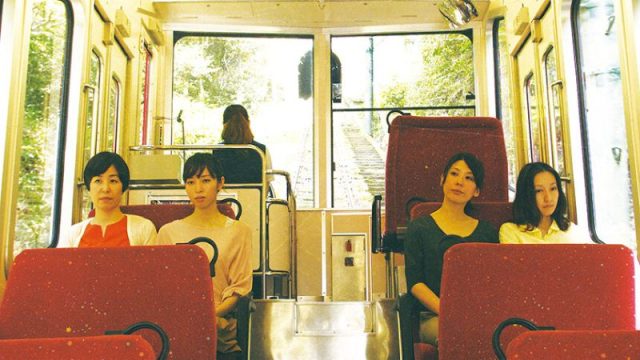
In the scene where Kawashima and Harue ride the deserted train, the west exit of Komaba-Todaimae Station (Meguro, Tokyo) on the Keio Inokashira Line is visible.
Toward the end of the film, the scene of Michi and Kawashima driving through the deserted city by car was shot on the streets around Ginza and Yurakucho (Chuo, Tokyo) (reportedly filmed early on a public holiday morning, with an assistant director controlling traffic).
The scene of their escape to sea by motorboat was filmed in a harbor area along the coast of Tokyo Bay.
Cinematography and Special Effects
Cinematography
The cinematographer was Junichiro Hayashi, who had also shot Hideo Nakata’s “Ring” (1998); the heavily shadowed visual style characteristic of J-horror carries over into this film as well.
The film as a whole employs the “silver retention” (gin-nokoshi) process, which produces high contrast and desaturated color.
Special Effects
Visual effects were supervised by Shuji Asano, and special makeup effects by Yuichi Matsui. Masaru Tateishi served as CG director, and Yoshihisa Kato as digital art director.
Scenes such as the suicide by jumping and the plane crash used computer-controlled motion-control cameras.
The Bus Scenes
In the film, there are scenes in which Michi and Yabe each ride a bus alone to Taguchi’s apartment complex. The bus interiors were shot on a studio set, with the scenery outside the windows artificially rendered through screen process and compositing. This technique, also used in Kurosawa’s earlier film “Cure,” deliberately detaches the scenes from real locations, creating the impression of a transition from everyday space into an uncanny realm.
The Suicide-by-Jumping Scene
In the scene of Michi witnessing the suicide by jumping, the sequence — from the woman leaping from the apartment complex’s water tower to her impact on the ground — is presented so as to appear as a single continuous shot. In the actual filming, footage of a stuntwoman performing a bungee jump was combined with footage of a dummy dressed in matching costume falling to the ground, with the bungee cord digitally erased using CGI.
The Ghost Close-Up
In the scene in which Kawashima confronts a ghost inside the forbidden room of the abandoned factory, a black silhouette with only its face appearing in white slowly approaches him. As the ghost draws nearer, its initially blurred face gradually comes into focus, culminating in a close-up in which focus shifts to its wide-open eyes.
Music and Sound Design
Music
The score was composed by Takefumi Haketa. Combining chamber music with synthesizer, the score largely avoids dramatic climaxes, favoring pieces that build a slow, creeping sense of unease. Particularly notable is the use of wordless female vocal performance (vocalise), whose unarticulated sound gives musical expression to the nonverbal realm of the spirit world. The instrumentation, which includes harp, also lends the score a mystical, weightless texture.
Soundtrack
On February 21, 2001, an original soundtrack album for “Pulse” was released on CD by PSC International. It contains all 16 tracks of Takefumi Haketa’s original score. The CD has since gone out of print, but excerpts can be streamed on retail sites such as Billboard JAPAN, Tower Records Online, HMV & BOOKS online, and Neowing.
Sound Design
In terms of sound design, the film restrains dramatic sound effects and musical cues, instead relying heavily on deliberate silence and low, sustained ambient noise to sustain a quiet, persistent fear.
Theme Song: Cocco, “Hane: Lay Down My Arms”
The theme song, “Hane: Lay Down My Arms,” is Cocco’s tenth single, released on February 21, 2001, by Speedstar Records (Victor Entertainment). Cocco wrote both the lyrics and the music herself, with arrangement by Takamune Negishi.
The Substantialization of Ghosts in J-Horror
So-called “J-horror” films from the late 1990s onward — “Ring” (1998), the “Ju-on” series (2000– ), among others — departed from earlier ghost-story cinema by increasingly presenting ghosts on screen as substantial entities. Visual signifiers such as long black hair, pale skin, and unnaturally jointed movement became conventions of the genre during this period.
The depiction of ghosts in “Pulse” is positioned within this lineage. In the scene in which Kawashima confronts the ghost inside the forbidden room of the abandoned factory, he reaches out to touch it and is startled to find that it is tangible; the ghost tells him, “I am not an illusion.”
Kurosawa, however, as noted above, places greater emphasis on generating a slow-building, sustained sense of fear and unease through silence and emptiness, rather than through the design of the ghosts themselves — a point that marks a degree of authorial distance from the genre’s conventions.
Shots Through Glass
In the film, scenes shot through the glass of a window or wall, or through a translucent plastic curtain, appear throughout. This technique is a consistent feature of Kiyoshi Kurosawa’s directorial style, and is often discussed as a means of visualizing the boundary separating characters from the outside world — or from the other world.
Footage shot through glass or a plastic curtain, subject to reflection and distortion, lets the viewer sense that something is happening on the other side while keeping the view obscured. The result is a sustained sense of an alien presence, even as any direct confrontation with it is avoided. This effect is closely bound up with the directorial approach, running throughout the film, of sustaining fear through stillness and silence.
Thematic Analysis and Interpretation
Loneliness as Existential Anxiety
This film treats the anxiety of “isolation” in contemporary society as its central motif.
The film scholar Jerry White, in his book “The Films of Kiyoshi Kurosawa: Master of Fear,” writes of the film: “More than anything, Pulse is about isolation… Specifically, the very human need to connect with another person.”[4]
The historical backdrop of the film also included a social anxiety: the sense that the “connection” offered by networks might, in practice, isolate people. An environment in which networks connect people to one another paradoxically foregrounds an anxiety over isolation.
At the time, alongside the rapid spread of the internet, concerns had also begun to be voiced that prolonged internet use might thin out real-world human relationships, giving rise to a nascent wariness of what came to be called “internet addiction.”
This motif of isolation also resonates with phenomena in Japanese society such as “hikikomori” (social withdrawal) and “kodokushi” (dying alone). It overlaps with the historical backdrop of an era in which, even as networked society drew human relationships closer together, the existence of people isolated both physically and psychologically was just beginning to be recognized as a set of social problems.
In English-language criticism, the film is often described as “prophetic,” seen as having foreseen an acceleration of loneliness brought about by the internet.
In this film, however, it is not so much this social awareness but an existentialist stance that forms the foundation: the recognition that human beings are inherently alone, and that this cannot be resolved through connection with others.
No matter how connected one becomes to others, no one can escape the loneliness of being a single individual. This existential anxiety serves as the core theme running through the entire film.
The Fear of Death and the Fear of Loneliness
Two distinct registers of fear run through the film. One is a direct fear of “death,” evoked by scenes of suicide, disappearance, and encounters with ghosts. The other is a fear of “loneliness,” crystallized in Harue Karasawa’s question: “What if you’re still alone even after you die?”
The film suggests that the ghosts’ purpose is not to kill human beings, but to keep them alive forever, trapped within loneliness. This premise causes the center of gravity of the film’s fear to gradually shift, from the classic horror theme of the loss of life toward a more contemporary, existential theme: a loneliness from which one can never escape, no matter how connected to others one becomes.
This thematic shift also appears in the words of the ghost Kawashima confronts in the forbidden room of the abandoned factory near the film’s end. The ghost says, “Long… death was eternal loneliness…” — a line that suggests a rupture between death as a singular event and loneliness as an unending, persisting condition.
From Horror to Science Fiction: The Transformation of Genre
One of the film’s notable features is its transformation from horror in the form of a ghost story into an apocalyptic work of science fiction.
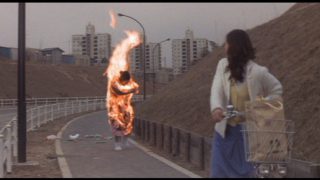
In its first half, the film proceeds along the conventional lines of J-horror: characters are frightened by unsettling footage on monitors, and people meet mysterious deaths or vanish. In the second half, however, the focus shifts away from the individual uncanny encounters of its characters and toward apocalyptic imagery suggesting the extinction of humanity itself — an emptied Tokyo, a crashing airplane, a burning cityscape.
The film offers no clear causal link between the explanation of ghosts overflowing from the spirit world and the phenomenon of people vanishing into black stains. This gap has sometimes been criticized as a structural flaw undermining the coherence of the plot, but it can equally be understood as a deliberate directorial strategy that refuses causal explanation altogether, or as an expression of “an incomprehensible catastrophe.”
The Motif of Contagion
This film was Kiyoshi Kurosawa’s return to horror following “Cure” (1997), and a thematic continuity can be traced between the two works. “Cure” depicted a “contagious madness,” in which, through contact with an amnesiac man (Mamiya), a violent impulse spreads from person to person like a virus. In “Pulse,” “loneliness” similarly spreads from person to person through contact with ghosts, eventually engulfing the entire city, and finally the entire world.
This form of transmission — “contagion” — is sometimes discussed as a thematic motif running throughout Kurosawa’s body of work. The critic Adam Nayman, from this perspective, has described Kurosawa as “the great modern filmmaker of contagion, be it chemical, biological, or intellectual.”[5]
The Motif of the Forbidden Room and the Symbolism of the Red Tape
The setting of the “forbidden room” (akazu no ma) is not an invention original to this film, but a stock motif long found in Japanese ghost stories and urban legends. Tales of a room sealed off, never to be opened again, due to a suicide, a murder, or some unexplained cause, circulate widely as accounts of real-life hauntings and uncanny experiences.
In the film, the red tape functions in a role akin to the “shimenawa” (sacred straw rope) or paper talismans traditionally used in Japan to demarcate and seal off sacred or forbidden spaces. In other words, sealing off a room with red tape creates a “forbidden room,” while peeling away the tape opens a channel between the spirit world and the world of the living, forming a route through which ghosts encroach upon this world.
In traditional Japanese culture, red has long been associated with warding off evil and misfortune, as seen in the color of shrine torii gates and in the clothing traditionally worn by infants. The red tape in the film may likewise have been chosen with this traditional symbolism of the color red in mind.
Interpreting the Disappearance of Human Beings and the Black Stain
In the film, a person who encounters a ghost in the “forbidden room” vanishes, leaving a black stain on the wall. The film never clearly explains the cause of this phenomenon. The following interpretation is commonly offered.
Combining Yoshizaki’s hypothesis that the spirit world has a finite capacity to hold souls with Harue’s account that ghosts try to keep people alive forever by trapping them in loneliness, the black stain can be interpreted as the trace of a person trapped in “eternal loneliness,” suspended in a state somewhere between life and death. In other words, because of a shortage of capacity in the spirit world, human beings can no longer die and pass on to the afterlife; the ghosts overflowing into this world, instead of killing people, seek to make them exist forever within loneliness.
From an existentialist perspective, this depiction of people vanishing into black stains can be read not simply as social isolation or the fear of death, but as an expression of a more fundamental existential fear of disappearance — the fear that one’s own existence might vanish without a trace, leaving behind neither meaning nor memory.
Regarding the image of a person’s disappearance, Kurosawa has said, in a 2016 interview for Arrow Video, that it was drawn from a memory of the scene in Kurt Neumann’s science-fiction horror film “The Fly” (1958), in which a cat vanishes after a failed matter-transmission experiment.
Mirrors Reflect Loneliness
In this film, mirrors and their reflections function as a mechanism to suggest “eternal loneliness.”
The floppy disk left behind by Taguchi after his suicide includes photo data of him standing in a dark room, his back to the camera; in the photo, a secondary monitor reflects his face like a mirror.
In the scene at the deserted convenience store Michi visits, a figure who should not be visible — a clerk standing in the back room — appears through the two-way mirror inside the store, looking like a ghost.
A closer look at the video appearing in the film — showing a man with a black plastic bag over his head, in a dark room whose walls are covered with the mirror-written words “help me” repeated over and over, committing suicide with a handgun — also reveals the use of a visual trick produced by the reflection of plate glass, known as “Pepper’s ghost.”
Moreover, the infinity mirror appearing in the film can also be understood as a device for visualizing eternal loneliness.
Within Taguchi’s photo, the main monitor displays the same photo nested within itself. This is the infinite reflection of an infinity mirror.
Emmanuel Levinas, in his early essay “On Escaping,” points to a condition in which the solitary subject cannot escape its own existence, and ceaselessly returns to itself.[6] One who is cut off from others becomes trapped within a cycle of self-reflection resembling that of an infinity mirror: the self reflecting the self reflecting the self reflecting the self… (and so on, forever). Eternal loneliness in this film, in this sense, is the endless return to the self that Levinas describes — a prison of recursion.
Interpretations of Harue’s Embrace
The scene at Harue’s apartment, in which she says, “I’m not alone,” reaching into empty air as if embracing someone, and smiles, is one of the most disputed points of interpretation in the film.
After attempting to escape aboard a deserted train with Kawashima, Harue returns home alone.
At Harue’s apartment, her computer connects to the mysterious site: the monitor shows a video of a man pulling off a black plastic bag covering his head and shooting himself with a handgun, while the printer prints out a page reading “How to Make a Forbidden Room.”
Noticing what appears to be webcam footage of herself, shot from behind, displayed on the monitor, Harue turns around and approaches the unseen figure she believes to be filming her, saying, “I’m not alone,” reaching into empty air as if embracing someone, and smiling.
Who, or what, does Harue embrace in this scene? Why does she appear to have been freed from the fear of loneliness? The film offers no answer to either question, leaving the matter to the viewer’s judgment. The principal interpretations are as follows:
- The ghost reading: Harue is embracing a ghost. On this reading, the scene marks the moment at which she overcame, or came to accept, the “eternal loneliness” she had until then feared, through communion with the ghost. In this case, the ghost’s gaze was what displayed Harue’s figure on the monitor, functioning like a webcam.
- The hallucination reading: Nothing was actually there at all; under extreme loneliness and fear, a defense mechanism produced a hallucination, or an inward form of relief. On this reading, Harue’s mind conjured up, as a phantom, some figure to save her from her loneliness.
- The mirror-image reading: Much as Narcissus, in Greek mythology, was cursed, as punishment for spurning the love of others, to fall in love with his own reflection in the water, on this reading Harue is embracing her own mirror image, reflected in a mirror surface invisible to the audience. In this case, the figure captured in the webcam-like footage would have been herself, seen from the angle of her own mirror image. This is the view that Harue, having withdrawn from relations with others, became imprisoned within her own self-image. This reading is rich in implication. From a psychoanalytic perspective, first, this scene appears to represent a regression to what Freud termed “primary narcissism,” or, in Lacanian theory, an identification with the mirror image — an idealized image of the self. Then, from the standpoint of those who evaluate the film as prophetic in relation to social pathology, this scene can also appear as a metaphor for a structure in which isolated individuals in an information society become trapped within a reverberant space that excludes any different other—as seen, for example, in the echo-chamber phenomenon of online social media spaces.
- The meta-reading: By declining to specify what Harue is embracing, the director blurs the boundary between life and death, human and ghost, leaving the interpretation to the viewer. On this reading, the interpretation of the scene itself functions as a kind of mirror, reflecting back the viewer’s own view of loneliness and mortality.
Interpretations of Harue’s Appearance at the Abandoned Factory
Following the embrace scene described above, Harue goes missing, and Kawashima and Michi subsequently find her at an abandoned factory. She pulls off a black plastic bag that had been covering her head, presses the muzzle of a handgun against her jaw, fires, and collapses. This sequence of events admits of several interpretations:
- The “she has died” reading: Harue genuinely committed suicide by gunshot in the scene at the factory. This lacks realism, however: how she obtained the gun is never explained, and no blood accompanied the gunshot.
- The “she has already died” reading: Harue has already died — or already become a ghost — by the time of the earlier embrace scene at her apartment, and the figure appearing at the factory was a ghostly Harue repeating and re-enacting her own death.
- The “she has not died” reading: Harue became a ghost without ever undergoing physical death, or was captured by eternal loneliness while still alive. This also connects to a meta-reading in which Harue is deliberately portrayed as neither fully living nor fully dead. This reading is supported by Harue’s own words to Kawashima, in which she says that ghosts try to keep people alive forever, trapping them in loneliness.
Which, if any, of these interpretations is correct — or whether some other reading is possible — is never made explicit in the film. It is left to the viewer to decide.
Release
The film was released in Japan on February 10, 2001. That same year, it was selected for the Un Certain Regard section of the Cannes Film Festival.
Awards
2001 (54th) Cannes Film Festival — FIPRESCI Prize (International Federation of Film Critics)
Home Media
In Japan, the DVD was released by Pioneer LDC on August 24, 2001.
In English-speaking markets, the film was released on DVD by Magnolia Home Entertainment in North America on February 21, 2006. A dual-format Blu-ray/DVD edition was subsequently released by Arrow Video in North America and the United Kingdom in 2017.
In 2024, Umbrella Entertainment (Australia) released a limited-edition numbered “Pulse: Collector’s Edition” on 4K UHD and Blu-ray (released December 4, 2024). This marked the film’s first 4K HDR release and includes a 150+ page hardback book, artcards, a poster, and new special features.
Streaming Availability
The film has previously been available on various streaming platforms, including Amazon Prime Video, Max, Hulu, U-NEXT, Plex, Hoopla, and Philo, among others. Availability varies significantly by region and over time, and the film is occasionally offered for free for limited periods. For the most up-to-date information, check the following cross-search on JustWatch:
Cross-Search for “Kiyoshi Kurosawa Pulse” on JustWatch
Reception
At the time of its release, the film was regarded, alongside “Cure,” as having raised Kiyoshi Kurosawa’s international profile.
The film’s box office performance in Japan totaled approximately ¥200 million, falling short of a commercial hit.[7] Its North American theatrical run likewise grossed only around $51,000.[8] Critically, however, it fared well, holding a 76% approval rating (average score 6.8/10) on Rotten Tomatoes and a score of 68 on Metacritic, reflecting its strong standing as a work of art-house horror.
Western critics have praised the film as a work of considerable intellectual depth within the J-horror lineage, one that uses the internet — then a new medium — to depict the paradox of technology’s spread deepening human isolation. The American journalist Anita Gates, for instance, writing for “The New York Times” in 2008, described the film as follows:
“There are very few moments in Kiyoshi Kurosawa’s fiercely original, thrillingly creepy horror movie that don’t evoke a dreamlike dread of the truly unknown.”[9]
On the other hand, the film’s lack of causal explanation and its slow pacing have drawn criticism. Owen Gleiberman, for instance, writing for “Entertainment Weekly,” remarked that “the line that separates the uncanny and the obtuse has rarely been so thin,”[10] while J. Hoberman, writing for “The Village Voice,” criticized the film’s length and structure, calling it “at least half an hour too long” and noting that it “sometimes plods.”[11]
Reappraisal in English-Speaking Markets
In English-speaking markets, the film’s reputation has grown since Arrow Video’s 2017 Blu-ray release. On “Time Out” magazine’s list of the best horror films of all time, voted on by figures from the horror community, the film was ranked 65th as of 2021.[12] Recent English-language criticism has repeatedly emphasized the sheer intensity of fear the film induces, and it has come to be regarded as a cult favorite, often cited as “one of the scariest movies ever made” or “among the most frightening entries in J-horror.”
Reappraisal in the 2020s
Viewed from the perspective of the 2020s, the film leaves a different impression than it did at the time of its release.
The technologies depicted in the film — dial-up connections, CRT monitors, floppy disks, and early internet-enabled mobile phones — were cutting-edge at the time. With the rapid technological progress since then, these have either been superseded by newer technology or have disappeared altogether, and they now evoke what might be called “technostalgia” — a nostalgia for bygone technology.
Additionally, the film’s depiction of people growing isolated from one another and a city emptying out strikes audiences who have experienced the mutual isolation and lockdowns of the global COVID-19 pandemic, which began in 2019, with a strange sense of déjà vu.
From this perspective, the British freelance writer Jon O’Brien, in a 2020 contribution to the American online magazine “Inverse,” cited the film as the scariest movie to watch amid the COVID-19 pandemic, arguing that its themes of technophobia, social isolation, and psychological trauma had, twenty years after its release, become more relevant than ever.[13]
Novel
An original novel titled “Kairo,”[14] written by Kiyoshi Kurosawa himself, was published in hardcover by Tokuma Shoten on January 31, 2001, shortly before the film’s theatrical release, with a bunkobon (pocket-sized paperback) edition following in 2003.
While the novel shares its basic motifs with the film, its setting and plot differ from those of the film. Rather than a novelization based on the screenplay, it is an original science fiction novel depicting an invasion by ghosts.
The purpose and identity of the ghosts are never clearly explained in the film, but, as discussed below, the novel depicts the ghosts as beings seeking to trade places with the living in order to escape eternal loneliness.
Main Differences Between the Film and the Novel
The main differences between the film and the novel are as follows.
- The novel does not use the term “ghosts”; instead, terms such as “them,” “the dead,” and “the invaders” are used.
- In the novel, the purpose of the dead is explained as follows.
- The dead seek to escape eternal loneliness by eliminating the living, taking their place, and becoming substantial in this world.
- The fact that the living are on the verge of achieving eternal life through immortality poses a threat to the dead, and it is this that prompts the dead to begin their invasion.
- The living are left with three choices: to be eliminated by the dead and reduced to nothing; to take their own lives, become one of the dead, and be trapped in eternal loneliness; or to escape the invasion of the dead and survive. Achieving eternal life through immortality is the hope held out to those who survive.
- The forbidden room does not appear in the novel; instead, computer monitors bordered with red tape serve as the gate through which the dead invade this world.
- In the film, Taguchi hangs himself, and Yabe vanishes after encountering a ghost, whereas in the novel, Taguchi goes missing, and Yabe dies by jumping after encountering the now-dead Taguchi.
- In the film, Kawashima is reunited with Harue and confronts a ghost at an abandoned factory, whereas in the novel, this becomes an episode in which Kawashima encounters the now-dead Harue in a university research building.
- The novel contains no scene of Harue embracing someone at her apartment. In its place, there is a passage in which Harue, watching herself on a computer monitor as captured by a digital video camera, is freed from the fear of loneliness by coming to recognize that her own existence is the whole of the world.
French Edition
In 2004, a French translation, “Kairo: roman fantastique,” translated by Karine Chesneau, was published by Philippe Picquier (Picquier poche imprint).
Remakes
The 2006 Remake
An English-language American remake, “Pulse,” was released in 2006. It was directed by Jim Sonzero, with a screenplay by Wes Craven and Ray Wright, and starred Kristen Bell, Ian Somerhalder, and Christina Milian. It was distributed by Dimension Films. Two further installments, “Pulse 2” and “Pulse 3,” were subsequently produced, though these bear little narrative continuity with either the original film or the 2006 remake, functioning instead as largely independent, low-budget horror films.
Where the original conveys, through silence and emptiness, an existential anxiety in which connection breeds isolation, the remake leans toward conventional horror conventions, making heavy use of jump scares and CGI, and adds a more action-oriented plot that treats the ghosts as threats to be defeated. The original’s central theme of “eternal loneliness,” along with its transformation from horror into apocalyptic science fiction, is largely absent, resulting in a work that amounts to something closer to an altogether different film.
The New Reimagining
In September 2026, it was reported that Screen Gems, a Sony Pictures subsidiary, and Spyglass were developing a new reimagining of the film. Dave Boyle (“House of Ninjas”) and Luke Piotrowski are attached to direct and write the screenplay, with Parker Finn of “Smile” among the producers.
Operas
In 2009, the French avant-garde music group Art Zoyd created a spoken opera titled “Kairo” (also known as “Le Réseau,” meaning “Network”), based on Kiyoshi Kurosawa’s novel “Kairo,” which premiered in Enghien-les-Bains, France. The group’s founder, Gérard Hourbette, served as music and artistic director.
Akiko Kitamura, the contemporary dancer who played the ghost in the film, also choreographed and performed the role of the ghost in this opera. The opera was also covered in the film magazine “Cahiers du Cinéma.”
In 2010, a related work, also based on the novel, titled “Les Particules Noires” (“Black Particles”), was produced, in which Kitamura likewise took part.
Influence
The American filmmaker Curry Barker, in an interview published by eiga.com in 2026, has spoken openly about this film’s influence on his feature “Obsession” (2025).[15] English-language critics have likewise noted that a scene in “Obsession,” in which a figure approaches with unnatural movements, pays homage to Yabe’s encounter with a ghost in this film.
Search Links
Cross-Search for “Kiyoshi Kurosawa Pulse” on JustWatch
Search for “Kiyoshi Kurosawa Pulse” on Amazon.com
Synopsis (Spoilers)
Prologue (The Large Ship)
The film opens with the sound of a dial-up connection. It begins aboard a large ship sailing the open sea, carrying survivors including Michi.
(Michi, in voiceover): “One day, it began, quite casually, like this.”
Taguchi’s Suicide
At the houseplant retailer Sunny Plant Sales, preparations are underway for a sale, and an employee named Taguchi has failed to show up for work. Michi Kudo visits Taguchi’s apartment complex, finds a key hidden beneath a flowerpot, and lets herself into his apartment. She discovers that Taguchi has hanged himself.
A floppy disk he left behind includes photo data of him standing in a dark room, his back to the camera. Yabe, one of Michi’s coworkers, notices that, in the photo, the main monitor displays the same photo nested within it, while a secondary monitor reflects Taguchi’s face, and shows the photo to Michi and their colleague Junko. Looking at the photo, Junko murmurs, “What is going on with this?”
At home, while Michi does housework with the television on, the news broadcast becomes filled with noise in both picture and sound: the audio pitch drops, the picture freezes, and the upper half of the newscaster’s face disappears.
Connecting to the Ghost Site
When Ryosuke Kawashima, a university student, tries to connect to the internet at home, his computer connects on its own to a mysterious site that asks, “Would you like to meet a ghost?” The monitor displays unsettling videos, each showing a different figure in a different dark room.
Kawashima and Harue Meet
Suspicious, Kawashima approaches a student in the faculty of science and engineering who seems knowledgeable about the internet. Harue Karasawa, another student in the same faculty, advises him that the next time he connects to the site, he should either save the address (by bookmarking it) or capture the screen (by pressing Print Screen).
Yabe Encounters a Ghost
Michi’s mother visits her at home and tells her to get in touch with her divorced father.
Yabe receives a call on his cellphone with the message “help me,” and the screen shows an image of a woman standing with her back turned inside Taguchi’s room.
Yabe visits Taguchi’s apartment and finds a piece of paper reading “How to Make a Forbidden Room.”
Within the same apartment complex is a room sealed off with red tape. Yabe peels away the tape and enters, where he sees a female ghost approaching him with strange movements. He screams and, for a time afterward, stops coming to work.
Near her home, Michi witnesses a woman pasting red tape across a door.
Connecting to the Ghost Site Again
The mysterious site connects again to Kawashima’s computer at home. He presses Print Screen. The monitor displays a video of a man with a black plastic bag over his head moving about in a dark room, its walls covered with the mirror-written words “help me” repeated over and over; frightened, Kawashima hastily unplugs the connection cable.
Kawashima visits Harue at the university research lab, where she is assisting her graduate-student senior, Yoshizaki, with his research, and reports that his computer connected to the site again. Harue shows him Yoshizaki’s computer monitor, and explains the numerous glowing white dots moving against the black screen. According to Harue, it is a simulation studying the conditions for human survival: the dots are programmed so that if two points come too close together they die, while if they drift too far apart they are drawn back toward one another.
Harue visits Kawashima’s apartment to collect data related to the mysterious site. She tells him, “People aren’t really connected. Each of us lives entirely alone.”
Michi grows worried about Yabe, who has withdrawn into himself, but the company president tells her that noninterference in others’ affairs is also a choice that requires courage.
Yabe warns Michi never to enter the room sealed with red tape.
Michi Witnesses a Suicide by Jumping
Near her home, Michi witnesses a woman jumping to her death from the water tower of an apartment complex.
Yoshizaki’s Hypothesis
At the university library, Kawashima runs into Harue, who is researching literature on ghosts.
Harue shows Kawashima that ghost-like points have begun appearing in the white-dot simulation, and tells him she suspects this anomaly is connected to the mysterious site.
Kawashima chases a black silhouette that appears in the library but cannot catch up to it. Yoshizaki tells Kawashima his hypothesis: that the spirit world’s capacity to hold souls is finite, and that ghosts exceeding this critical threshold are now encroaching on the world of the living. “The circuit has opened,” he says. Yoshizaki suggests that the disturbance began when a forbidden room, created almost by accident, became a kind of device.
(At this point, a scene is inserted showing a construction worker sealing a room with red tape at a work site.)
Strange Occurrences Among Michi’s Circle
Michi’s company president goes missing.
When Michi answers a call at the office, she hears Yabe’s voice saying, “Help me.” In the company’s storeroom, she finds Yabe, now a black stain on the wall.
Michi’s coworker Junko enters a room within the company sealed with red tape, sees a female ghost, and loses her sanity. Michi leads her out and brings her home to look after her.
Michi goes to a nearby convenience store, but finds it completely empty.
Harue and Kawashima Talk
Kawashima tries calling Harue, but cannot reach her. Worried, he visits her apartment, where he finds her soaked from the pouring rain and in a state of panic, murmuring, “Everyone’s gone somewhere,” and “I have to get away somewhere.”
At her apartment, Harue talks with Kawashima. “What if you’re still alone even after you die?” she asks him, gripped by a fear of loneliness. She tells him that loneliness has nothing to do with being alive or dead — that “humans and ghosts are the same” — and that ghosts try to keep people alive forever by trapping them in loneliness.
Junko’s Disappearance
When Michi returns home, Junko turns into a black stain on the wall, which breaks apart into black fragments and scatters in the wind.
Michi tries calling her mother, but there is no answer. She sets out to find her.
Kawashima and Harue’s Flight
That night, Kawashima sees a black silhouette of a woman in an empty amusement arcade and flees.
Kawashima goes to Harue’s apartment. Frightened, she asks him to take her somewhere.
Kawashima and Harue board a deserted train at a deserted station.
The train stops on the tracks. Kawashima tells Harue he’s going to check the driver’s cab and to wait there for him, but Harue leaves Kawashima behind and returns home alone.
Harue’s Embrace
At Harue’s apartment, her computer connects to the mysterious site: the monitor shows a video of a man pulling off a black plastic bag covering his head and shooting himself with a handgun, while the printer prints out a page reading “How to Make a Forbidden Room.”
Noticing what appears to be webcam footage of herself, shot from behind, displayed on the monitor, Harue turns around and approaches the unseen figure she believes to be filming her, saying, “I’m not alone,” reaching into empty air as if embracing someone, and smiling.
Kawashima, following after Harue, arrives at her apartment and calls out to her from outside the door, “Let’s live together,” but there is no answer. He breaks down the door and goes inside, but Harue is nowhere to be found.
Kawashima and Michi Meet
Kawashima wanders through a residential neighborhood emptied of people. A television left in a warehouse broadcasts information about countless numbers of the dead across the Kanto region. An announcer reads out an endless list of addresses (prefectures and municipalities), names, and ages, while snapshot photographs of the deceased, taken while they were alive, appear on screen.
Kawashima encounters Michi, who is sitting in her car on the street. Michi has been unable to confirm whether her parents are alive and has nowhere left to go. Kawashima tells her about his missing friend, Harue.
Michi suggests to Kawashima that they go looking for Harue.
The two drive to Harue’s apartment. As he drives, Kawashima murmurs, “I’ll make this the last time. And then, I’ll go as far as I can. I can see something now. The future.”
The Abandoned Factory
Kawashima and Michi enter Harue’s apartment, but she is not there. The walls of her bedroom are covered with the message “help me,” written over and over.
Kawashima and Michi search for Harue at an abandoned factory near her apartment. Michi warns Kawashima never to go near a room sealed with red tape.
The two find a woman with a black plastic bag over her head, holding a handgun. The woman removes the bag. It is Harue.
Kawashima calls out to her, urging her to come with him, but Harue presses the muzzle of the handgun against her jaw, fires, and collapses.
Unable to save Harue, Kawashima tries to leave with Michi by car, but the car runs out of gas, and Kawashima goes back alone to the factory to get gasoline.
Inside the factory, Kawashima wanders into a forbidden room and confronts a male ghost. A black silhouette with only its face appearing in white slowly approaches him, murmuring, “Long… death was eternal loneliness…” “Help me…” “Long… eternal… loneliness…”
Believing the ghost to be an illusion, Kawashima tries to grab it to make it disappear, but is startled to find, upon touching it, that it is tangible. The ghost tells him, “I am not an illusion.”
The Deserted City
Michi drives Kawashima through the deserted city, past car accidents and fires burning in the streets.
The car reaches a wharf on the coast of Tokyo Bay. Sensing that Kawashima is fated to vanish, Michi weeps. After confirming Kawashima’s resolve to “go as far as we can,” she puts him in a motorboat and heads out to sea. An airplane crashes into the coastal town behind them.
Epilogue (The Large Ship)
(Michi, in voiceover): “Death comes to everyone eventually. If that’s so, perhaps it would have been happier to simply return to everyone else. But we kept going. Onward, and onward.”
Michi is aboard a large ship that is sailing the open sea in search of survivors. The captain tells her that a signal, apparently from survivors, is coming from the direction of South America, and that they will head that way.
Aboard the ship, Kawashima vanishes, leaving a black stain on the wall.
(Michi, in voiceover): “Right now, I am with my last friend. I was happy.”
Notes
- Erik Davis, “TechGnosis: Myth, Magic, and Mysticism in the Age of Information,” Harmony Books, 1998. ↩︎
- Scott Tobias, “The New Cult Canon: Pulse,” The A.V. Club, 2008. ↩︎
- Mamoru Oshii, “How to Enjoy Betrayal Movies” Part 7, Movie Walker Press, 2026. ↩︎
- Jerry White, “The Films of Kiyoshi Kurosawa: Master of Fear,” Stone Bridge Press, 2007. ↩︎
- Adam Nayman, “‘Cure’ Still Haunts,” Gawker, 2022. ↩︎
- Emmanuel Levinas, “De l’évasion,” Fata Morgana, 1982. ↩︎
- Kinema Junpo, February (late issue) 2002. ↩︎
- Box Office Mojo. ↩︎
- Anita Gates, The New York Times, 2008. ↩︎
- Owen Gleiberman, Entertainment Weekly, 2005. ↩︎
- J. Hoberman, Village Voice, 2005. ↩︎
- “The 100 best horror films,” Time Out, 2021. ↩︎
- O’Brien, “This Forgotten Japanese Horror Movie Is the Scariest Thing to Watch in 2020,” Inverse, 2020. ↩︎
- Kiyoshi Kurosawa, “Kairo,” Tokuma Shoten, 2001. ↩︎
- “YouTuber-Turned-Director Curry Barker: ‘Horror Has Endless Possibilities’ — His Scares Were Greatly Influenced by Kiyoshi Kurosawa’s ‘Pulse,'” eiga.com, 2026. ↩︎