

















































Overview
“The General” is a 1926 American silent film starring and co-directed by Buster Keaton. Based on the actual Civil War event known as the Great Locomotive Chase (1862, commonly called Andrews’ Raid), it depicts the process by which locomotive engineer Johnnie Gray recovers his beloved engine “The General” and his sweetheart, through precisely calculated gags and spectacular live-action sequences. Running time varies by version but is approximately 75–79 minutes (8 reels).
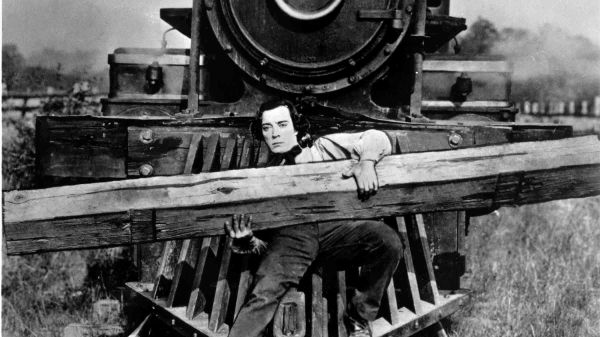
It was a major production of Keaton’s independent period, made on a then-exceptional budget of about $750,000. Although it was commercially and critically disappointing upon release, it was later reevaluated and is now widely regarded as one of the supreme achievements of silent cinema and of film history as a whole. In the United States it entered the public domain in the mid-1950s because the copyright was not renewed, making free exhibition, distribution, and adaptation possible.
Trailer
Watch the Full Film on the Internet Archive
Film Data
- Production: Buster Keaton Productions, Joseph M. Schenck Productions
- Director: Buster Keaton, Clyde Bruckman
- Screenplay: Buster Keaton, Clyde Bruckman (adaptation: Al Boasberg, Charles Smith)
- Source: William Pittenger, “The Great Locomotive Chase” (a memoir based on Civil War experiences)
- Cinematography: Devereaux Jennings, Bert Haines
- Editing: Sherman Kell, Buster Keaton and others
- Technical Director: Fred Gabourie
- Principal Cast: Buster Keaton (Johnnie Gray), Marion Mack (Annabelle Lee), Glen Cavender (Captain Anderson), Jim Farley (General Thatcher), Frederick Vroom (Southern General), Charles Smith (Annabelle’s father), Frank Barnes (Annabelle’s brother), Joe Keaton and others (Union Generals)
- Distributor: United Artists
- Release: December 31, 1926 (Tokyo), February 5, 1927 (New York), etc.
- Language: Silent (English intertitles)
- Format: 35mm black-and-white, aspect ratio approximately 1.33:1
- Budget: approximately $750,000
- Box office: reported as approximately $1 million (worldwide); domestically it fell far short of recovering production costs.
Plot Synopsis
In Georgia immediately after the outbreak of the Civil War. Western & Atlantic Railroad engineer Johnnie Gray loves above all else his locomotive “The General” and his sweetheart Annabelle Lee. He volunteers for the Confederate army but is rejected because of his value as an engineer, and is misunderstood by Annabelle as a coward.
A year later, Union spies seize “The General,” taking Annabelle, who happens to be aboard, with them. Johnnie begins a solitary pursuit in another locomotive, “The Texas,” and, dodging obstacles on the tracks and pursuit, penetrates enemy territory. In a house he overhears a strategy conference, rescues Annabelle, recaptures “The General,” and returns south. On the return journey he again eludes pursuit, burns an important bridge to halt the Union advance, and is finally recognized as a Confederate hero.
Commentary
Production Background
The film is based on the actual 1862 incident known as the Great Locomotive Chase, in which Union spy James J. Andrews and others seized a Confederate locomotive in Georgia and drove it north while destroying track. Pittenger’s source memoir is written from the Union viewpoint, but Keaton and Bruckman shifted the perspective to a Confederate engineer and restructured the story around the recovery of personal love and honor.
Keaton originally wished to use the real “General,” preserved in Chattanooga, and to shoot in Georgia, but the owners’ refusal and postwar changes in the landscape forced him to abandon the plan. Instead he utilized the narrow-gauge railroad and old steam locomotives around Cottage Grove, Oregon. In the summer of 1926 a large quantity of equipment, props, and costumes was transported there, and local residents and National Guard troops were employed as extras for extensive location shooting. Keaton himself performed many dangerous stunts.
The high budget and poor box-office performance brought an end to Keaton’s independent production system and led to his subsequent contract with Metro-Goldwyn-Mayer.
Characteristics
The film’s greatest characteristic is the strict symmetry of its narrative structure. The first half is Johnnie’s “northbound chase” in pursuit of “The General”; the second half is the “southbound flight” after its recovery, when he is pursued by the Union forces—almost mirror images of each other. Gags are placed in accordance with this structure: obstacles and tactics used by the enemy in the first half are reused by Johnnie himself in the second half.
Keaton’s expressionless performance, known as the “Great Stone Face,” rather highlights emotional nuances amid the intense action. The physical comedy in which the human body is precisely interlocked with the enormous machine of the locomotive produces a dry, mechanical humor different from Chaplin’s pathos or Lloyd’s modern thrills.
While taking a historical event as its basis, the film prioritizes a personal heroic tale over strict historical reconstruction—another characteristically Keaton choice.
Cinematography
Virtually all photography was done with real steam locomotives and track, minimizing reliance on miniatures or special effects. The camera frequently uses pans and tracking shots coordinated with the movement of the trains, preserving a sense of immediacy through continuous shots approaching long takes. Especially famous is the sequence in which a bridge collapses and a locomotive falls into the river—an expensive single take in which a real locomotive was actually dropped.
Keaton himself performed life-risking stunts such as riding the cowcatcher, running along the roof, and leaping between moving trains. The coexistence of such physical danger with the geometric precision of the compositions supports the film’s visual accomplishment.
Locations
The principal locations were in the vicinity of Cottage Grove, Oregon. The narrow-gauge logging railroad was suitable for recreating a Civil War-era landscape. A set representing Marietta station was also constructed there, and shooting proceeded with interruptions caused by forest fires. The bridge-collapse sequence was filmed on a river in the same region.
Thematic Analysis
The central theme running through the film is the intersection of machine and human being, of individual will and a great historical event. For Johnnie the locomotive is not merely a tool but an object of love equal to his sweetheart; the intimate relationship with the machine becomes the driving force of the story. The process by which the distortion of social evaluation represented by the rejection of enlistment is overturned through physical and mechanical practice is typical of the structure found throughout Keaton’s work: “an apparently powerless individual who masters the situation by utilizing environment and machine.”
While set against the national tragedy of the Civil War, the film does not foreground the war’s causes or political conflicts, focusing instead on personal honor and love. As a result, a balance is maintained that keeps the heroic tale from becoming excessively patriotic or sentimental.
Release
The film was released in the United States from the end of 1926 into early 1927. There are also records of exhibition in Japan at approximately the same time. Contemporary criticism was largely negative—“drawn-out,” “few gags”—and the box office was poor.
Reception
After the initially lukewarm response, the film established its status during the reevaluation of silent cinema from the 1950s–60s onward. It is sometimes cited within the context of André Bazin’s realist criticism as an example that emphasizes long takes and the physicality of live action.
In 1989 it was selected as one of the first films for the National Film Registry, recognized as “culturally, historically, or aesthetically significant.” It ranks high on the American Film Institute’s “100 Years…100 Laughs” and “100 Years…100 Movies” lists, and continues to maintain extremely high ratings on IMDb and various critical sites.
Historical Position
It is the culmination of Keaton’s independent period and one of the high points of large-scale silent comedy at the end of the silent era. The large-scale action using real locomotives is also regarded as a forerunner of later adventure and action films. The commercial failure that prompted a turning point in Keaton’s career makes it a personal watershed as well.
Public Domain
In the United States the film entered the public domain in the mid-1950s because the copyright was not renewed. As a work released in 1926, more than 95 years have passed under current law, and in the U.S. free reproduction, exhibition, alteration, and distribution are possible. High-quality versions are available on the Internet Archive and various public-domain film sites, and the film is also held on Wikimedia Commons. It should be noted, however, that later music-accompanied re-edited versions or certain restored editions may carry separate rights.
Home Media
Because it is in the public domain, numerous DVD, Blu-ray, and digital editions are in circulation. High-quality restored versions have been released by the Criterion Collection and others, and editions with new scores by Carl Davis and Joe Hisaishi also exist. Various labels have issued it in Japan as well.
Remakes
In 1956 Walt Disney remade it as “The Great Locomotive Chase,” a non-comic adventure film closer to historical fact (starring Fess Parker). Direct remakes of the Keaton version are few, but the motif of the train chase has influenced later works.
Other Topics
Keaton himself ranked the film among his own masterpieces alongside “The Navigator” (1924). The fact that his father, Joe Keaton, appears as a Union general is an interesting detail showing a family connection. It is frequently ranked with Chaplin’s “The Gold Rush” (1925) and Lloyd’s “Safety Last!” (1923) as a pinnacle of silent-era physical comedy.
Search Links
Cross-Search for “Buster Keaton The General” on JustWatch
Search for “Buster Keaton The General” on Amazon.com
Detailed Plot (Spoilers)
Outbreak of War and Rejection of Enlistment
Spring 1861, Marietta, Georgia. Western & Atlantic Railroad engineer Johnnie Gray loves above all two things: the steam locomotive “The General” that he drives and his sweetheart Annabelle Lee. Upon arriving at the station, Johnnie immediately visits Annabelle’s house. Annabelle’s brother rushes in with the news of the attack on Fort Sumter and the outbreak of the Civil War. The father and brother resolve to enlist in the Confederate army; Johnnie also indicates his intention to volunteer in Annabelle’s presence and heads for the recruiting office.
Johnnie is first in line at the recruiting office but is rejected because his skill as an engineer is indispensable in wartime. Not being told the reason, Johnnie is misunderstood as a “coward” by Annabelle and her family. Annabelle declares that she will not speak to him until he returns in uniform, and the two become estranged.
The Theft of “The General”
A year passes. Annabelle boards a train pulled by “The General” to visit her wounded father. At Big Shanty the train stops; while passengers and crew leave for a meal, a band of Union spies (Captain Anderson and others) seize “The General.” Annabelle, who had returned to the train for her belongings, is carried off with it.
Johnnie witnesses “The General” departing and begins pursuit on foot. Via handcar and bicycle he reaches Kingston station, secures another locomotive, “The Texas,” and continues the solitary northward chase. He attempts to take on Confederate troops, but the coupling comes loose and Johnnie is left alone. The spies obstruct him by placing ties on the track and uncoupling cars, but Johnnie uses his wits to overcome these obstacles.
Rescue and Recapture in Enemy Territory
Johnnie penetrates deep into Union-occupied territory and, in a torrential rain, enters a house to obtain food against his hunger. It turns out to be the meeting place of Union officers. Hastily hiding under a table, Johnnie overhears the Union surprise-attack plan (an invasion via the Rock River Bridge) and, further, discovers Annabelle, who is being held captive in the same house.
That night Johnnie rescues Annabelle, dons a Union uniform, and approaches “The General.” He places Annabelle in a sack to make her look like supplies, recaptures “The General,” and begins the flight south. The Union forces pursue in “The Texas” and other engines.
Southward Flight and the Bridge Collapse
On the return journey the same obstacles and tactics of the first half are repeated, but now Johnnie is the one employing them. Eluding pursuit while heading south, Johnnie sets fire to the wooden bridge over the Rock River. When the pursuing Union train reaches the burning bridge, the bridge collapses and the locomotive plunges into the river (this sequence was filmed by actually dropping a locomotive).
Return as a Hero
Having returned to the Confederate side, Johnnie reports the Union invasion plan and is welcomed as a hero together with a Union officer he has coincidentally taken prisoner. Relations with Annabelle are also restored. Johnnie is given a Confederate officer’s uniform and sword by a Southern general and is commissioned a lieutenant.
Johnnie returns with Annabelle to “The General” and sits on the side of the locomotive. He tries to embrace Annabelle, but because he must continually return the salutes of the soldiers who pass by, he holds Annabelle with his left hand and keeps saluting with his right, and the story ends.