




























































Overview
“North Face” (German original title: Nordwand) is a 2008 German-Austrian-Swiss historical drama film based on the true story (the 1936 Eiger North Face climbing disaster) of the race to make the first ascent of the Eiger’s North Face in the Bernese Alps, Switzerland, in 1936.
Running time: 126 minutes (per the German official catalog, filmportal.de).
Director: Philipp Stölzl.
Screenplay: Christoph Silber, Rupert Henning, Johannes Naber, Philipp Stölzl, Benedikt Röskau.
Producers: Danny Krausz, Boris Schönfelder, Rudolf Santschi, Benjamin Herrmann.
Production companies: Triluna Film AG, MedienKontor Movie, Dor Film (Dor Film-West), Bayerischer Rundfunk (BR), ARD/Degeto, Schweizer Radio und Fernsehen (SRG SSR), Majestic Filmproduktion, Lunaris Film- und Fernsehproduktion.
Cinematography: Kolja Brandt.
Editing: Sven Budelmann.
Sound: Heinz Ebner.
Music: Christian Kolonovits.
Production design: Udo Kramer, Tommy Vögel.
Costume design: Birgit Hutter.
Principal cast: Benno Fürmann (Toni Kurz), Florian Lukas (Andreas “Andi” Hinterstoisser), Johanna Wokalek (Luise Fellner), Ulrich Tukur (Henry Arau), Simon Schwarz (Willy Angerer), Georg Friedrich (Edi Rainer), Erwin Steinhauer, Petra Morzé, Hanspeter Müller-Drossaart (as mountain guide Hans Schlunegger), Erni Mangold (as Kurz’s grandmother).
Language: German.
Format: Super 35mm, 2.35:1 aspect ratio, color.
Trailer
Plot Summary
Nazi Germany, on the eve of the 1936 Berlin Olympics. The regime regards the first ascent of the Eiger’s North Face — considered the last great unclimbed challenge in the Alps — as an opportunity for national prestige, promising the climber who succeeds an honor equivalent to an Olympic gold medal (the Alpinism Prize), and promotes the attempt heavily through the mass media.
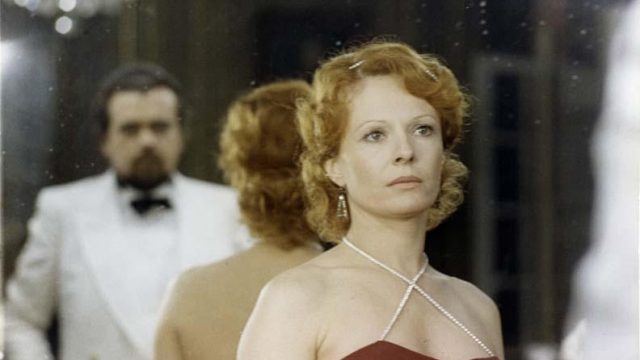
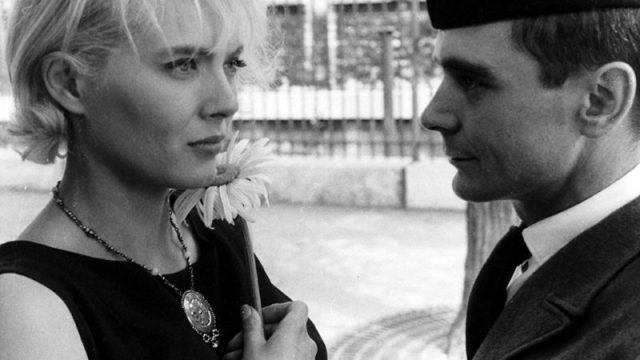
Toni Kurz and Andreas (“Andi”) Hinterstoisser, childhood friends from Berchtesgaden and mountain infantrymen, decide to attempt the wall already feared as the “Mordwand” (Murder Wall) and leave the army for Switzerland. At the foot of the mountain, in Kleine Scheidegg, their childhood friend Luise Fellner, a young reporter for a Berlin newspaper, is staying to cover the story together with her editor, the regime-friendly journalist Henry Arau. A quiet, unspoken affection lingers between Toni and Luise from their youth.
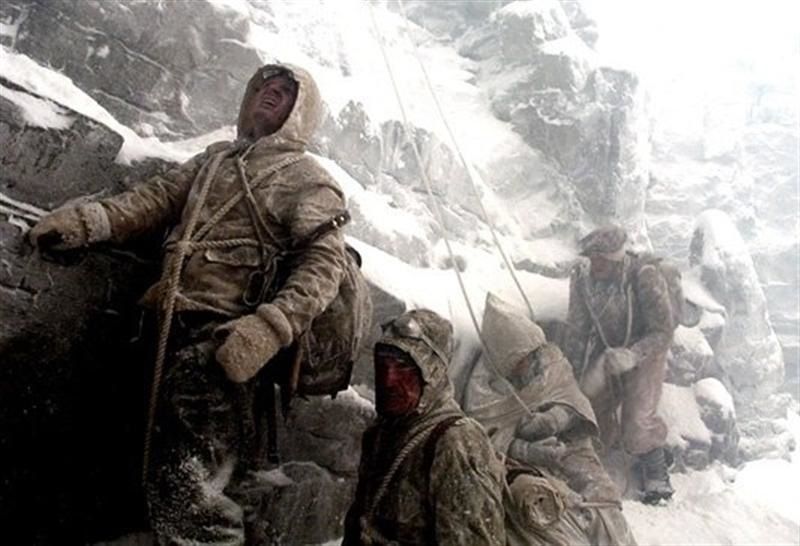
The two men begin their climb, closely followed by the Austrian pair Willy Angerer and Edi Rainer. They initially make good progress, but Willy is injured by falling rock, and the weather then turns abruptly, bringing a violent blizzard and avalanches. The four attempt to retreat, but fail to retrieve the rope they removed on the way up, leaving them unable to return by the known route (the passage later known as the “Hinterstoisser Traverse”). At the hotel below, Luise, Arau, and a crowd of mountaineers, journalists, and spectators from various countries watch the men’s struggle through telescopes and newsreel cameras, and the fate of the four climbers, descending through the worsening storm, remains suspended in tension through to the film’s closing stretch.
Commentary
Background and Production
The 1936 Eiger North Face disaster is one of the most widely retold tragedies in the mountaineering history of the German-speaking world, and the story of the accident has been recounted in numerous memoirs and photographic collections. In researching existing mountaineering films while preparing the screenplay, Stölzl and his production team were particularly struck by the realism of the reenacted sequences in Kevin Macdonald’s “Touching the Void” (German title: “Sturz ins Leere,” 2003), which dramatized Joe Simpson’s account of his own mountaineering accident. The filmmakers are reported to have contacted Macdonald directly to ask how this sense of immediacy could be achieved without exposing the actors to undue danger — a conversation said to have led to the idea of combining footage shot on the actual cliff face with scenes filmed in a refrigerated warehouse.
Principal photography took place from April 17 to June 4, 2007. Location shooting was carried out in Berchtesgaden, Bavaria (the Bräustüberl of the Berchtesgaden Hofbräuhaus, and the mountain infantry barracks at Bischofswiesen-Strub), in Switzerland (the Bernese Oberland, around Kleine Scheidegg), and in Austria (the Dachstein massif). For the sequences of the actual climb, real mountaineers were cast as stunt doubles alongside the lead actors. Because of insurance requirements, the most dangerous rock-face sequences were performed by these doubles rather than by the actors themselves, and the principal cast reportedly signed waivers accepting personal responsibility for any climbing they undertook.
Most of the close-up shots of the actors’ faces, along with the scenes involving frostbite makeup effects, were filmed on a set built inside a converted refrigerated warehouse in Graz, Austria. A rock face covered in snow and ice was constructed inside the warehouse, and filming continued there for five weeks in temperatures of around minus 10 degrees Celsius, using wind machines and snow machines. Cast and crew alike have described the prolonged shoot in such extreme cold as physically exhausting. The warehouse footage was matched as closely as possible to the weather conditions of the location footage and combined with it in the edit; some sequences also make use of green-screen compositing and CGI for weather effects and set extensions.
Characteristics
The film’s most distinctive feature is that, while dramatizing an actual mountaineering disaster, it introduces two figures with no basis in the historical record — Luise Fellner, a childhood friend of the climbers working as a reporter, and her editor, the regime-friendly journalist Henry Arau — through whom the climb is given a media and political dimension.
The muted romance between Luise and Toni, and the sensationalist, pro-Nazi journalism embodied by Arau, are dramatic inventions with no confirmed basis in the documented record of the 1936 events; the director himself has acknowledged this departure from historical fact in several interviews. This choice distinguishes the film from a straightforward documentary-style reenactment, but, as discussed below, it has also been a point of critical disagreement.
A second defining feature is the film’s foregrounding of the Nazi regime’s political exploitation of the Eiger climb. The narrative treats the outcome of the ascent as propaganda material for national prestige ahead of the Berlin Olympics, and in one scene Arau and his fellow journalists bluntly discuss how a successful summit or a fatal outcome would make the front page, while a retreat would merit no more than a small item buried on page three — a moment that carries a critical view of the sensationalist journalism of the period. As discussed further under “Thematic Analysis” below, however, critics have been sharply divided on whether this political framing succeeds.
Cinematography
Cinematographer Kolja Brandt’s camera stays in close physical proximity to the climbers throughout, favoring tight, intimate framing. The physical exhaustion of the actors and the real mountaineers doubling for them registers directly on screen, in a style critics have described as raw and unpolished in contrast to Hollywood films built around heavy visual effects, such as “Vertical Limit” (2000), to which the film is frequently compared.
As noted above, the technical core of the film lies in the seamless editorial combination of location footage shot on the mountain with studio footage shot in the refrigerated warehouse, matched as closely as possible in weather and light. The film also repeatedly employs cross-cutting between the terrace of the luxury hotel at Kleine Scheidegg, where spectators and journalists watch the ascent through binoculars, and the climbers themselves in their extremity on the wall above — a device that visually underscores the gap between the disaster as spectacle and the life-and-death reality of those caught up in it.
Locations
Location filming took place in Toni and Andi’s hometown of Berchtesgaden, Bavaria (the Bräustüberl of the Berchtesgaden Hofbräuhaus, and the mountain infantry barracks at Bischofswiesen-Strub), in the Bernese Oberland region of Switzerland (around the foot of the Eiger and Kleine Scheidegg), and in the Dachstein massif in Austria. Most of the actors’ close-ups and the frostbite sequences were filmed on a set built inside a converted refrigerated warehouse in Graz, Austria.
Thematic Analysis
The film’s central theme is the tension between mountaineering as an activity appropriated for state political purposes and the individual lives and deaths of the young men caught up in that appropriation. Toni and Andi are portrayed from the outset as indifferent to national prestige, driven instead by a pure passion for climbing itself, even as the surrounding Nazi authorities and sensationalist press attempt to use them as, in effect, “German envoys in the Alps.”
On this point, the film has repeatedly been discussed in relation to the Bergfilm, or mountain film, a genre established in German cinema in the 1920s and ’30s by Arnold Fanck, Luis Trenker, and Leni Riefenstahl, and one that later became closely bound up with Nazi-era propaganda film — in effect, a politically “contaminated” genre, to use a term Stölzl himself has used in interviews. Critic Rüdiger Suchsland, citing Stölzl’s own remarks tracing a visual lineage from Fanck’s Bergfilme to Riefenstahl’s “Triumph of the Will” (a propaganda film of a Nazi Party rally), has also noted the director’s earlier engagement with fascist aesthetics in his music-video work (including Rammstein’s “Du hast” and “Stripped”), and has argued sharply that the film reproduces Nazi-inflected ideals of strength, joy, German heroism, self-sacrifice, and a will that overrides reason, without maintaining sufficient critical distance from them. The trade publication film-dienst has made a similar point, arguing that the film’s stylization of the climbers as “German envoys in the Alps” risks reviving a “blood and soil” sensibility that was supposed to have been overcome.
By contrast, the online review outlet critic.de has argued that the film’s depiction of nature — wild, unpredictable, and indifferent to human life — sets it apart from an overproduced Hollywood film such as “Vertical Limit,” and that it instead succeeds as a plain, unvarnished story of humans against nature.
From an academic perspective, Caroline Schaumann (Emory University), in an article titled “The Return of the Bergfilm: Nordwand (2008) and Nanga Parbat (2010)” published in The German Quarterly (2014), offers an ambivalent assessment: despite Stölzl’s evident anti-Nazi intentions, the film’s fusion of an Alpine setting stripped of complex historical context with historical fact and melodrama ends up presenting Germany’s mountaineering past — a considerably heavier history — in a simplified, more easily digestible form for audiences.
A further axis of the film’s thematic concern is the consumption of tragedy by the media. Through the contrast between the sensationalism embodied by Henry Arau and Luise’s gradually deepening doubts about it, the film attempts a critique that extends beyond Nazi-controlled journalism specifically to the broader tendency to consume disaster as spectacle.
Differences from Historical Fact
While based on real people and events, the film takes numerous dramatic liberties. The most significant of these, as noted above, is the invention of Luise Fellner and Henry Arau, two characters with no basis in the historical record.
The characterizations of the Austrian climbers Willy Angerer and Edi Rainer have also been flagged as departures from fact. Willy in particular is portrayed as a somewhat antagonistic figure in the film, a characterization for which there appears to be no basis in the historical record, and this has drawn objections from relatives and from viewers familiar with mountaineering history.
The actual first ascent of the Eiger’s North Face was accomplished two years after the events depicted in the film, in 1938, by a combined German-Austrian party consisting of Anderl Heckmair and Ludwig Vörg (Germany) and Heinrich Harrer and Fritz Kasparek (Austria). The film is thus positioned as an account of the tragic failure that preceded that eventual success.
Release
The film had its world premiere on August 9, 2008, at the Piazza Grande outdoor venue of the Locarno International Film Festival. Theatrical release followed in Switzerland on October 9, 2008, in Germany on October 23, 2008, and in Austria on October 24, 2008.
The film’s American theatrical release, distributed by Music Box Films, began as a limited release on January 29, 2010.
Reception
Critical response in the German-speaking press was sharply divided at the time of release. The daily newspaper Die Welt, reporting on the premiere, described an enthusiastic response from the more than 8,000 spectators who filled the outdoor venue and characterized the screening as a major success. Film-dienst and critic Rüdiger Suchsland of Artechock, by contrast, as discussed above under “Thematic Analysis,” questioned whether the film maintained sufficient critical distance from the political baggage of the Bergfilm genre. The trade publication epd Film likewise noted that the film closely follows the visual conventions established by Fanck, Riefenstahl, and Trenker in its use of color, aspect ratio, and camerawork, and observed that its melodramatic staging remains faithful to the genre’s earlier examples.
Reception in the English-language press was generally favorable. As of this writing, the review-aggregation site Rotten Tomatoes lists a critics’ score of 84 percent (based on 57 reviews) and an audience score of 82 percent, with a consensus summarizing the film as a tense, absorbing historical drama set against the snow. The Hollywood Reporter praised the immediacy of the climbing sequences while noting that the film’s linkage of Nazi politics with its romantic subplot was somewhat unconvincing. Kolja Brandt’s cinematography has been repeatedly singled out by critics as the film’s greatest strength.
At the box office, the film grossed approximately 3 million euros (roughly $4.3 million) in Germany, according to The Hollywood Reporter. Its American box office gross, per figures listed on Rotten Tomatoes, was $711,000.
The film won the Deutscher Filmpreis (German Film Award) for Best Cinematography (Kolja Brandt) and Best Sound (Heinz Ebner, Guido Zettier, Christian Bischoff, and Changiz Charq) in 2009, and was also nominated for Best Production Design. It won the Preis der deutschen Filmkritik (German Film Critics’ Award) for Best Screenplay and Best Cinematography in 2008.
Historical Significance
“North Face” is frequently discussed, together with Joseph Vilsmaier’s 2010 film “Nanga Parbat,” as part of a “return of the Bergfilm” in German-language cinema in the late 2000s. As Schaumann’s article, cited above, argues, both films inherit the aesthetic and narrative scaffolding of a genre ideologically contaminated by the Nazi era, while presenting politically “innocent” images of the mountaineers themselves — an attempt, in effect, to find a cinematic form of Vergangenheitsbewältigung, or “coming to terms with the past,” for the heavier history of German mountaineering.
Home Media
A DVD and Blu-ray were released in Germany by Majestic in 2009.
Physical media releases followed in the English-speaking world between 2009 and 2013, and the film is also available through digital streaming platforms.
Other Topics
Kevin Macdonald’s “Touching the Void” (2003), cited by the filmmakers as a reference, was itself widely praised for its documentary-style method of combining interviews with the actual survivor of the accident with reenacted dramatization, and it is frequently discussed alongside “North Face” for its direct influence on the latter’s technique of combining location footage with studio filming.
Search Links
Cross-Search for “North Face” on JustWatch
Search for “North Face” on Amazon.com
Synopsis (Spoilers)
Prologue
In a Berlin cinema, newspaper reporter Luise Fellner watches a newsreel. The newsreel reports on the deaths, the previous year (1935), of Karl Mehringer and Max Sedlmayr, who froze to death attempting the Eiger’s North Face, as well as on a German pilot’s flight close to the wall. At an editorial meeting, Luise mentions that two well-known climbers, Toni and Andi, are childhood friends of hers, which catches the attention of her editor, Henry Arau, and she is assigned to the story.
The Climb Begins
On July 14, 1936, mountaineers, journalists, and spectators from various countries gather at the foot of the mountain in Kleine Scheidegg, hoping to witness the first ascent. On July 18, judging the weather favorable, Toni and Andi begin their climb, closely followed by the Austrian pair Willy Angerer and Edi Rainer. Because the two pairs climb too close together, however, Willy is struck by falling rock and seriously injured.
Disaster
On July 19, the four climbers reach an altitude of 3,350 meters, but Willy’s condition has deteriorated to the point that continuing is impossible, and the group decides to descend. On July 20, however, the weather deteriorates sharply into a violent blizzard. On July 21, an avalanche strikes the four men as they descend: Edi is killed instantly, striking his head on the rock face, while Andi and Willy lose consciousness while suspended on the rope. In his last moments of clarity, Andi cuts the rope to protect Toni, and falls together with Willy.
Toni’s Final Hours
Left alone, Toni runs out of rope and reaches the limit of his strength, unable to move further. The rescue team is unable to reach him because of the bad weather, and at the foot of the mountain Luise joins the rescuers in their effort to save him. On July 22, the weather finally clears, and the rescue team manages to reach within close range of Toni, but a knot in his rope has jammed in his carabiner, and he no longer has the strength to free it. Within sight of the rescue team, Toni utters his last words — “I’m so cold” — and dies.