































































Overview
“Roman Holiday” is a 1953 American romantic comedy directed and produced by William Wyler. It tells the story of a brief, bittersweet love affair between a European princess and an American correspondent over the course of a single day in Rome — in effect, an inverted Cinderella story.
The film marked Audrey Hepburn’s effective Hollywood starring debut; it won her the Academy Award for Best Actress and made her an overnight international star.
Production Company: Paramount Pictures.
Director/Producer: William Wyler.
Screenplay: Dalton Trumbo, Ian McLellan Hunter, John Dighton. Trumbo, who was blacklisted in Hollywood at the time, went uncredited on release; his friend Ian McLellan Hunter served as his “front.”
Story: Dalton Trumbo.
Cinematography: Franz Planer, Henri Alekan.
Editing: Robert Swink.
Music: Georges Auric, Victor Young.
Costume Design: Edith Head.
Art Direction: Hal Pereira, Walter H. Tyler.
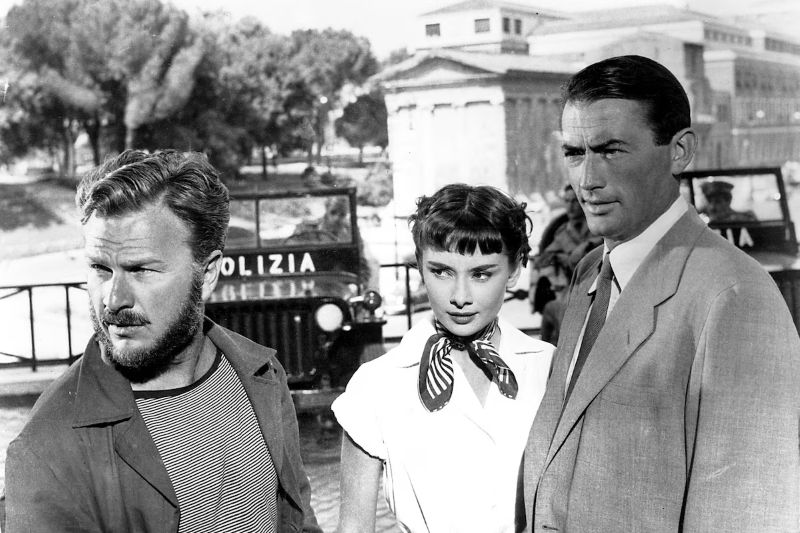
Starring: Gregory Peck (Joe Bradley), Audrey Hepburn (Princess Ann), Eddie Albert (Irving Radovich), Hartley Power, Harcourt Williams, Margaret Rawlings (Countess Vereberg), Tullio Carminati (General Provno), Paolo Carlini (Mario Delani, the barber).
Distributor: Paramount Pictures.
Language: English (with some Italian).
Format: 35mm black and white, Academy ratio 1.37:1.
Running Time: 118 minutes.
Budget: approximately $1.5 million. Box Office: approximately $5 million in North America.
Trailer
Plot Summary
Princess Ann, on a goodwill tour of Rome for an unnamed European kingdom, has grown weary of a life bound by protocol and ceremony. One night, she flees the embassy.
Having been given a sedative by her doctor, she falls asleep on a park bench, where she is found by American newspaper correspondent Joe Bradley. Not knowing her true identity, he lets her spend the night at his apartment.
The next morning, Joe reads a news report of Ann’s official “illness” and realizes who she really is. Sensing the scoop of a lifetime, he conceals what he knows and takes her sightseeing around Rome.
As the two visit a barbershop, the Spanish Steps, the Mouth of Truth, and the Colosseum, they gradually fall for one another — but caught between her royal duty and her freedom as an individual woman, Ann ultimately chooses to return to the palace.
Commentary
Production Background
The project originated in 1949, when Frank Capra optioned the film rights as a reworking of his own “It Happened One Night” (1934). Capra initially planned to direct, with Cary Grant and Elizabeth Taylor in the leads. However, when his production company, Liberty Films, ran into financial trouble and was sold to Paramount, the studio balked at a budget exceeding $1.5 million, and Capra withdrew from the project. Some accounts suggest the reason for his departure went beyond budget concerns: word had spread that the screenwriter, Trumbo, was regarded as a “Red,” and Capra feared being associated with a suspected communist.
Wyler, who took over as director, agreed to the project on the condition that it be shot entirely on location in Rome. Frank Freeman, the head of Paramount’s studio operations, opposed location shooting on budgetary and logistical grounds, but Wyler accepted sweeping budget cuts to make the Rome shoot possible — as a result, “Roman Holiday” became the first American film shot in its entirety in Italy. The production had originally been planned in Technicolor, but was switched to black and white to save costs.
The screenplay was principally the work of Dalton Trumbo. Trumbo, one of the “Hollywood Ten,” had served a prison sentence under McCarthy-era anti-communist prosecutions and was in no position to put his own name on a script. His friend and fellow screenwriter Ian McLellan Hunter agreed to act as his “front,” secretly passing along the bulk of the payments he received from the studio to Trumbo. When the film went on to critical and commercial success, it was Hunter who accepted the Academy Award for Best Story — the Academy’s members had no idea they were, in effect, honoring a blacklisted writer. This arrangement went uncorrected for decades, until Trumbo’s name was restored to the credits with the 2003 DVD release, and on December 19, 2011, he was formally credited for his work on the screenplay as well.
The blacklisted director Bernard Vorhaus also worked on the production as an assistant director, under a pseudonym.
Casting, too, went through several twists. The role of Joe was first offered to Cary Grant, who turned it down, feeling himself too old to play opposite a princess; Gregory Peck was cast in his place.
For the role of the princess, Elizabeth Taylor and Jean Simmons were the initial candidates, but neither was available due to other commitments. En route to Rome via London, Wyler met with his first choice, Jean Simmons, and also sat in on screen tests for several other young actresses — among them an unknown named Audrey Hepburn.
On September 18, 1951, Hepburn’s screen test was filmed at Pinewood Studios in London under director Thorold Dickinson. After she performed a scene from the script, Paramount requested an additional, unscripted interview segment to capture Hepburn simply being herself. It was reportedly this unguarded footage that ultimately secured her the role. Wyler, deeply impressed by the test, cast the unknown newcomer in the lead.
Characteristics
The film’s defining characteristic is that its black-and-white cinematography was, in effect, an accident of circumstance: the color, studio-bound production originally envisioned under Capra gave way to a monochrome shoot once location filming was secured in exchange for a reduced budget. And yet the interplay of that monochrome palette with the real streets of Rome as a functioning backdrop lent the film an unexpectedly documentary-like sense of authenticity.
The other defining feature of the film is the presence of the then-unknown Audrey Hepburn herself. Her performance was praised for blending innocence and charm with emotional depth with a naturalness that belied her inexperience, and the film effectively marks the birth of Audrey Hepburn, Hollywood actress.
Locations
While the studio scenes were shot at Cinecittà — Rome’s largest studio and one of the largest in Europe — nearly all of the rest of the film was shot on the actual streets of Rome. The newsreel-style opening credits show glimpses of the Colosseum and the Roman Forum, and the title card immediately afterward proudly announces that the entire film was shot in Rome.
The famous late scene at the Mouth of Truth (Bocca della Verità) — a weathered stone mask, said to depict the sea god Oceanus, set into the portico of the Church of Santa Maria in Cosmedin — takes place near the Colosseum.
The riverside dance scene, to which Ann and Joe are invited by the barber Mario after her haircut, was staged on the banks of the Tiber in front of Castel Sant’Angelo; it is here in the film that the pair, discovered by the secret police, dive into the river to escape.
The famous Vespa chase, often assumed to take place near the Colosseum, was in fact filmed along Via del Teatro di Marcello, beside the Theatre of Marcellus, as later research has confirmed. Ann and Joe then switch Vespas near the Piazza Venezia, leading the police on a chase through the small roundabouts around the Corso Vittorio Emanuele II and the Largo di Torre Argentina.
Joe’s apartment is placed at Via Margutta 51, while the fictional embassy where the princess is staying is portrayed using the real Palazzo Brancaccio. The scenes at Mario’s barbershop, and at the gelato stand where Ann and Joe reunite, were filmed around the Trevi Fountain, the Spanish Steps, and the Palazzo Colonna.
Cinematography
The film’s cinematography is marked by its shifting rhythms as it moves through the real streets of Rome to carry the story forward.
The Vespa chase sequences were filmed amid the actual traffic of Rome at the time, with landmarks such as the Colosseum, the Roman Forum, and the Piazza Venezia forming a vivid, fast-moving backdrop to the princess and the journalist’s escapade.
The film also makes notable use of the actors’ genuine reactions themselves — as in the barbershop scene, where Hepburn’s long hair is actually cut off, or the Mouth of Truth scene, where Peck pretends his hand has been bitten off by the stone mask. The latter was reportedly an improvised idea on Peck’s part; Hepburn’s visibly startled reaction is said to be so convincing precisely because she genuinely believed, in the moment, that his hand really had become stuck.
Hepburn’s Costumes
The combination Princess Ann wears through the streets of Rome — a cotton blouse, a wide belt, and a full circle skirt — remains one of the film’s most enduring images to this day. The costumes were designed by Edith Head, who deliberately chose a “simple look that wouldn’t stand out on the street,” so that the princess could plausibly pass as an ordinary young woman blending into the city. This image of “a princess disguised as an ordinary girl” is thrown into relief by contrast with her formal court attire — the elaborate gown, jewels, and tiara she wears elsewhere in the film.
For this costume design, Edith Head won the Academy Award for Best Costume Design, Black-and-White.
The bold short haircut Hepburn debuts partway through the film was likewise Head’s suggestion, and is credited with setting off a distinct trend in 1950s fashion.
Thematic Analysis
The theme running through the entire film is the conflict between royal “duty” and individual “freedom.”
The film’s narrative structure has repeatedly been linked to Frank Capra’s “It Happened One Night”: the pairing of a woman of high birth traveling incognito with a newspaperman who is drawn to her even as he angles for a scoop clearly belongs to that lineage. Where “It Happened One Night” ultimately brings its two leads together, however, “Roman Holiday” deliberately withholds that resolution — a conscious departure from genre convention.
At its core, the film borrows the structure of the classic Cinderella story, in which star-crossed lovers overcome the obstacles of class to be united, and inverts it. Here, it is not a commoner in disguise but an actual princess who moves in disguise through the world, and what she ultimately chooses is not love but a return to the court. This bittersweet ending is one reason the film is regarded as something more than mere romantic entertainment.
The setting of postwar Rome carries its own significance. Rather than picturing a city of rubble, the film presents a Rome that has regained its vitality — as if symbolizing the capacity of a war-torn city and its people to be reborn. This stands in deliberate contrast to the poverty-stricken postwar Rome depicted in contemporaneous Italian neorealist cinema, offering instead an American vision of the city.
Release
The film had its official premiere at the Venice International Film Festival on August 20, 1953, and opened theatrically in the United States on August 27 of that year.
Reception
From the outset, the film was received with great critical and commercial acclaim.
“Variety” praised Wyler for using the ancient city’s streets and monuments as a colorful, beautiful backdrop, weaving in tender, poignant moments throughout without ever losing his comic timing.
Today the film holds a 97 percent approval rating on the review aggregator Rotten Tomatoes, based on sixty reviews, with an average score of 8.40 out of 10; the site’s consensus summary credits the radiance of Audrey Hepburn’s American debut with helping to establish the modern romantic comedy template, calling the film both beautiful and funny.
On the awards front, the film received ten Academy Award nominations, winning three: Best Actress (Hepburn), Best Costume Design, Black-and-White (Head), and Best Story (officially credited to Hunter). It was also nominated for Best Picture, Best Director, Best Supporting Actor (Eddie Albert), Best Screenplay, Best Film Editing, Best Art Direction (Black-and-White), and Best Cinematography (Black-and-White). Hepburn additionally won the Golden Globe for Best Actress in a Drama, the BAFTA Award for Best British Actress, and the New York Film Critics Circle Award for Best Actress.
The film’s cultural impact extended well beyond its critical reception. Sales of the Vespa scooter, prominently featured in the film, reportedly tripled in the years following its release. The film was also enthusiastically embraced by British and American audiences alike, and its popularity was reflected in a marked upsurge in tourist demand for Rome.
Historical Standing
“Roman Holiday” stands as one of the representative films of what became known as “Hollywood on the Tiber” — the wave of postwar Hollywood productions shot in Italy. This trend was driven in part by the financial logic of the time, whereby studios used frozen foreign earnings — in this case, Italian lira — to fund local production. The film’s success helped pave the way for a subsequent cycle of films about Americans falling in love in Rome, such as “Three Coins in the Fountain” (1954), which likewise portrayed American romance against a Roman backdrop.
The film has also come to be recognized as a work of significant cultural value worthy of formal preservation. In 1999, it was selected for preservation in the United States National Film Registry by the Library of Congress as a work deemed culturally, historically, or aesthetically significant. It has also been honored by the American Film Institute, ranking fourth on AFI’s 100 Years… 100 Passions list and fourth on AFI’s list of the ten greatest films in the romantic comedy genre.
Home Media
A thorough digital restoration was undertaken in the United States in 2015. Because the original camera negative had been damaged at an Italian film laboratory, the restoration work proceeded instead from a new 4K scan of a 35mm fine-grain print and a duplicate negative. Building on this restored material, Paramount Presents released the film’s first-ever Blu-ray edition — a 4K remaster — on September 15, 2020, followed by a 4K UHD disc using the same restored elements in 2023.
Search Links
Cross-Search for “Roman Holiday” on JustWatch
Search for “Roman Holiday” on Amazon.com
Synopsis (Contains Spoilers)
Princess Ann’s Escape
Princess Ann of an unnamed European kingdom, midway through a goodwill tour of Rome, attends a ball hosted by the embassy. Frustrated by her rigid schedule of official duties, she is given a sedative by her doctor that night — but after going to bed, she secretly slips out of the embassy.
Meeting Joe
As the sedative takes effect, Ann falls asleep on a bench on a Roman street. American newspaper correspondent Joe Bradley happens by; mistaking her for a drunk but unable to simply leave her there, and unable to afford cab fare, he takes her back to his apartment for the night. Joe heads to work the next morning still unaware of who she really is.
Discovery and a Day Chasing a Scoop
At the office, Joe reads a report that the princess has canceled all her public engagements due to “sudden illness,” and realizes that the woman from the night before was Princess Ann herself. Sensing the scoop of a lifetime, he conceals what he knows and proposes a day of sightseeing to “Anya,” as Ann has introduced herself. He secretly brings along his photographer friend Irving Radovich, who documents the day using a camera hidden inside a cigarette lighter.
A Day in Rome
Savoring her freedom, Ann stops by the barbershop of a man named Mario and has her long hair cut into a short, stylish bob. The pair share gelato on the Spanish Steps, then race through the streets around the Colosseum and the Roman Forum on Joe’s Vespa. At the Mouth of Truth, Joe startles Ann by pretending the stone mask has bitten off his hand.
The Dance at Castel Sant’Angelo, and the Escape
That night, invited by Mario, the pair head to a riverside dance party on a barge moored along the Tiber in front of Castel Sant’Angelo. Unbeknownst to them, secret police searching for the missing princess are waiting there; in the chaos of a brawl, Joe and Ann dive into the Tiber and narrowly escape. In the midst of this commotion, the two quietly acknowledge, for the first time, their feelings for one another.
Farewell and the Press Conference
The next day, having been found by palace officials, Ann decides — reluctantly — to return to the embassy. At the official press conference that follows, she realizes that Joe and Irving, present among the reporters, were her companions from the day before, but she continues on with her duties as though nothing were amiss. Joe quietly hands her the undeveloped negatives of Irving’s photographs from their day together, a silent signal that the story will never run. Without a word passing between them, the two exchange a final glance, and Ann leaves the press conference to return to her life as princess.