







































Overview
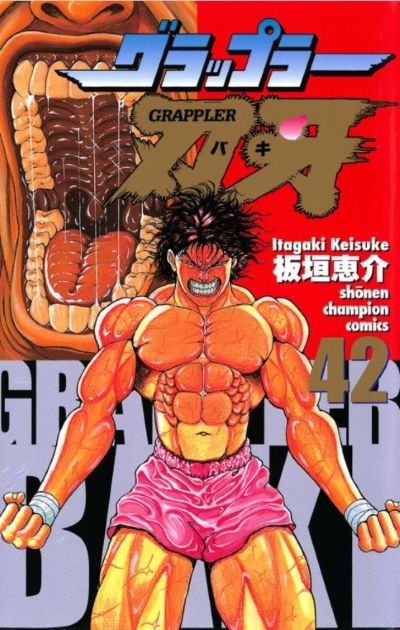
“Baki the Grappler” is the first installment of Keisuke Itagaki’s long-running fighting manga franchise, the Baki series. It was serialized in Akita Shoten’s “Weekly Shōnen Champion” from 1991 to 1999 and collected into 42 tankōbon volumes. The series continued afterward with “Baki” (1999–2005, 31 volumes), “Baki Hanma” (2005–2012, 37 volumes), “Baki-Dou” (2014–2018, 22 volumes), “Bakidou” (2018–2023, 17 volumes), and “Baki Rahen” (2023–present, ongoing), and as of May 2024 the series’ combined print run had surpassed 100 million copies. This article discusses the first installment (1991–1999), the starting point of the franchise.
Commentary
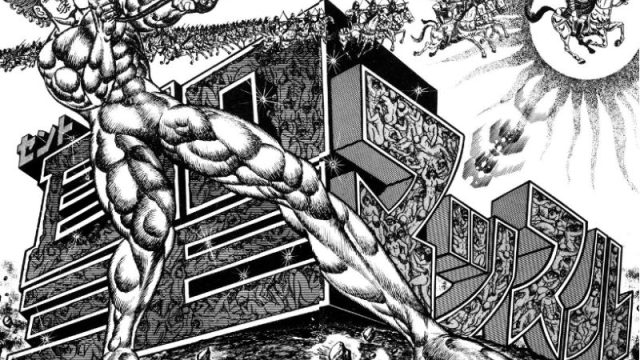
The manga depicts fighters living in a world of bare-knuckle, no-holds-barred “vale tudo” combat, where anything short of weapons is permitted. Its protagonist is Baki Hanma, a teenage boy who trains relentlessly and fights continuously in order to one day defeat his father, Yujiro Hanma, described as “the strongest creature on Earth.” At the same time, it is an ensemble drama of idiosyncratic fighters, each pursuing supremacy in unarmed combat in their own way.
The series is defined by bloody, over-the-top battle action that has no real-world equivalent, coupled with unpredictable plotting. Realism is consistently subordinated to entertainment value (outlandish ideas, scenarios with no basis in reality), and intense exaggeration is interspersed among otherwise serious combat sequences — with the result that the manga can also be read as a comedy.
Itagaki himself holds a second-degree black belt in Shōrinji Kempō and is a former member of Japan’s Self-Defense Forces, and his friendships with numerous real-world fighters lend the manga’s combat scenes their persuasive detail. Many of the characters are widely said to be modeled on real fighters and public figures: the protagonist, Baki Hanma, is often linked to the mixed martial artist Naoyuki Taira, while Doppo Orochi is said to draw on the karateka Masutatsu Oyama (founder of Kyokushin Kaikan) and Hideo Nakamura of Kendo Kai. This grounding of the fiction in “real bodies,” even as the drawing pushes those bodies past the limits of human anatomy, is one of the manga’s more interesting features to a critical reader.
The first installment is structured in three arcs: the Underground Arena Arc, the Childhood Arc, and the Maximum Tournament Arc.
In the Underground Arena Arc, seventeen-year-old Baki Hanma, reigning champion of an arena built beneath the Tokyo Dome, fights a series of challengers.
The Childhood Arc consists of episodes from Baki’s fights as a junior-high-school student.
The Maximum Tournament Arc depicts all thirty matches of a tournament contested by thirty-eight fighters (an approximate figure, discussed in detail below) from around the world, Baki among them.
The Series in Context
“Baki the Grappler” is not a standalone work but the starting point of a fighting-manga saga that has now been written continuously for more than three decades. After the first installment concluded, the story moved on to “Baki” (centered on the Most Evil Death Row Convicts arc, in which five escaped convicts clash with the fighters of the underground arena), then to “Baki Hanma” (built around the father-son confrontation between Baki and Yujiro), then to “Baki-Dou” and “Bakidou” (depicting battles between contemporary fighters and a cloned, resurrected Musashi Miyamoto), and finally to the currently serialized “Baki Rahen.” In addition, numerous spin-offs center popular supporting characters such as Kaoru Hanayama and Doppo Orochi, including “Grappler Baki Gaiden,” “Baki Gaiden: Scarface,” “Baki Gaiden: Sōzura” (lit. wound face), and “Orochi Doppo Gaiden: Kenjin” (lit. fist blade).
The franchise’s media-mix presence has likewise been extensive. An OVA was released in 1994, followed by a TV anime on TV Tokyo in 2001. Unlike the original manga, the TV anime restructured the story in chronological order — Childhood Arc, then Underground Arena Arc, then Maximum Tournament Arc — and was retitled “Baki the Grappler: Maximum Tournament” from episode 25 onward. Later installments of the franchise have been animated for Netflix as “BAKI” (2018, 2020) and “Baki Hanma” (2021, 2023), with an anime adaptation of “Baki-Dou” planned for 2026. The franchise has also expanded into video games and pachinko/pachislot machines, a scale of media presence unusual for a fighting manga.
Reception
“Baki the Grappler” embeds the question of “what is the strongest on Earth” within the narrow frame of combat sports and pursues that question with remarkable consistency across the entire work, and it is widely credited with having significantly influenced later entries in the mixed-martial-arts and tournament-manga lineage. Readers and commentators frequently place it among the “landmark” or “quintessential” works of the fighting-manga genre. Its deliberate blurring of the line between seriousness and comedy — inviting readers to laugh along with its outlandish premises and implausible feats of endurance as simply “that kind of manga” — has also fed a long-running fan culture, including the internet-meme-like phenomenon sometimes called “Baki syntax” in Japanese fan discourse.
Reception has not been uniform, however. While many fighting-fans praise the manga’s prioritization of entertainment value over realism, opinion is more divided over the increasing prominence of comedic elements in the later installments of the franchise. Even so, techniques that first appear here — combat sequences that erupt without warning in the middle of ordinary life, fight choreography exaggerated to near-anatomical absurdity, and a running commentary-style narration overlaid onto the action — went on to spread widely through later fighting and battle manga, and this formal innovation has been noted critically as well as by fans.
Publication History
“Baki the Grappler” was serialized in “Weekly Shōnen Champion” from September 1991 to 1999 and published in 42 volumes under the Shōnen Champion Comics imprint. Between 2007 and 2008, a 24-volume “Complete Edition,” re-edited by story arc, was also published.
English-Language Translation and Reception
The manga’s presence in English was limited for a long time. The earliest release was the 1998 North American distribution of the OVA by Central Park Media. In 2002, Gutsoon! Entertainment serialized the first 46 chapters in English in its manga anthology magazine “Raijin Comics,” but the magazine folded in 2004 and the planned collected volumes were apparently never completed. In 2005, Funimation released both 2001 TV anime series in North America.
For many years afterward, no official English translation of the complete original manga existed. In May 2025, the newly established publishing imprint Kodama Tales announced it had acquired worldwide English-language publishing rights, and beginning in October of that year it released a 24-volume “Complete Edition,” based on the 2007–2008 Japanese re-edited edition of the same name, in both print and digital formats; the full run was completed by September 2026. The translation is by David Evelyn, with lettering by Rafael Zaiats. The sequel series, known in Japanese as “Baki,” has likewise been available in English digitally since 2018 through Media Do International under the title “Baki.” Separately, Kodama Tales announced in April 2026 that it had acquired worldwide English-language publishing rights to the same series, to be released beginning in November of that year under the title “New Grappler Baki,” based on the 17-volume Japanese “Complete Edition” of the sequel.
Search Link
Search for “Baki the Grappler” on Amazon.com
Synopsis (Spoilers)
The Underground Arena Arc
The story opens in a secret “underground arena” built beneath the Tokyo Dome. Hosted by a man named Mitsunari Tokugawa, the arena stages no-rules combat forbidding only the use of weapons, and its reigning, undefeated champion is seventeen-year-old Baki Hanma, who otherwise lives the life of an ordinary high-school student.
In order to study Kosho Shinogi, the karateka he is scheduled to face, Baki enters an open tournament held by Shinshinkai, the karate organization to which Shinogi belongs. Shinshinkai’s head, Doppo Orochi, is himself a veteran of the underground arena. Witnessing Orochi’s ability firsthand at the dojo, Baki comes to revise his assessment of the man.
In the arena itself, Baki defeats a series of formidable opponents in succession: Shinshinkai’s Atsushi Suedō; Kosho Shinogi, known by the nickname “String-Cutter”; the towering professional wrestler Mount Toba; and Kureha Shinogi, Kosho’s older brother, a physician and fighter in his own right.
The arc’s climax is the appearance of Baki’s father, Yujiro Hanma, celebrated as “the strongest creature on Earth.” Doppo Orochi, who once suffered instant defeat at Yujiro’s hands in a bar, requests a rematch to avenge that humiliation. Baki, initially wary of the idea, comes to accept the match after sparring with Orochi himself, concluding that “this man might actually be able to beat my father.” In the ensuing battle, Orochi is defeated and loses an eye when Yujiro fights in earnest — an episode traditionally described as revealing the “face of a demon” across Yujiro’s back. This confrontation is often cited as one of the finest set pieces in the entire series.
The Childhood Arc
The timeline here moves backward from the Underground Arena Arc to depict Baki’s junior-high-school years, roughly ages thirteen to fifteen. The material is framed as a memory: after his match against Kureha Shinogi in the underground arena, Baki stands beneath a great tree he calls “the Elder” in the Aokigahara forest at the foot of Mt. Fuji, and the recollections that follow constitute the arc.
At thirteen, Baki is undergoing an elite training regimen arranged by his mother, Emi Akezawa, under a team of top-tier coaches. It gradually becomes clear that Emi is training her son to strength not out of maternal affection but in order to please Yujiro Hanma — a distorted mother-son relationship that forms one of the more shadowed and affecting threads in the entire work.
Seeking to test his own strength, Baki single-handedly challenges a gang of a hundred delinquents, but collapses after defeating thirty-seven of them. Disappointed by what he sees as his own inadequacy, he is introduced by a senior classmate to the professional boxer Yuri Chakovsky and asks for a sparring match, only to be defeated decisively. Doubting the value of his training up to this point, Baki retreats alone into the mountains, where he survives a battle against a giant primate known as the “Yasha Monkey” and, through the experience, masters a technique for consciously controlling his own endorphin release.
Coming down from the mountain, Baki confronts Kaoru Hanayama, “Japan’s foremost fighter,” discovered by Hitoshi Kuriyagawa, one of his mother’s subordinates. Hanayama fights according to an aesthetic of refusing all armor and all formal training, absorbing every attack without defending, and his battle with Baki is one of the highlights of the arc. Immediately afterward, Yujiro Hanma appears and further batters the already-battered Hanayama, and witnessing this, Baki comes to recognize the fundamental difference between what he and his father each seek from combat.
Baki then fights Gaia, a mercenary and former Self-Defense Forces special operator, before arriving at the arc’s climax: a confrontation with his father, Yujiro. At thirteen, Baki remains hopelessly outmatched and is beaten down. The memory ends here, and the narrative returns to the point at which the Underground Arena Arc left off — with the now-grown Baki heading toward the Maximum Tournament.
The Maximum Tournament Arc
Emerging from the memory sequence of the Childhood Arc, Baki confronts the “Maximum Tournament,” the event that occupies the remaining half of the first installment. Hosted by Mitsunari Tokugawa in the Tokyo Dome’s underground arena, the tournament is a single-day, one-night event contested for a championship belt of ancient Roman pankration — said to be worth one billion yen — and draws fighters from around the world. Many of the series’ most iconic characters — Retsu Kaioh, Katsumi Orochi, Goki Shibukawa, and Jack Hammer — make their first appearance here.
The tournament is often promoted, and remembered, as having “thirty-eight participants.” A careful count of everyone actually involved, however, yields thirty-two official entrants (eight each in Blocks A through D), three reserves who entered as substitutes for injured fighters (Mount Toba, Francis Xavier, and Takuji Kuriki), two wildcard entrants recommended outside the normal reserve system (Yu Amanai and Alexander Gaolen), and two further figures who were never formally entered at all (Yasha Monkey Jr. and the anaconda) — thirty-nine in all (thirty-seven humans and two animals). Different secondary sources apply slightly different criteria here — whether to count the animals, whether to count a participant whose match was voided — which accounts for some variation in the totals cited. The list below follows this count of thirty-nine.
Participants
Block A
| Fighter | Style / Background | Notes |
|---|---|---|
| Baki Hanma | Hanma Baki-style fighting (mixed) | The protagonist. Youngest-ever champion of the underground arena. Awakens to “the blood of Hanma” during this tournament. |
| Andreas Regan | Professional wrestling | A giant of a wrestler able to call the 209cm Mount Toba “short.” Said to be modeled on the masked wrestler El Gigante. |
| Zool (Zūru) | Vale tudo | A Brazilian who hunts wild animals bare-handed to support his family; billed as a “pure fighter.” |
| Dentorani Sitpaiker | Muay Thai | Known for elephant-print trunks. |
| Rob Robinson | Kickboxing | Self-proclaimed unified kickboxing champion. Said to be modeled on Peter Aerts. |
| Kanji Igari (Antonio Igari) | Professional wrestling | A professional-wrestling legend modeled on Antonio Inoki. |
| Izou Motobe | Motobe-style jujutsu | A practitioner of highly practical jujutsu; later serves as an in-story color commentator. |
| Kinryu | Sumo | An active yokozuna, competing without the sanction of the Sumo Association. |
Block B
| Fighter | Style / Background | Notes |
|---|---|---|
| Sergei Taktarov | Sambo | All-Russia sambo champion. |
| Retsu Kaioh | Chinese kenpō (Bailin Temple) | Makes his first appearance in this arc; one of the tournament’s strongest competitors. |
| Ravert Geran | Boxing | Said to be modeled on Roberto “Hands of Stone” Durán. |
| Kiyosumi Kato | Shinshinkai karate | A Shinshinkai karateka. |
| Kaoru Hanayama | Bare-handed street fighting | Fought a life-and-death battle against Baki in the Childhood Arc; now nineteen. Adheres to an aesthetic of neither armor nor formal training. |
| Bunnoshin Inagi | Nihon kenpō | Known for his straight thrusts. |
| Roland Istaz | Professional wrestling (submissions) | Said to be modeled on a young Karl Gotch. |
| Katsumi Orochi | Shinshinkai karate | Doppo Orochi’s adopted son; nicknamed “karate’s ultimate weapon.” |
Block C
| Fighter | Style / Background | Notes |
|---|---|---|
| Lee Maenghu | Taekwondo | A veteran of the South Korean marine corps. |
| Iron Michael | Boxing | World heavyweight champion; said to be modeled on Mike Tyson. |
| Chiharu Shiba | Self-taught (motorcycle gang) | The tournament’s only non-professional, non-martial-artist entrant; advances on sheer guts alone. |
| Kohei Hatanaka | Judo | A judoka of national-championship caliber. |
| Kengo Misaki | Shōrinji Kempō | A practitioner devoted to Shōrinji Kempō’s ethic of self-defense. |
| Mike Quinn | American professional wrestling | Said to be modeled on the Ultimate Warrior. |
| Sergio Silva | Brazilian jiu-jitsu | A jiu-jitsu fighter active in real-world vale tudo competition. |
| Jack Hammer | Pit fighting | A fighter of unknown background; the arc’s de facto final boss. |
Block D
| Fighter | Style / Background | Notes |
|---|---|---|
| Jagatta Shaman | Muay Thai | Loses his slot without ever actually fighting, after Yujiro intervenes. |
| Minoru Yamamoto | Shoot wrestling | Said to be modeled on Masakatsu Funaki. |
| Richard Fils | Street fighting (bouncer) | Self-proclaimed “toughest guy on Earth.” |
| Doppo Orochi | Shinshinkai karate | Head of Shinshinkai. Said to be modeled on Masutatsu Oyama and Hideo Nakamura. |
| Roger Halon | Amateur wrestling | An Olympic-level competitor. |
| Goki Shibukawa | Shibukawa-style aiki-jujutsu | A master of aiki. Said to be modeled on Gōzō Shioda. |
| Kureha Shinogi | Medical-fighting hybrid style | A physician and fighter; Kosho Shinogi’s older brother. |
| Kosho Shinogi | Shinogi-style karate | Nicknamed “String-Cutter.” Said to be modeled on the musician Yoshiki of X Japan. |
Reserves, Wildcards, and Others
| Fighter | Category | Style / Background | Notes |
|---|---|---|---|
| Mount Toba | Reserve | Professional wrestling | Also appeared in the Underground Arena Arc. Enters as a substitute for an injured fighter. |
| Francis Xavier | Reserve | Capoeira | Dispatched almost instantly by Yasha Monkey Jr. |
| Takuji Kuriki | Reserve | Traditional karate | Same fate as above. |
| Yu Amanai | Wildcard | Bodyguard | Enters as a wildcard on Yujiro Hanma’s recommendation; a former U.S. presidential bodyguard. |
| Alexander Gaolen | Wildcard | Amateur wrestling | Enters as a wildcard at the organizer’s recommendation. Said to be modeled on Alexander Karelin. |
| Yasha Monkey Jr. | Other | Wild (primate) | Son of the Yasha Monkey Baki defeated in the Childhood Arc. Storms the arena; never formally entered. |
| The anaconda | Other | (animal) | A colossal snake brought in as an unofficial demonstration opponent for Gaolen, not a formal reserve. |
Results of All Thirty Matches
The results below are organized by round. In the first round, the match “Kiyosumi Kato vs. Ravert Geran” was voided after Yasha Monkey Jr. stormed the ring, and the reserve Mount Toba entered the bracket in the second round in Geran’s place. In the second round, Iron Michael was disqualified in his match against Chiharu Shiba after Michael’s own corner interfered — but Shiba himself sustained serious injuries in that same interference and was unable to compete in the quarterfinals, so Alexander Gaolen, recommended from Russia, took the vacated spot. In addition, the Block C quarterfinal listed as “Alexander Gaolen vs. the anaconda” was an unofficial demonstration bout, requested by Gaolen himself, who objected to having advanced through the first two rounds without a real fight — it is not counted as an official tournament match. Once these two bouts are set aside, the number of genuine tournament matches comes to the “thirty” cited above.
First Round
| Block | Match | Winner |
|---|---|---|
| A | Baki Hanma vs. Andreas Regan | Baki Hanma |
| A | Zool vs. Dentorani Sitpaiker | Zool |
| A | Kanji Igari vs. Rob Robinson | Kanji Igari |
| A | Kinryu vs. Izou Motobe | Kinryu |
| B | Retsu Kaioh vs. Sergei Taktarov | Retsu Kaioh |
| B | Kiyosumi Kato vs. Ravert Geran | Voided (Yasha Monkey Jr. interference) |
| B | Kaoru Hanayama vs. Bunnoshin Inagi | Kaoru Hanayama |
| B | Katsumi Orochi vs. Roland Istaz | Katsumi Orochi |
| C | Iron Michael vs. Lee Maenghu | Iron Michael |
| C | Chiharu Shiba vs. Kohei Hatanaka | Chiharu Shiba |
| C | Kengo Misaki vs. Mike Quinn | Kengo Misaki |
| C | Jack Hammer vs. Sergio Silva | Jack Hammer |
| D | Yu Amanai vs. Minoru Yamamoto (opponent changed from Jagatta Shaman) | Yu Amanai |
| D | Doppo Orochi vs. Richard Fils | Doppo Orochi |
| D | Goki Shibukawa vs. Roger Halon | Goki Shibukawa |
| D | Kosho Shinogi vs. Kureha Shinogi | Kosho Shinogi |
Second Round
| Block | Match | Winner |
|---|---|---|
| A | Baki Hanma vs. Zool (best of three) | Baki Hanma |
| A | Kanji Igari vs. Kinryu | Kanji Igari |
| B | Retsu Kaioh vs. Mount Toba | Retsu Kaioh |
| B | Kaoru Hanayama vs. Katsumi Orochi | Katsumi Orochi |
| C | Iron Michael vs. Chiharu Shiba | Chiharu Shiba (Michael disqualified) |
| C | Kengo Misaki vs. Jack Hammer | Jack Hammer |
| D | Yu Amanai vs. Doppo Orochi | Doppo Orochi |
| D | Goki Shibukawa vs. Kosho Shinogi | Goki Shibukawa |
Quarterfinals
| Block | Match | Winner |
|---|---|---|
| A (Battle of Charisma) | Baki Hanma vs. Kanji Igari | Baki Hanma |
| B (Battle of Geniuses) | Retsu Kaioh vs. Katsumi Orochi | Retsu Kaioh |
| C (Battle of Monsters) | Alexander Gaolen vs. Jack Hammer | Jack Hammer |
| D (Battle of Masters) | Doppo Orochi vs. Goki Shibukawa | Goki Shibukawa |
Semifinals
| Match | Winner |
|---|---|
| Baki Hanma vs. Retsu Kaioh | Baki Hanma |
| Jack Hammer vs. Goki Shibukawa | Jack Hammer |
Final
| Match | Winner |
|---|---|
| Baki Hanma vs. Jack Hammer | Baki Hanma (champion) |
Baki defeats Jack Hammer in the final and is crowned champion of the Maximum Tournament. Set against the story as a whole, however, this victory is only a way station on the road to the true wall standing before him: his father, Yujiro. Indeed, partway through the tournament Yujiro himself storms the arena and forces the winners of each match to fight him again, looming as a figure capable of tearing apart the very structure the tournament was built to contain. This pattern — the very framework of the tournament torn open by the figure of the father — makes visible, even within the internal logic of the Maximum Tournament Arc itself, the asymmetry that runs through the entire first installment: that “strongest” for Baki never means the abstract “strongest on Earth” pursued by every other fighter in the bracket, but only, and always, the defeat of his father.