



































































Overview
“Call Me by Your Name“ (Italian title: Chiamami col tuo nome) is a 2017 romantic drama film directed by Luca Guadagnino, based on André Aciman’s 2007 novel of the same name. The screenplay was written by James Ivory. Running time: 132 minutes. An Italian-American-French-Brazilian co-production.
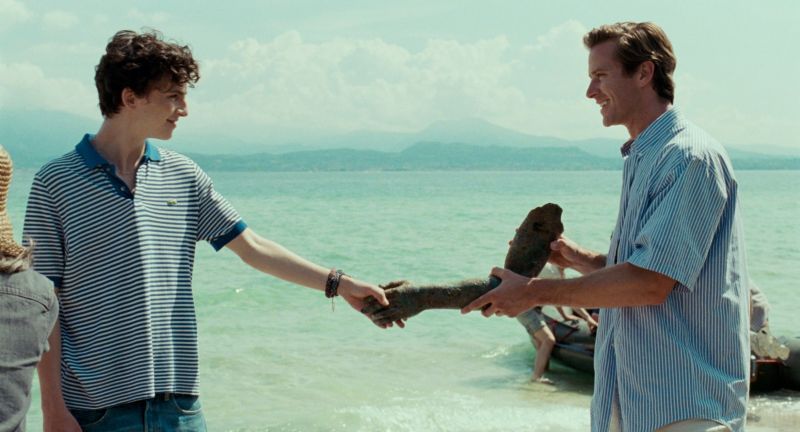
Set in northern Italy in 1983, the film depicts the romantic relationship that develops between Elio Perlman, a 17-year-old French-Italian Jewish boy, and Oliver, a 24-year-old American graduate student who comes to stay with the family to assist Elio’s father with his archaeological research.
The film is the third and final entry in what Guadagnino has called his “Desire” trilogy, following “I Am Love” (2009) and “A Bigger Splash” (2015).
Produced by: Peter Spears, Luca Guadagnino, Emilie Georges, Rodrigo Teixeira, Marco Morabito, James Ivory, Howard Rosenman.
Production companies: Frenesy Film Company, La Cinéfacture, RT Features, M.Y.R.A. Entertainment, Water’s End Productions.
Distributed by: Sony Pictures Classics (worldwide), Warner Bros. (Italy).
Cinematography: Sayombhu Mukdeeprom.
Editing: Walter Fasano.
Music curated by: Luca Guadagnino (with three original songs contributed by Sufjan Stevens).
Principal cast: Timothée Chalamet (Elio Perlman), Armie Hammer (Oliver), Michael Stuhlbarg (Mr. Perlman), Amira Casar (Annella Perlman), Esther Garrel (Marzia), Victoire Du Bois (Chiara).
Languages: English, Italian, French (with a passage of German also quoted in the film).
Budget: $3.5 million. Worldwide box office: approximately $43 million.
Trailer
Plot Overview
Summer, 1983. Seventeen-year-old Elio Perlman spends his days at his family’s country home in northern Italy with his parents, occupying himself with reading, piano playing, and the company of his childhood friends Marzia and Chiara.
Oliver, a 24-year-old American graduate student, comes to stay with the Perlman family as a research assistant to Elio’s father, an archaeology professor.
Elio and Oliver gradually grow closer, going into town together and accompanying Mr. Perlman on his archaeological excavations. Elio becomes aware of his feelings for Oliver and eventually confesses them. The two share a first kiss, but Oliver hesitates to go further, and for several days afterward the two stop speaking to each other.
A note from Elio breaks the silence, and the two arrange to meet at midnight, where they have sex for the first time. Afterward, Oliver tells Elio, “Call me by your name, and I’ll call you by mine.”
As the end of Oliver’s stay approaches, Elio’s mother suggests to his father that the two of them spend a few days away together before Oliver departs, and Elio and Oliver take a short trip to Bergamo.
After three days away, Oliver returns to the United States. Overcome with grief, Elio is consoled by his father, who speaks of the rarity of the bond the two of them formed and urges him not to close himself off from feeling.
At the end of the year, after a phone call from Oliver announcing his engagement, Elio sits gazing into the fireplace, in tears.
Commentary
Development and Background
The project originated in 2007, when producers Peter Spears and Howard Rosenman read galley proofs of Aciman’s novel and acquired the film rights before its publication. The two brought in their friend James Ivory as executive producer, and development began in 2008. Several director and screenwriter candidates, including Gabriele Muccino, Ferzan Özpetek, and Sam Taylor-Johnson, were approached over the following years, but none of these arrangements came to fruition.
Guadagnino, the producers’ first choice, initially declined to direct due to other commitments and instead joined the project as a location consultant, owing to his residence in northern Italy. A co-directing arrangement with Ivory was later proposed but never formally concluded; Ivory agreed to co-direct on the condition that he write the screenplay himself, a process that took approximately nine months.
Financing was assembled from the French company La Cinéfacture, the Italian company Frenesy Film Company (Guadagnino’s own production company), the American company M.Y.R.A. Entertainment, the Brazilian company RT Features, and the American company Water’s End Productions, with additional support from the Italian Ministry of Cultural Heritage and Activities and Tourism.
In 2016, Ivory withdrew as co-director, leaving Guadagnino as sole director. According to Ivory, the distributor Memento Films International judged that a co-directing arrangement would be difficult to manage, citing concerns over potential conflict on set.
Among the principal departures from the novel: whereas the novel is narrated retrospectively from Elio’s point of view, the film presents the entire story as unfolding in the “present” of 1983. The setting was moved from the novel’s Bordighera, in Liguria, to the countryside near Crema, where Guadagnino resides, and the year of the events was changed from 1987 in the novel to 1983 in the film.
In revising the screenplay, Guadagnino removed nearly all of the novel’s narration, along with much of its nudity.
The trip to Rome that Elio and Oliver take near the end of the novel — given a full chapter in the source material — was altered for budgetary reasons and ultimately became the trip to Bergamo depicted in the film.
The novel’s dialogue between Mr. Perlman and Elio’s mother Annella concerning HIV/AIDS, as well as the closing scene of decorating a Christmas tree, were also omitted from the film.
Cinematographic Technique
The film was shot on 35mm film, using a single lens throughout. This choice was influenced by the work of David Cronenberg, and was intended to reinforce a consistency of perspective and to translate the performers’ tension directly onto the screen.
Filming proceeded in the chronological order of the story, a choice intended to allow the changes undergone by both the characters and the performers to be captured within the sequence of shooting itself.
During the 33-day shoot, rain fell on 28 days, an unusually persistent run of poor weather, and cinematographer Sayombhu Mukdeeprom was obliged to compensate with artificial lighting in order to reproduce the light of a northern Italian summer.
The scene in which Elio confesses his feelings to Oliver, set at the Piazza Vittorio Emanuele in Pandino (in front of the town’s First World War memorial), was filmed as a single long take using an extended dolly track, a choice intended to preserve an uninterrupted “flow of emotion” without cutting away.
Mr. Perlman’s extended monologue to Elio was filmed toward the end of the shoot; Guadagnino is reported to have limited the number of takes and favored as unobtrusive a direction as possible, leaving the scene largely to the actors’ performances.
Nudity in sexual scenes — including the garden scene in which Elio and Oliver share their final kiss — is handled without direct depiction, for instance by panning the camera away to the trees outside a window; this was in part due to contractual provisions by which the actors (Chalamet and Hammer) were not required to appear fully nude. Ivory has publicly disagreed with this treatment, arguing that a franker approach to nudity, of the kind found in his own film “Maurice” (1987), would have been more natural.
Filming Locations
Principal photography took place mainly in and around the city of Crema, in the province of Cremona, Lombardy. The Perlman family villa was represented by Villa Albergoni, an uninhabited 17th-century estate in the village of Moscazzano.
The swimming pool seen in the film was designed to resemble the livestock watering troughs common to the region.
The square in front of Crema Cathedral (Piazza Duomo) and the arch of its bell tower, the Torrazzo, were also among the principal filming locations, used together with the surrounding streets.
The archaeological excavation scenes were filmed at the Grottoes of Catullus, on the shore of Lake Garda in the province of Brescia.
The trip to Bergamo was filmed at a number of historic sites, including Bergamo Cathedral, the Basilica of Santa Maria Maggiore, the courtyard of the Liceo Classico Paolo Sarpi (Piazza Rosate), and the exterior of the Ateneo di Scienze, Lettere ed Arti di Bergamo.
The scene in which the two hike into the mountains to visit a waterfall during their stay in Bergamo was filmed at the Cascate del Serio (Serio Falls), near Valbondione.
The train station scene near the end of the film was shot at Pizzighettone station.
Additional filming took place in and around Pandino, Montodine, Ripalta Cremasca, and Crespiatica, in the province of Lodi.
Characteristics as a Film
Guadagnino has described his approach to the film as “light and simple,” a direction he presents as a departure from the “stylized and hallucinatory” quality attributed to his earlier work. He has framed the film as a dedication to “the fathers of my life — my own father, and my film fathers,” citing the influence of Jean Renoir, Jacques Rivette, Éric Rohmer, and Bernardo Bertolucci. Maurice Pialat’s “À nos amours” (1983) is cited in particular as a model for a narrative that captures two people “in the moment,” without relying on conflict or tragedy as its structuring device.
Guadagnino sought to avoid the schematic structure common to coming-of-age films, in which growth is depicted through romantic conflict or binary choice. Regarding the film’s sexual content, he has stated that he had no interest in depicting the sexual act itself directly, and that his aim was for the audience to surrender fully to the emotional journey of the two central characters and to relive the experience of first love.
Jewish identity, one of the central themes of Aciman’s novel, is carried over into the film. Through his contact with Oliver, who is openly and unselfconsciously Jewish, Elio’s own relationship to his Jewish identity shifts over the course of the story.
The themes of sexual self-discovery and Jewish identity unfold in parallel, both structured as a movement from concealment toward self-acceptance through Elio’s relationship with Oliver. The Star of David pendant that Oliver wears functions as a visual device for this theme.
Costume designer Giulia Piersanti deliberately avoided strict period accuracy, aiming instead for what she described as “an unselfconscious teenage sensuality, the heat of summer, a sense of sexual awakening.” She has cited the costuming of Éric Rohmer’s “Pauline at the Beach” (1983), “A Tale of Springtime” (1990), and “A Summer’s Tale” (1996) as points of reference.
Guadagnino has stated that casting was based on performance and chemistry between the actors rather than on sexuality.
Author André Aciman and producer Peter Spears each make cameo appearances as party guests, playing a gay couple, Mounir and Isaac.
Release
The film had its world premiere on January 22, 2017, at the Sundance Film Festival. It was subsequently screened at the Berlin International Film Festival on February 13, the Toronto International Film Festival on September 7, and the New York Film Festival on October 3 of the same year.
In the United States, the film opened in limited release on November 24, 2017, in four theaters in New York and Los Angeles, before expanding gradually and moving into wide release across 815 theaters on January 19, 2018, timed shortly before the announcement of the Academy Award nominations. It opened in limited release in the United Kingdom on October 27, 2017, and in Italy on January 25, 2018, distributed by Warner Bros.
A screening had been scheduled for the Beijing International Film Festival in April 2018 but was removed from the official program without explanation. The Hollywood Reporter interpreted this as reflecting the Chinese government’s consistent intolerance toward content dealing with homosexuality.
Reception
The film has generally been received as a beautifully made romantic drama that portrays a same-sex relationship without treating it as exceptional.
On Rotten Tomatoes, the film holds a 95% approval rating based on 363 reviews, with an average score of 8.8/10; the site’s consensus summary describes it as a melancholic and deeply persuasive portrait of first love, anchored by sympathetic performances from Chalamet and Hammer. On Metacriticthe film holds a weighted average score of 94 out of 100 based on 53 reviews, indicating “universal acclaim.”
Many critics named the film among the best of 2017; Justin Chang of the Los Angeles Times, David Rooney of The Hollywood Reporter, and David Ehrlich of IndieWire each placed it at number one on their year-end lists. Peter Debruge of Variety described the film as a story of first love that transcends the frame of a same-sex relationship, arguing that it advances the canon of gay cinema, and compared its sensuous direction to that of Pedro Almodóvar and François Ozon.
Critical assessments were not uniformly positive, however. Weaknesses noted include the film’s middle-class framing of same-sex representation, with limited attention to broader social context or class consciousness, and its heavy reliance on picturesque, tourist-oriented imagery.
Armond White of “Out” magazine criticized the film as unabashedly commercial, describing it as an “ultra-bourgeois fantasy” that commodifies and distorts the romantic aspirations of queer audiences.
In 2025, the film ranked 37th on the list of the 100 best films of the 21st century by “The New York Times” and 56th on a similar list published by “Rolling Stone.”
At the 90th Academy Awards, the film was nominated for Best Picture, Best Actor (Chalamet), and Best Original Song (“Mystery of Love”), and won Best Adapted Screenplay.
At the British Academy Film Awards, it received four nominations, including Best Film and Best Director, and won Best Adapted Screenplay (Ivory).
At the Independent Spirit Awards, it won Best Male Lead (Chalamet) and Best Cinematography (Mukdeeprom).
At Italy’s Nastro d’Argento and Ciak d’Oro awards, it won Best Editing (Fasano).
Soundtrack
The soundtrack album was released digitally on November 3, 2017, and on physical media on November 17 of the same year. It comprises 17 tracks with a total running time of 71 minutes and 8 seconds. Music selection was overseen by Guadagnino himself, who sought both to reflect Elio’s character as a music-loving pianist and to draw on the pop songs that were actually playing on local radio that summer.
Track List
- Hallelujah Junction – 1st Movement (John Adams): A movement from a work for two pianos by the contemporary minimalist composer.
- M.A.Y. in the Backyard (Ryuichi Sakamoto): A piano piece by Sakamoto.
- J’adore Venise (Loredana Bertè): A song by the Italian pop singer, from the 1980s.
- Paris latino (Bandolero): A French disco hit from 1983.
- Sonatine bureaucratique (Erik Satie, performed by Frank Glazer): A solo piano work by Satie.
- Zion hört die Wächter singen (from Cantata BWV 140, J.S. Bach, performed by Alessio Bax): A piano arrangement based on the melody from Bach’s cantata.
- Lady Lady Lady (Giorgio Moroder & Joe Esposito): A synth-pop track by Moroder from the 1980s.
- Une barque sur l’océan (from Miroirs, Maurice Ravel, performed by André Laplante): A piano work by Ravel.
- Futile Devices (Doveman Remix) (Sufjan Stevens): A Doveman remix of a track from Stevens’s 2010 album The Age of Adz.
- Germination (Ryuichi Sakamoto): Another piano piece by Sakamoto.
- Words (F.R. David): A song by the French pop singer, from the 1980s.
- È la vita (Marco Armani): A song by the Italian pop singer.
- Mystery of Love (Sufjan Stevens): One of two original songs written for the film. Nominated for Best Original Song at the 90th Academy Awards.
- Radio Varsavia (Franco Battiato): A song by the Italian composer and singer.
- Love My Way (The Psychedelic Furs): A new wave anthem from 1982. Guadagnino has described it as a song that deeply influenced him at age 17. It plays during the film’s dance scene.
- Le jardin féerique (from Ma mère l’Oye, Maurice Ravel, performed by Valerie Tryon & Ronald Cavaye [as credited on the album, four-hand piano]): A piece for piano duet by Ravel.
- Visions of Gideon (Sufjan Stevens): The second original song written for the film. It plays over the film’s final scene.
In addition, disco music associated with Giorgio Moroder and various Italian pop songs can be heard briefly as background music at several points in the film.
Criticism
The film depicts a sexual relationship between Elio (17) and Oliver (24), an age gap that generated particular controversy in the United States, where the age of consent is higher in many states than in Italy. At the time of filming, Chalamet was 20 and Hammer was 30.
Karamo Brown, a host of “Queer Eye,” criticized the film as glorifying sexual assault, stating that it appeared to depict an adult man having sex with a much younger boy.
Writer Cheyenne Montgomery expressed discomfort with the fact that Elio is depicted in markedly childlike terms — shaving the down from a peach, seeking comfort from his parents — while his partner is clearly depicted as an adult.
Psychiatrists René Sorrentino and Jack Turban, writing in “Psychiatric Times,” characterized the film as being about sexual predation, raising questions about the power imbalance between the two characters and about the ethics of a sexual encounter between an intoxicated, vomiting 17-year-old and a more experienced 24-year-old.
By contrast, the LGBT magazine “The Advocate” raised a comparative argument, noting that heterosexual relationships with similar or greater age gaps — such as that between Scarlett and the 33-year-old Rhett Butler in “Gone with the Wind” — have not faced comparable criticism.
The film’s marketing also drew controversy. Some of the promotional materials used by Sony Pictures foregrounded images of Chalamet and Garrel (who plays Marzia) rather than the relationship between Elio and Oliver; Daniel Megarry of “Gay Times” characterized this as an attempt to “straight-wash” the film’s subject matter, and Benjamin Lee of “The Guardian” similarly criticized it as a disastrous marketing effort that exposed the industry’s awkward reluctance to embrace queerness.
Home Media
The film was made available for digital download on February 27, 2018, and was released on Blu-ray and DVD in the United States on March 13, 2018.
Total home media sales in the United States reached approximately $4 million. In the United Kingdom, the film reached number 7 on the DVD sales chart and number 4 on the Blu-ray sales chart.
In Japan, the film was released on Blu-ray and DVD on September 21, 2018.
Other Notes
Crema became a site of “pilgrimage” for fans of the film after an Italian fan published the coordinates of its filming locations; official tours of the film’s locations have since been organized.
In China, the film was received largely by heterosexual female audiences as a Western romance in the vein of “boys’ love” fiction, and gained popularity on the review and discussion site Douban.
Search Links
Cross-Search for “Call Me by Your Name” on JustWatch
Search for “Call Me by Your Name” on Amazon.com
Synopsis (Contains Spoilers)
In the summer of 1983, at his family’s country home in northern Italy, 17-year-old Elio Perlman is spending another summer as he has every year, together with his father, an archaeology professor, and his mother, Annella.
Elio is trilingual, speaking French, Italian, and English, and is an introspective young man who occupies himself with the piano and composition.
Oliver, a 24-year-old American graduate student, comes to stay with the family for the summer as his father’s research assistant.
Elio initially finds little in common with the confident and easygoing Oliver. During a game of volleyball, Oliver touches Elio’s back, and Elio deflects the gesture. At the same time, Elio grows jealous upon witnessing Oliver kiss his childhood friend Chiara.
Elio and Oliver gradually grow closer, cycling into town together and accompanying Mr. Perlman on his archaeological expeditions. During one such trip, the two witness the recovery of a bronze statue from a lake. Elio’s feelings for Oliver deepen to the point that he sneaks into Oliver’s room to smell his clothing.
Elio finally confesses his feelings to Oliver, who refuses, saying such things cannot be discussed. Later, in a secluded spot, the two share a first kiss. Oliver hesitates to take the relationship further, however, and the two stop speaking to each other for a time.
During this period, Elio goes on a date with Marzia, and the two sleep together. Elio leaves Oliver a note to break the silence between them, and Oliver responds, proposing that they meet at midnight. Elio agrees, and the two have sex for the first time. Afterward, Oliver tells Elio, “Call me by your name, and I’ll call you by mine.”
The following morning, still caught up in his inner conflict, Elio masturbates using a peach, and Oliver becomes aware of it. Elio weeps, thinking of how little time remains before Oliver’s departure.
Marzia, who has gone several days without hearing from Elio, confronts him in frustration; Elio responds coldly, hurting her.
As Oliver’s departure approaches, Elio’s mother Annella suggests to his father that it might be good for the two of them to get away for a few days, and Elio and Oliver travel to Bergamo, spending three days largely alone together in a hotel room.
After parting from Oliver at the end of the trip, a grief-stricken Elio calls his mother and asks her to meet him at the station and drive him home.
Marzia, for her part, expresses understanding of Elio’s feelings and tells him she wishes to remain friends.
Seeing his son’s sorrow, Elio’s father speaks to him of the rarity of the bond he formed with Oliver, and urges him not to close himself off from the pain but to remain open to further joy and experience.
At the end of that year, during the Jewish festival of Hanukkah, Oliver telephones the Perlman household to announce his engagement to a woman he has been seeing intermittently for several years. Elio addresses Oliver by his own name, and Oliver in turn addresses Elio by his, telling him that he remembers everything. After the call ends, Elio sits before the fireplace as his parents and the household staff prepare dinner, gazing into the flames in tears. It is at this point that the film’s title appears on screen for the first and only time.