




















































Overview
“BGM” is an album by the Japanese electronic music band Yellow Magic Orchestra (hereafter YMO), their fifth overall, or their fourth if the mini-album “×∞Multiplies” is excluded. It was released by Alfa Records on March 21, 1981. The title is an abbreviation of “background music,” yet the work is experimental in character, marked by the increasing complexity of rhythm, the transformation of timbre into noise, and the obscuring of both melody and harmony.
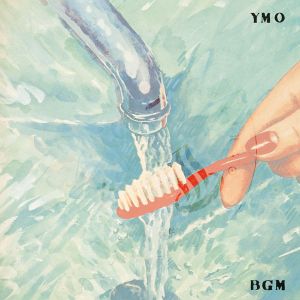
The album peaked at No. 2 on the Oricon chart, sold approximately 275,000 copies in total, and ranked 28th among the year’s best-selling albums in 1981.
In November 1981, another experimental album “Technodelic” was released, and the two albums of that year represent the peak of YMO’s middle period.
Background
Following their debut in 1978, YMO achieved commercial success with catchy synth-pop built on a foundation of disco beats, as typified by “Rydeen.” With “BGM,” produced after “×∞Multiplies” (1980), the band turned toward a more introspective and intelligent music. The members themselves described this shift as a “culling of fans,” and it indicates that the pursuit of their own musical interests took precedence over commercial success. It has also been said that weariness with repeatedly performing the same songs in concert fueled their interest in more complex compositions.
The album drew its principal inspiration from two records released in 1980: Ryuichi Sakamoto’s solo album “B-2 Unit” and Kazuhiko Katō’s solo album “L’Opéra Fragile.”
“B-2 Unit” is an experimental album that fully embraces dub techniques, and it exerted a direct influence on “BGM.” Haruomi Hosono is said to have admired its track “Riot in Lagos,” which sustains a loop on a single chord, and he chose it as the opening number of YMO’s second World Tour in the autumn of 1980.
Katō’s “Utakata no Opera,” on which Haruomi Hosono and Yukihiro Takahashi participated, is an album themed on 1920s Berlin, and its European romanticism also influenced this album.
Recording took place at Studio “A” from January 15 to February 20, 1981, on a schedule designed to meet the March 21 release date. The lyrics were not ready in time for printing and were first made public in the photobook “OMIYAGE.”
Production Methods
The album was made with deliberately modest equipment: the Prophet-5 as the synthesizer and the TR-808 as the rhythm machine. These were played through amplifiers in the studio, picked up by microphones, recorded on a TEAC eight-channel recorder, and then dubbed onto 3M’s digital multitrack recorder, the DMS. Passing the signal through the analog domain in this way reflects an approach in which sounds were processed with equipment in the studio rather than constructed within the synthesizer itself, and it is regarded as an early example of what later came to be called “tape compression.” Sakamoto, however, said in a later interview that he was not enthusiastic about the method, which he felt resembled imitating the bedroom recording practices of Britain at the time.
The sequencer was changed from the MC-8 to the MC-4. Other instruments used included the Minimoog, the ARP Odyssey, and the Roland Jupiter-8. Acoustic instruments were hardly used.
The drums make extensive use of gated reverb, a cutting-edge acoustic effect of the period that became widely known through XTC’s album “Black Sea” (1980).
Takahashi’s drums feature a noisy timbre produced by a noise oscillator, custom-ordered from Ishibashi Gakki and attached to the rim of the snare drum.
The dry texture of the TR-808 and the effect-driven handling of space characterize the impression of the album as a whole.
Eight of the ten tracks run about four and a half minutes, and the remaining two about five minutes and twenty seconds, so the running times are nearly uniform.
The lyrics were written by the members themselves, with Peter Barakan responsible for the English translation and pronunciation coaching.
Reception
On its release, “BGM” was regarded as difficult by general listeners who had expected the pop and catchy image of the band’s earlier work, and its sales did not match those of “Solid State Survivor.” In later reassessments, however, it has been highly praised as one of the albums in which YMO’s experimentalism was most fully realized, and it is often positioned as a precursor of ambient techno and minimal techno.
In a review published in March 2021 by the American music outlet Pitchfork, the musician and music writer Noah Yoo described the album as a technically accomplished and enormously expensive production whose shadow still falls over four decades of electronic music-making. He wrote that it offered a “startlingly prescient” glimpse of where electronic music was heading, and he pointed to the groove of “Rap Phenomena,” the ambient approach of “Happy End,” and the drum programming of “U·T” and “Camouflage” as influences on later IDM, ambient techno, and hip-hop.
Song Commentary
1. “Ballet” (lyrics: Yukihiro Takahashi, Peter Barakan; music: Yukihiro Takahashi)
A piece that holds both sweetness and romanticism within a dark atmosphere. The lyrics take as their subject the Art Deco painter Tamara de Lempicka, with Takahashi evoking the atmosphere of Warsaw in fog. Hosono created the sound-effect-like timbres with a locomotive in mind. The French voice is that of Tomoko Nunoi.
2. “Music Plans” (lyrics: Ryuichi Sakamoto, Peter Barakan; music: Ryuichi Sakamoto)
This is the only newly written piece Sakamoto contributed to the album, and he also sings the vocals. The lyrics are infused with irony and defiance toward music-making. A single “pop” can be heard at one point in the track, which stems from jitter noise caused by a data error on the digital recorder.
3. “Rap Phenomena” (lyrics: Haruomi Hosono, Peter Barakan; music: Haruomi Hosono)
The title plays on two meanings of “rap,” the rapping of spirits in paranormal phenomena and the rap of hip-hop, which was just beginning to attract attention at the time. Hosono keeps speaking about “rap phenomena” in a rap-like manner throughout the piece. Hip-hop was not yet widely known then, and the track is regarded as one of the earliest rap songs by a Japanese artist.
4. “Happy End” (music: Ryuichi Sakamoto)
This is a dub-style reconstruction of the B-side of Sakamoto’s solo single “Front Line” (1981). At the 1981 Winter Live, it was performed in an arrangement close to the original. A piano quartet version appears on Sakamoto’s 2005 album “/05.”
5. “1000 Knives” (music: Ryuichi Sakamoto)
This is a re-recording (self-cover) of a track from Sakamoto’s 1978 solo album “Thousand Knives.” Although it was frequently performed at YMO concerts, the arrangement on this album is more experimental. In the middle section, a synthesizer solo that makes full use of pitch bend unfolds in an aggressive timbre reminiscent of a distorted guitar. Sakamoto has said that he drew on Talking Heads’ album “Remain in Light” (1980), on which Adrian Belew participated, for this solo.
6. “Cue” (lyrics: Yukihiro Takahashi, Haruomi Hosono, Peter Barakan; music: Yukihiro Takahashi, Haruomi Hosono)
Later released as a single, this is one of the album’s representative songs. The influence of the contemporaneous band Ultravox is evident, especially that of “Passionate Reply,” the B-side of their 1981 single “Vienna,” and similarities in the rhythm parts and timbres have been pointed out. Sakamoto is said to have felt the song was an imitation of Ultravox and to have stayed out of the recording. With its catchy melody and Takahashi’s vocals, it is one of the more pop-oriented tracks on the album.
7. “U·T” (music: YMO)
The title is an abbreviation of “Ultra-Terrestrial.” This instrumental is characterized by rapid-fire sixteenth-note drums, a “clattering” pattern created with a digital delay. It was also included as the B-side of the single “Cue.” A minimal, reverb-laden drum loop continues throughout, over which an ambient melody is layered. In the middle section, the members speak about “U·T” in processed voices. The track was also performed live and is regarded as one of the highlights of the album.
8. “Camouflage” (lyrics: Yukihiro Takahashi, Peter Barakan; music: Yukihiro Takahashi)
This track was also included as the B-side of the single “Mass.” A dark and tense piece composed by Takahashi, it uses microtones (in particular 31-tone equal temperament) to produce an unstable and alien sound that cannot be obtained in the usual 12-tone equal temperament. In the latter half, Takahashi’s heavily effects-processed voice appears.
9. “Mass” (lyrics: Haruomi Hosono, Peter Barakan; music: Haruomi Hosono)
This song was later released as a single. The title carries a double meaning, referring both to the masses and to the Mass (a religious rite). The piece evokes the atmosphere of a solemn ritual, and the spirituality and mystical elements characteristic of Hosono are strongly felt. Peter Barakan recites the lyrics in two languages, English and Russian.
10. “Loom” (music: YMO, Hideki Matsutake)
This ambient piece foregrounds an endlessly rising scale (an auditory illusion close to the Shepard tone). Ascending and descending tones sound simultaneously, and the piece is constructed so that it seems to rise without end (created by Hideki Matsutake using an E-mu). It is an experimental closing track, and it also gives an impression of anticipating THX’s “Deep Note” (the electronic sound effect heard with the THX logo in cinemas, in which a dense cluster of low tones gradually spreads out to form a chord).
Track Listing
Total running time: 47:09. The running times follow the notation on the SACD hybrid edition (MHCL-10112), released on May 29, 2019.
Side One
- “Ballet” – 4:34
- “Music Plans” – 4:33
- “Rap Phenomena” – 4:32
- “Happy End” – 4:32
- “1000 Knives” – 5:22
Side Two
- “Cue” – 4:32
- “U·T” – 4:33
- “Camouflage” – 4:34
- “Mass” – 4:31
- “Loom” – 5:20
Personnel
Yellow Magic Orchestra
- Haruomi Hosono – bass, synth bass, keyboards, production, mixing
- Yukihiro Takahashi – drums, vocals, keyboards
- Ryuichi Sakamoto – keyboards, vocoder, vocals
Guest and Supporting Musicians
- Hideki Matsutake – synthesizer programming, computer programming
- Peter Barakan – lyrics (English translation), pronunciation coaching (also spoken word on “Mass”)
- Tomoko Nunoi – French narration on “Ballet” (uncredited)
Technical Staff
- Mitsuo Koike – recording engineer, mixing engineer
- Yoshifumi Iio – recording engineer
- YMO – mixing
- Takeshi Fujii, Don Nagata (Jun Nagata), Tomoki Miyadera – equipment coordination
Other Credits
- Producer: Haruomi Hosono
- Executive producers: Shoro Kawazoe, Kunihiko Murai
- A&R coordinator: Kazusuke Obi
- Art direction and jacket design: Yukimasa Okumura
- Photography: Kenji Miura
Streaming Services
Search Links
Search for “YMO BGM” on Amazon.com
Search for “YMO BGM” on Apple Music