






















































Overview
“Luminous Moss” (original Japanese title: Hikarigoke) is a novella published in 1954 by the Japanese novelist Taijun Takeda.
It is based on an actual incident of cannibalism that occurred under starvation conditions on the Shiretoko Peninsula in Hokkaido during the final years of World War II (1943–1944), commonly known as the “Hikarigoke Incident” (Shiretoko cannibalism incident).
The narrative begins as a travelogue written in an I-novel style, in which a writer referred to as “I” visits Hokkaido. In its latter half, the work shifts into dramas written in play form.
This is a thought-experimental novel that explores the question of whether it is possible to ethically condemn acts of cannibalism that are unavoidable in order to survive in extreme conditions of starvation.
Synopsis
The work consists of three parts: an untitled opening travelogue and a play in two acts, “Act I (The Makkausu Cave Scene)” and “Act II: The Courtroom Scene.”
Travelogue
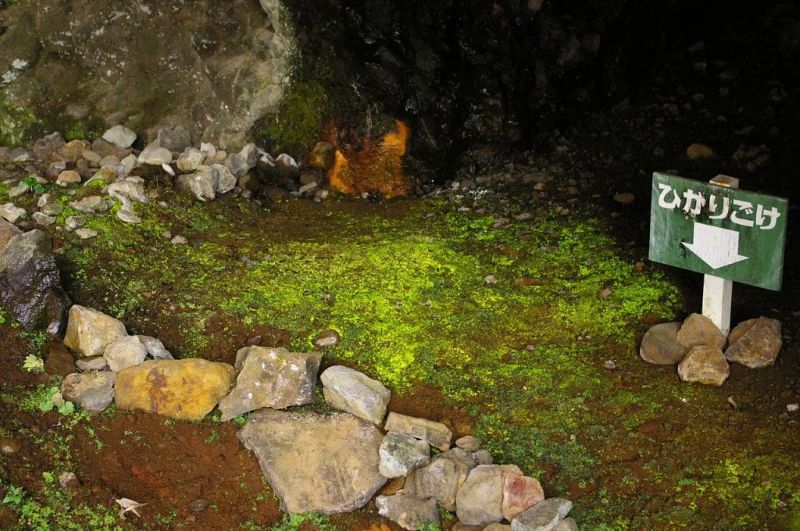
“I,” who visits the village of Rausu in Hokkaido, is guided by the local middle school principal to Makkaushi Cave, where he sees luminous moss glowing in a golden-green color.
After hearing from the principal about the Shiretoko cannibalism incident, “I” recalls a story told by Mr. M, an Ainu linguist. Mr. M is said to have been furious when a Japanese scholar made unfounded claims about cannibalism among the Ainu during a conference on Ainu studies.
Through an introduction by the principal, “I” meets a young man named S and reads “A Local History of Rausu Village” (1950), compiled by S, thereby learning the details of the Shiretoko cannibalism incident.
“I” is intrigued by S’s speculation that, in the incident, murder may have been committed in order to eat a human being.
After returning from the trip, “I” considers turning this incident into a novel.
“I” reflects on why cannibalism is regarded as more abhorrent than murder, linking this taboo to the ideology of civilized society that views cannibalism as a savage and uncivilized act. In this context, he critically refers to two novels that depict characters who “committed the crime of murder but did not commit the crime of cannibalism under conditions of starvation”: “The Neptune” (1922) by Yaeko Nogami and “Fires on the Plain” (1951) by Shōhei Ōoka.
“I” decides to transform the incident into a literary work in the form of “a play to be read,” which cannot be performed (a closet drama).
Act I (The Makkausu Cave Scene)
The captain and three sailors—Nishikawa, Hachizō, and Gosuke—are inside a cave.
Gosuke dies.
The captain and Nishikawa eat Gosuke’s flesh, while Hachizō refuses and dies of starvation.
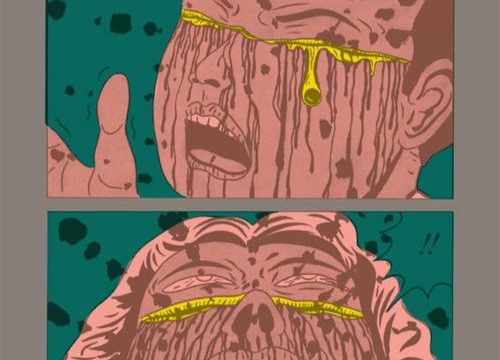
Just before his death, Hachizō sees a ring of light at the back of Nishikawa’s neck. It is a golden-green glow resembling the light of luminous moss, which, according to old legends, appears on the necks of those who have eaten human flesh.
The captain and Nishikawa survive by eating Hachizō’s flesh.
After Hachizō’s flesh is exhausted, Nishikawa fears that the captain will kill and eat him and attempts to throw himself into the sea, but the captain kills Nishikawa.
Act II: The Courtroom Scene
The captain’s trial is held in a courtroom.
The prosecutor outlines the crimes of murder and cannibalism committed by the captain.
The captain admits his guilt but declares that he wishes to be judged either by someone who has eaten another human being or by someone who has been eaten by another, enraging the prosecutor.
The captain claims that a ring of light should be visible at the back of his own neck, but no one can see it.
Rings of light appear at the backs of the prosecutor’s, the presiding judge’s, the defense attorney’s, and the spectators’ necks (these rings of light are visible only to the reader).
The captain urges the people to look at him more closely, insisting that they should be able to see the ring of light. He is surrounded by a crowd bearing rings of light. Countless glowing circles cluster together.
Commentary
On Luminous Moss
Luminous moss (Schistostega pennata) is a rare species of moss that reflects even faint light, emitting a golden-green glow in dark places such as caves.
It is found in cool regions of the Northern Hemisphere, including Europe, North America, Siberia, and Japan.
On the Hikarigoke Incident (1943–1944)
The Hikarigoke Incident (also known as the Shiretoko cannibalism incident) refers to a case in which survivors of a Japanese Army requisitioned vessel that ran aground near the Shiretoko Peninsula in Hokkaido in December 1943 (Shōwa 18), during the final phase of the Pacific War, were alleged to have eaten the bodies of the dead under conditions of starvation, leading to a trial.
In 1944, the ship’s captain was arrested on suspicion of murder, abandonment of a corpse, and mutilation of a corpse. He admitted to having eaten the body of one crew member but denied committing murder. The prosecution charged him with mutilation of a corpse, and the court sentenced him to one year of imprisonment.
The Hikarigoke incident is an extremely rare case in the history of modern criminal law in which only the act of cannibalism, rather than any accompanying act of murder, was tried by law and made subject to criminal punishment. However, as in many other countries, Japanese criminal law does not define cannibalism as an independent offense; accordingly, the charge applied was mutilation of a corpse.
After Takeda’s novel “Luminous Moss” gained prominence, the incident came to be commonly referred to as the “Hikarigoke Incident,” but Takeda’s work is not a reconstruction of historical fact; it is a work of fiction.
In the actual incident, the captain testified that he ate the crew member’s body in an uninhabited watch hut at Cape Shiretoko. In Takeda’s novel (the drama part in the latter half), however, the act of cannibalism is set in Makkausu Cave (also known as Makkaushi Cave) in Rausu Village (present-day Rausu Town), a location known as a natural habitat of luminous moss.
At the time the incident occurred, Japan was under wartime conditions, so it was not reported in newspapers. Because the investigation and court records were subsequently lost, when Takeda wrote this work the only available reference material was the article on the incident titled “Shipwreck Incident” included in “A Local History of Rausu Village.” That article was based on rumors and hearsay, and its correspondence with the facts was not entirely accurate.
In the 1990s the journalist Ichidō Gōda published his investigative records of the incident as nonfiction, and the full picture of the event became clear for the first time.
About the Author
Taijun Takeda (1912–1976) was a Japanese novelist regarded as a member of the first generation of postwar writers, and he was also an ordained priest of the Jōdo sect of Buddhism.
He is known for a body of intellectually profound novels that, drawing on his ideological conversion from leftist activism, his wartime experiences, the influence of Chinese literature, and his distinctive religious interpretations, capture the complexity of human existence from multiple perspectives.
He was born in Tokyo in 1912 as the third son of a Jōdo-sect temple.
While still in high school, he immersed himself in Chinese literature and joined leftist movements.
In 1931, he entered the Department of Chinese Literature at the Faculty of Letters, Tokyo Imperial University, but withdrew after one year.
In 1933, he obtained qualifications as a Buddhist priest.
In 1934, he co-founded the “Chinese Literature Research Society” with Yoshimi Takeuchi and others.
He was arrested three times for his involvement in leftist movements during his student years and later withdrew from activism.
In 1937, he was conscripted for the Second Sino-Japanese War and sent to the Central China front, but was discharged two years later.
In 1943, he published “Sima Qian: The World of the Records of the Grand Historian,” a critical study of the ancient Chinese historian Sima Qian and his “Shiji / Records of the Grand Historian.”
In 1944, he moved to Shanghai, where he worked on translation and document preparation.
He experienced the end of the war in Shanghai in 1945 and returned to Japan the following year.
In 1947, he became an associate professor at the Faculty of Law and Letters at Hokkaido University, but resigned after six months and returned to Tokyo to pursue a career as a writer.
In 1948, he attracted attention as a postwar writer with the publication of the I-novel-style short story “Mamushi no Sue / This Outcast Generation.”
In 1952, he published “Fūbaikā (Wind-pollinated Flower),” a novel depicting a group portrait of intellectuals in postwar Japan.
In 1954, he published “Hikarigoke / Luminous Moss,” based on a wartime cannibalism incident.
From 1955 to 1958, he published the novel “The Festival of Forests and Lakes,” set in Hokkaido and depicting racial conflict between the Ainu and ethnic Japanese.
From 1969 to 1971, he published “Fuji,” a novel set in a psychiatric hospital at the foot of Mount Fuji during the final phase of the Pacific War.
From 1971 to 1972, he published the unfinished autobiographical novel “Keraku (Pleasure),” depicting the youth of a young Buddhist monk in mid-1930s Japan.
He died in 1976.
Bibliographic Information
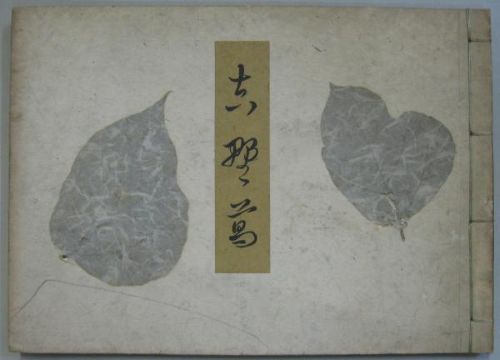
The work was first published in March 1954 in the magazine “Shinchō” and later included in the short story collection “Bibō no Shinto (Believers of Beautiful Appearance),” published by Shinchosha in July of the same year.
Translations
English Edition
An English translation titled “Luminous Moss” was published in 1967 in the United States by Charles E. Tuttle Company in the volume “This Outcast Generation and Luminous Moss,” alongside “This Outcast Generation,” the English translation of Takeda’s short story “Mamushi no Sue.” The translators were Yusaburo (Yūzaburō) Shibuya and Sanford Goldstein.
Czech Edition
A Czech translation of this work was included in “Světélkující mech: Výbor povídek (Luminous Moss: Selected Short Stories),” a book by Takeda published in 1980 by the Czechoslovak publisher Odeon. The translation was done by Vlasta Winkelhöferová.
Danish Edition
A Danish-language edition of this work was included in Takeda’s short story collection “Lysende Mos” published by Forlaget Silkefyret in Denmark in 2025. Translated by Mads Schanz.
Background
The historical background for this work’s theme of whether human actions in extreme situations can be judged by peacetime ethics is the social situation in Japan in the 1950s, when questions of war responsibility and war crimes were being actively debated.
From August to September 1953, Takeda traveled to Hokkaido. In Sapporo, he met Mashiho Chiri, an Ainu linguist and former colleague at Hokkaido University. In Rausu Village, he visited Makkausu Cave under the guidance of a local middle school principal and heard about the Shiretoko cannibalism incident.
The opening travelogue of the novel is based on this journey and adopts an I-novel style.
The character M in the travelogue is modeled on Mashiho Chiri, and S is modeled on Morio Satō, who compiled “A Local History of Rausu Village.”
Narrative Multiplicity and Metafictional Structure
The opening travelogue is written from the first-person perspective of “I,” who is positioned as the author of the play in the latter half, which is presented as a literary creation.
“I” gives a detailed account of the Shiretoko cannibalism incident in the travelogue, quoting passages written by Morio Satō in “A Local History of Rausu Village.”
After reading the travelogue, the reader is required to read the play interpreting it as a director.
Adding further complexity, the captain in Act II is a different narrator from the captain in Act I.
In Act I, the captain speaks in coarse dialect, whereas in Act II, he speaks in rational, standard Japanese.
According to “I,” it is preferable for the captain in Act II to be played by a different actor than the captain in Act I. Moreover, the actor’s face must closely resemble that of the middle school principal who guided “I” to Makkaushi Cave and spoke about the Shiretoko cannibalism incident in the travelogue.
Interpretations
Political Perspective
The Hikarigoke Incident was an incident that occurred during the Pacific War when a fishing vessel commandeered by the Japanese Army ran aground. The basis of this work is anger towards the violence of the Japanese state, which waged colonial wars as a “civilized country’” under the imperial system.
In that sense, this work is not just a work that questions the pros and cons of cannibalism in extreme situations, but also a work that exposes the structure in which the state judges as a crime the acts that those who served the staten during wartime were forced to do in order to survive in extreme conditions, and unilaterally imposes blame on them.
What is the “Ring of Light”?
A common interpretation of the work reads the “ring of light” as a symbol of a fundamental sin akin to Christian original sin, and views the novel as dealing with themes such as the relativity of sin and impossibility of judgment. However, the meaning of the “ring of light” in this work is obscure, and its interpretation is left to the reader.
An important point in interpreting the “ring of light” is that it does not shine by emitting light of its own but by reflecting external light, like luminous moss; consequently, it may appear or disappear depending on the observer’s standpoint.
If the “ring of light” is understood as a symbol of the true nature of life—surviving by sacrificing the lives of others—then the ending of Act II can be interpreted as follows.
Such a nature is the fate of all living beings in the natural world: it cannot be represented by anyone, nor can it be ethically judged.
The captain attempts to privilege those who have experienced the relationship of eating and being eaten among humans and to sanctify himself as one who bears humanity’s original sin—that is, as a Christ-like sacrificial figure—but he fails.
In the courtroom, the distinction between “those who have committed a crime” and “those who have not,” and between “those who judge” and “those who are judged,” becomes blurred, and the trial of judgment ends in failure.
Film and Stage Adaptations
Stage
In addition to a stage adaptation by the Shiki Theatre Company, first performed in 1955, several other stage adaptations have been produced.
Opera
An opera based on the work, composed by Ikuma Dan and directed by Keita Asari, premiered in 1972.
Film
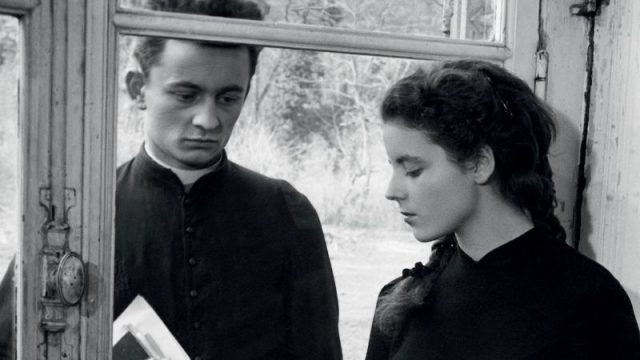
A film adaptation directed by Kei Kumai, “Luminous Moss,” was released in 1992. Rentarō Mikuni played the dual roles of the captain and the school principal.
TV Program
In 2020, a program introducing this work, “Dark Side Mystery: The Shock of ‘Hikarigoke’ — A Story of Us in the Present Day”, was broadcast on NHK BS Premium.
References
- Kakuzō Maeda, “On ‘Luminous Moss’: The Trajectory of a ‘Cannibalistic Drama under the Emperor System,’” “Studies in Modern Literature,” 1990.
- Tetsuya Kamada, “The Struggle of Mashiho Chiri,” “Gunzō,” 1999.
- Mutsumi Yamashiro, “‘Luminous Moss’ Notes,” Gunzō,” 2010.