




















































































Overview
“5th Dimension” is the second studio album by the Japanese female idol group Momoiro Clover Z. It was released on April 10, 2013, by Starchild (King Records).
It is a concept album with “evolution” as its theme. Incorporating a wide range of musical genres such as EDM, hip-hop, Latin, and symphonic rock in a cross-cutting manner, it is a work that expands and deepens the hyperpop-oriented direction of the previous album “Battle and Romance” (2011).
It achieved the group’s first number-one position on the Oricon weekly album chart, recording approximately 180,000 copies in its first week and a cumulative total of approximately 240,000 copies. It received a Platinum certification from the Recording Industry Association of Japan (shipments of 250,000 or more) and ranked 22nd on the 2013 yearly album chart. It was also selected for the “30 Greatest J-pop Albums of the Heisei Era” announced by the Yomiuri Shimbun in 2018. A clear narrative continuity is given to the track order, and the members strongly recommended listening through without shuffling.
Prior to the release, the nationwide arena tour “Momoiro Clover Z Japan Tour 2013 ‘5th Dimension’” was held, featuring an experimental production in which all the album tracks were performed in the recorded order without MC.
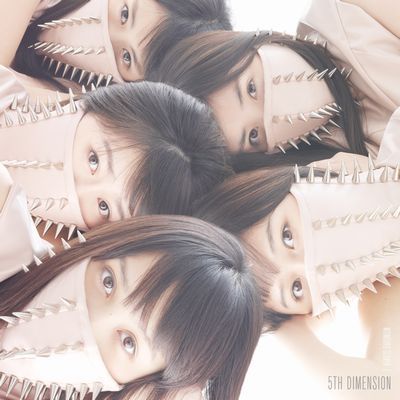
In terms of visuals, “evolved forms” with smiles erased and faces covered by spiked masks were presented, intentionally disrupting the established image of idols.
Background of Production
Momoiro Clover Z is a female idol group belonging to the entertainment agency Stardust Promotion. It was formed in 2008 as the six-member group “Momoiro Clover,” and after the departure of Akari Hayami in 2011, it was renamed “Momoiro Clover Z.” The first full album after the rename, “Battle and Romance” (2011), reached a peak of number 3 on the Oricon weekly album chart (updated to number 2 upon re-release) and sold a cumulative total of approximately 180,000 copies. It also won the Grand Prize (Japanese music category) at the 4th CD Shop Awards selected by the All Japan CD Shop Clerks Union, marking the first such achievement by an idol group.
That work solidified the foundation of the group with catchy and energetic songs and established a style that combines melancholic melodies derived from Showa-era kayō with diverse musical elements. In contrast, this album “5th Dimension” is positioned as an evolved form that maintains that direction while greatly enhancing musical completeness and conceptuality. Whereas the previous work had the character of an “assortment” of diverse songs, this work clearly established for the first time a direction in which the group “aligns itself” with the worldview of the songs.
The concept is “evolution to the fifth dimension,” and a narrative flow is set that progresses from virtual space through the cosmos, labor, war, and rebirth, to a new beginning from ashes. The artwork also visualizes this evolution, showing forms that change step by step from the first form to the third form (spiked masks).
A characteristic feature is that the involvement of Kenichi Maeyamada (Hyadain) decreased compared to the previous work, and diverse external creators participated, including TeddyLoid, Narasaki, Damian Kulash of the American rock band OK Go, Tomoyasu Hotei, Kenji Ohtsuki, and Seiko Ito. This promoted acoustic and structural experimentation that transcended the framework of idol music.
Production Methods and Musical Characteristics
The musical diversity of this work is established through the interplay of the diverse styles of the songs themselves (symphonic rock, hip-hop, EDM, Latin, waltz-time ballads, etc.) and the ingenuity of the arrangements and programming that support them. Electronic sounds (dubstep drops, gated beats, synthesizer layers) and acoustic instruments (orchestra, brass, guitar, Mellotron) coexist according to the character of each song, forming an overall sound that feels excessively constructed.
Through the remastering of the singles, uniformity of sound pressure and texture within the album has been achieved.
The members’ vocals have progressed from a conventional unison-centered approach to greater diversification into part divisions, solos, and rapping, with singing styles adjusted according to the narrative role of each song.
Reception
At the time of release, opinions were divided regarding the difficulty of the concept and the leaps in genre. While there were critical voices from listeners who expected the conventional catchiness, the Japanese edition of Rolling Stone (Kazumi Nanba) awarded it 4/5 points and evaluated it as “making one strongly feel the necessity of forming it as an album, with the songs intersecting and elevating one another.” Billboard JAPAN also received it positively, pointing out that the singles resonate more organically in the context of the album.
In reviews from outside Japan, the American music site Sputnikmusic praised it as “one of the most fun and entertaining pop albums of the year” and evaluated the adventurous quality of crossing from dubstep to classical. On the other hand, Ian Martin of The Japan Times recognized the appeal of the individual songs while stating that as a concept it is diffuse and more of an attempt at a new start than an evolution.
In later reevaluations, it is often positioned as a forerunner of concept albums in idol music and as a high point of genre-crossing experimentation in J-POP of the early 2010s. As a work that demonstrated the coexistence of commercial success and artistic ambition, it constitutes a turning point in the group’s career.
Track Commentary
1. “Neo Stargate” (Lyrics: Yuriko Mori / Music: Tomohiro Osumi / Arrangement: TeddyLoid)
An 8-minute-19-second masterpiece. The intro samples the choral piece “O Fortuna” from Carl Orff’s “Carmina Burana,” developing a solemn overture with choir and orchestra. After approximately two and a half minutes, the members’ vocals appear, and undulating breakbeats and aggressive bass lines gradually come to the fore. The EDM/dubstep drop forms the core, with electronic noise and choir merging into one. The SF motif of the “Stargate” is woven into the lyrics, symbolizing the entrance to the fifth dimension.
2. “Kasō Dystopia” (“Virtual Dystopia”) (Lyrics: Natsumi Tadano / Music & Arrangement: Akirastar)
An up-tempo, guitar-driven J-pop. Based on Shinichi Nishikawa’s guitar, Hiromitsu Kawashima’s bass, and Ryo Yamagata’s drums, with programming reinforcing them. A characteristic first attempt is dividing the chorus into two parts rather than full unison, creating polyphonic thickness. The lyrics take as their image the town of Onagawa in Miyagi Prefecture, which suffered damage in the Great East Japan Earthquake, and while including an homage to Bob Dylan’s “Blowin’ in the Wind,” depict regeneration from the rubble and “escape from virtual space.”
3. “Mōretsu Uchū Kōkyōkyoku Dai 7 Gakushō ‘Mugen no Ai’” (Bodacious Space Symphony’s Movement VII ‘Infinite Love'”) (Lyrics, Music & Arrangement: Kenichi Maeyamada)
The 7th single. Used as the opening theme for the TV anime series “Bodacious Space Pirates.” It packs intense developments and key changes into a symphonic rock framework. Marty Friedman’s lead guitar is added, with orchestra and choir amplifying the grandeur. The structure undergoes multidimensional changes in a short time, giving an impression that is both pop and solemn yet chaotic. Taking infinite cosmic love as its theme, it expands the scale of the narrative.
4. “5 The Power” (Lyrics: Seiko Ito / Music & Arrangement: Muro & Sui)
A hip-hop track based on an homage to Public Enemy’s “Fight the Power” and a sample of the Hungarian singer Koncz Zsuzsa’s song “Visz a vonat.” The members take turns rapping, switching with catchy hooks. The groove is funky and aggressive, demonstrating a level of completeness that transcends the framework of idol rap.
5. “Rōdō Sanka” (“Hymn to Labor”) (Lyrics: Kenji Ohtsuki / Music & Arrangement: Ian Parton)
The 6th single. Composed by Ian Parton of the British rock band The Go! Team. A labor song including a funky rhythm section, live brass (trombone, trumpet), and rapping by the members.
6. “Get Down!” (Lyrics: Yu Shimoji / Music & Arrangement: Damian J. Kulash Jr.)
Electro-pop by Damian Kulash. Kulash performs and programs all the instruments, balancing bubblegum lightness with electronic texture.
7. “Otome Sensō” (“Girl’Z War”) (Lyrics & Music: tica α / Arrangement: Kenji Kondo)
The 8th single. A song provided by Etsuko Yakushimaru under the name tica α. A complex arrangement interweaving strings (cello, viola, contrabass), oboe, brass, and drums. The lyrics sing about days of fighting enemies while leading a school life.
8. “Tsuki to Gingami Hikōsen” (“The Moon and a Silver-paper Airship”) (Lyrics: Yuho Iwasato / Music & Arrangement: Rui Nagai)
A ballad with a leisurely tempo and lyrical melody, the group’s first fully in triple meter. A Mellotron is used at the beginning, imbued with a Romanticism reminiscent of 1960s British rock.
9. “Birth 0 Birth” (Lyrics: Takahiro Maeda / Music: Narasaki / Arrangement: Narasaki & yuyoyuppe)
A theme song of rebirth based on EDM/dubstep. The music video depicts changes in the evolved forms. It is also positioned as an answer song to “DNA Kyōshikyoku” (“DNA Rhapsody,” the coupling track of the 7th single “Mōretsu Uchū Kōkyōkyoku Dai 7 Gakushō ‘Mugen no Ai’”), characterized by electronic drops and a melody that conveys strong will.
10. “Jōkyu Monogatari -Carpe diem-” (“Story of Going to the Earth -Carpe Diem-”) (Lyrics: zopp / Music & Arrangement: Katsuhiko Yokoyama)
A track incorporating elements of Latin music. Brass, percussion, and keyboards form a cheerful rhythm. “Jōkyu” (a pun on “jōkyo,” meaning going to Tokyo, here meaning a journey to Earth) and phrases such as “carpe diem (seize the day),” “memento mori (remember death),” and “que sera sera (whatever will be, will be)” are woven into the lyrics. In live performances, an improvised dance during the interlude becomes a highlight.
11. “Soratobu! Ozashiki Ressha” (“Flying in the Sky! Tatami-room Train”) (Lyrics: Nagae Kuwahara / Music: Akira Sato / Arrangement: Tomoki Hasegawa)
A track featuring a brass section and narration (Kenjiro Ishimaru). It expands the image of a Showa-era ozashiki train to a cosmic scale.
12. “Saraba, Itoshiki Kanashimitachi yo” (“Farewell, My Dear Sorrows”) (Lyrics: Yuho Iwasato / Music & Arrangement: Tomoyasu Hotei)
The 9th single. A rock number pushing Tomoyasu Hotei’s guitar to the forefront. Used as the theme song for the Nippon Television drama “My Little Nightmare.” It won the Drama Song Award at the 75th Television Drama Academy Awards.
13. “Hai to Diamond” (“Ashes and Diamonds”) (Lyrics: Natsumi Tadano / Music: Kenichi Maeyamada / Arrangement: Kenji Kondo)
A grand ballad using an orchestra. The lyrics depicting the path so far and the future ahead are sung with vocals brought so far forward that one’s breath is audible. As the final episode of the narrative, it symbolizes regeneration from ashes.
Track Listing
Total approximately 67:53 (regular edition).
- “Neo Stargate” – 8:19
- “Kasō Dystopia” – 4:09
- “Mōretsu Uchū Kōkyōkyoku Dai 7 Gakushō ‘Mugen no Ai’” – 5:12
- “5 The Power” – 4:19
- “Rōdō Sanka” – 4:38
- “Get Down!” – 3:34
- “Otome Sensō” – 6:56
- “Tsuki to Gingami Hikōsen” – 5:15
- “Birth 0 Birth” – 5:02
- “Jōkyu Monogatari -Carpe diem-” – 4:03
- “Soratobu! Ozashiki Ressha” – 4:28
- “Saraba, Itoshiki Kanashimitachi yo” – 5:01
- “Hai to Diamond” – 6:51
(Limited Edition A includes a bonus CD; Limited Edition B includes a DVD with music videos. An LP edition was also released in August 2013.)
Personnel
Momoiro Clover Z
- Kanako Momota, Shiori Tamai, Ayaka Sasaki, Momoka Ariyasu, Reni Takagi – vocals
Main composition, arrangement, and production
- TeddyLoid
- Akirastar
- Kenichi Maeyamada
- Muro & Sui
- Ian Parton
- Damian J. Kulash Jr.
- tica α
- Kenji Kondo
- Rui Nagai
- Narasaki
- yuyoyuppe
- Katsuhiko Yokoyama
- Tomoki Hasegawa
- Tomoyasu Hotei and others
Main participating musicians
- Guitar: Shinichi Nishikawa, Marty Friedman, Yusuke Itagaki and others
- Bass, drums, brass, strings: numerous
- Chorus: Tokyo Philharmonic Chorus and others
- Narration: Kenjiro Ishimaru (“Soratobu! Ozashiki Ressha”)
Streaming Services
Search Links
Search for “Momoiro Clover Z 5th Dimension” on Amazon.com
Search for “Momoiro Clover Z 5th Dimension” on Apple Music