


















































Overview
“Three Billboards Outside Ebbing, Missouri” is a 2017 British-American dark comedy / crime drama written, directed, and produced by the Irish playwright and filmmaker Martin McDonagh. The film stars Frances McDormand.
It tells the story of a mother enraged by the unsolved rape and murder of her daughter who erects three large billboards to denounce the local police, causing the small-town community to unravel as a chain of anger, violence, and forgiveness spreads.
This is McDonagh’s third feature film, following “In Bruges” (2008) and “Seven Psychopaths” (2012). It is regarded as a work that transplants the sharp dialogue, black humor, and moral ambiguity he cultivated in his stage plays into cinematic form.
The inspiration came from real billboards denouncing an unsolved crime that McDonagh himself saw while traveling by bus through the American South in the late 1990s. In the process of fictionalization, he made the mother rather than the father of the victim the protagonist and centered the story on a strong female figure.
After its release, the screenplay and performances received high critical praise. At the 90th Academy Awards it won Best Actress (McDormand) and Best Supporting Actor (Sam Rockwell). It also swept awards season with four Golden Globe Awards, including Best Motion Picture – Drama, and five BAFTA Awards. Against a production budget of approximately $12–15 million, it grossed about $162 million worldwide. At the same time, its handling of race and police violence drew some criticism, and the film’s ethical complexity became a subject of debate.
Trailer
Film Data
- Original title: “Three Billboards Outside Ebbing, Missouri”
- Director and screenplay: Martin McDonagh
- Producers: Graham Broadbent, Peter Czernin, Martin McDonagh
- Production companies: Film4, Blueprint Pictures
- Distributor: Fox Searchlight Pictures
- Cinematography: Ben Davis
- Editing: Jon Gregory
- Music: Carter Burwell
- Cast: Frances McDormand (Mildred Hayes), Woody Harrelson (Bill Willoughby), Sam Rockwell (Jason Dixon), Abbie Cornish (Anne Willoughby), Lucas Hedges (Robbie Hayes), John Hawkes (Charlie Hayes), Peter Dinklage (James), Caleb Landry Jones (Red Welby), Clarke Peters (Abercrombie), and others
- Release dates: September 4, 2017 (74th Venice International Film Festival); November 10, 2017 (limited U.S. release); December 1, 2017 (wide U.S. release); January 12, 2018 (United Kingdom); February 1, 2018 (Japan)
- Running time: 115 minutes
- Country of production: United Kingdom
- Language: English
- Budget: $12–15 million
Plot Summary
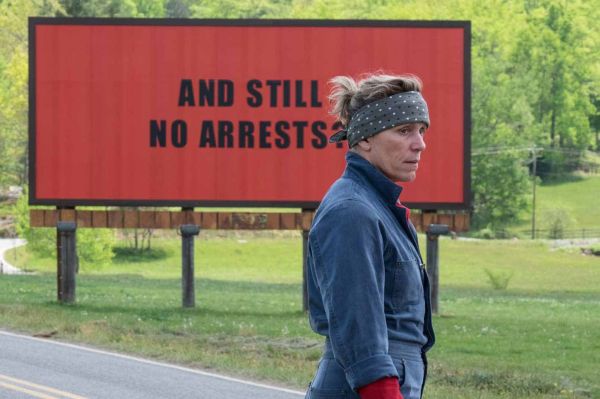
In the fictional town of Ebbing, Missouri, Mildred Hayes, whose daughter Angela was raped and murdered seven months earlier, grows frustrated with the stalled investigation and rents three dilapidated billboards on the outskirts of town for one year. She has them painted with the messages “Raped While Dying,” “And Still No Arrests?,” and “How Come, Chief Willoughby?”
The billboards provoke the townspeople, especially the locally respected police chief Bill Willoughby and his subordinate Jason Dixon. Willoughby, who makes no secret of his terminal pancreatic cancer, tries to persuade Mildred to take the billboards down, but she refuses. As tension rises in the town, personal acts of retaliation and violence cascade, and events begin to spiral in unexpected directions.
Commentary
Production Background
In the late 1990s, while traveling through the American South on a Greyhound bus, McDonagh saw a group of billboards near Vidor, Texas, that denounced the police for having “botched” a case. Although they had actually been put up by the victim’s father, McDonagh felt “intense anger, pain, and tragedy,” and the image stayed with him for a long time. After approximately ten years of development, he reimagined the person erecting the billboards as a mother and completed a screenplay centered on a strong female protagonist.
For the casting, the role of Mildred was written from the outset with Frances McDormand in mind. McDormand suggested that, given her age, it would be more natural for the character to be the grandmother, but McDonagh prioritized the intensity of the mother-daughter relationship; she ultimately accepted the part after persuasion from her husband, Joel Coen. The role of Dixon was written for Sam Rockwell. McDormand used John Wayne as a reference point for her performance, while Rockwell looked to Lee Marvin.
Principal photography took place over approximately 33 days beginning in May 2016 in western North Carolina (Sylva, Black Mountain, Dillsboro, and elsewhere). The main reason for choosing North Carolina rather than Missouri was tax incentives. The billboards were actually erected in a pasture near Black Mountain and were sometimes covered during the shoot out of consideration for local residents. The police station was created by converting a furniture store on Sylva’s Main Street.
Characteristics
The film does not fit neatly into a narrow genre. While taking the form of a crime drama, it layers black-comic timing and verbal wit with the imagery of a Western-style moral wilderness. McDonagh’s theatrical dialogue technique—ruthlessly laced with venom yet capable of piercing emotional nuance—runs throughout. No character fits a simple binary of good and evil; those who commit violence and those who claim justice are both portrayed as wounded and contradictory beings.
Cinematography and Visual Style
Cinematographer Ben Davis adopted an approach that prioritizes dialogue and performance while restraining excessive visual effects. The striking graphic of black lettering on a red background for the billboards forms the visual center of the narrative and heightens the contrast with the everyday landscape of the town. The fire sequences (the arson of the police station and the burning of the billboards) were carefully prepared key scenes, and the sequence in which Dixon assaults the advertising office was shot in a continuous take.
Locations
Although the story is set in the fictional town of Ebbing, Missouri, the actual filming took place in the mountainous region of western North Carolina. Sylva’s Main Street served as the center of the town, while the area near Black Mountain provided the location for the billboards. The closed nature of the small town and the mildness of the landscape stand in contrast to the violence of the story.
Music
The score is by Carter Burwell. He employed a folk-inflected American Midwestern sound based on guitar and mandolin, supporting the emotion without over-explaining it and remaining restrained. Burwell himself has remarked that “the screenplay and performances would work even without music,” while also noting that the music’s role is to evoke empathy for the characters in scenes of violence and hostility. Existing songs by ABBA, Joan Baez, and others are also used in the film.
Thematic Analysis
The central themes of the film are the cycles of anger and justice, forgiveness and violence. Mildred’s erection of the billboards is both a legitimate protest against an unsolved crime and an act that destroys the balance of the community. Willoughby is portrayed as a symbol of the “good policeman,” yet he exits the story by choosing death, while Dixon appears as a racist and violent officer but undergoes a certain transformation as the narrative progresses. That transformation, however, is neither complete “atonement” nor “redemption,” and remains ambiguous.
The depiction of racial issues and police violence drew criticism from the time of the film’s release. Some critics pointed to the fact that while the police treatment of Black victims forms part of the background, the central emotional focus remains on white characters, and to the structure that allows room for empathy with a violent officer, describing these as a “trivialization of the problem” or “excessive humanization.” McDonagh’s intention was to reject binary notions of good and evil and to depict the reality of wounded people harming one another, but the ethical balance of that approach is evaluated very differently depending on the viewer.
In addition, Mildred’s guilt over her daughter’s death (the memory of having said “I hope you get raped” in their final argument) forms the emotional core of the story. The paradox that acts seeking justice do not necessarily achieve justice and can sometimes generate new injustice runs through to the ending.
Release and Reception
The film won the Best Screenplay award at the Venice International Film Festival and the People’s Choice Award at the Toronto International Film Festival, becoming a leading contender in awards season. At the 90th Academy Awards it received seven nominations, including Best Picture, and won Best Actress and Best Supporting Actor. It took four Golden Globe Awards (Best Motion Picture – Drama, Best Actress, Best Supporting Actor, and Best Screenplay) and five BAFTA Awards. It was also a commercial success, reaching approximately $162 million in worldwide box-office gross.
Critics almost uniformly praised the wit of the screenplay and the depth of the performances, while debate over the handling of race and violence continued after release. On Rotten Tomatoes the film holds a critics’ score of around 90 percent (average rating around 8.4/10), and on Metacritic a score of around 88, maintaining overall high critical standing.
Historical Position
The film is frequently cited as evidence of McDonagh’s maturity as a filmmaker and as a work set against the backdrop of social division and distrust of police institutions in late-2010s America. Its refusal to identify the perpetrator or provide resolution continues to be discussed as a deliberate betrayal of genre expectations.
Home Media
In the United States, digital distribution began on February 13, 2018, from Fox Home Entertainment, followed by the release of 4K Ultra HD Blu-ray, Blu-ray, and DVD on February 27 of the same year. Special features include the making-of featurette “Crucify ’Em: The Making of Three Billboards” and McDonagh’s short film “Six Shooter” (2004, Academy Award winner for Best Live Action Short Film).
In the United Kingdom, digital distribution began on May 7, 2018, with Blu-ray and DVD released on May 21. 4K Ultra HD Blu-ray was also released around the same time, and a Zavvi exclusive SteelBook edition appeared later (November 2019).
In Japan, a two-disc Blu-ray & DVD set was released on June 2, 2018, by 20th Century Fox Home Entertainment. Special features include deleted scenes, a making-of feature, the short film “Six Shooter”, a still gallery, and theatrical trailers. A single-disc Blu-ray (around November 3, 2018) and a 4K Ultra HD Blu-ray released by Walt Disney Studios Japan (around May 26, 2021) later entered the market.
In Australia, DVD and Blu-ray were released around May 16, 2018. In Germany and other European countries, packages including 4K Ultra HD Blu-ray were rolled out around June 2018.
Search Link
Cross-Search for “Three Billboards” on JustWatch
Search for “Three Billboards” on Amazon.com
Plot Synopsis (Spoilers)
Erection of the Billboards
In the fictional town of Ebbing, Missouri, seven months earlier the teenage daughter Angela was raped, murdered, and her body set on fire; the case remains unsolved. Her mother, Mildred Hayes, angry at the stalled investigation, rents three dilapidated billboards standing along a sparsely traveled road on the outskirts of town from advertising agent Red Welby for one year. She pays $5,000 in advance for the first month, and the billboards are painted in sequence with “Raped While Dying,” “And Still No Arrests?,” and “How Come, Chief Willoughby?”
The first person to discover the billboards is local police officer Jason Dixon. He reports them to Chief Willoughby. Willoughby, who has made no secret of his terminal pancreatic cancer, is unsettled that the billboards single him out by name, yet he visits Mildred and tries to persuade her. Mildred refuses to yield and declares, “The police are too busy torturing Black people to bother solving actual crime.”
Town Backlash and Personal Conflicts
The billboards offend many townspeople. Mildred’s dentist, sympathetic to Willoughby, menaces her during a treatment. In retaliation, Mildred drills a hole through the nail of his thumb. Willoughby summons her for questioning, but during the interview he coughs up blood that sprays onto her face. He immediately has her released, admits himself to hospital, but soon checks himself out against medical advice.
Mildred’s relationship with her son Robbie deteriorates further. She is tormented by the memory of having said “I hope you get raped” during their final argument with Angela. Her ex-husband Charlie (a former police officer and violent man) visits to criticize the billboards and reveals that, shortly before Angela’s murder, he had refused her request to come and live with him. Following his mother’s advice, Dixon arrests Mildred’s friend, the Black woman Denise, on a trivial drug-possession charge in order to pressure Mildred.
Willoughby’s Death
Realizing his death is imminent, Willoughby spends a peaceful day with his wife Anne and their two daughters. Not wanting his family to watch him suffer, he goes to the barn after they have gone to sleep, puts a gun to his head, and shoots himself. He leaves several letters, one of them addressed to Mildred. Anne delivers it. In the letter Willoughby tells Mildred that the billboards were not the cause of his suicide, that he had genuinely tried to solve Angela’s case, and that he had arranged to pay for the billboards to remain up for another month at his own expense.
Learning of Willoughby’s death, Dixon flies into a rage, storms into Red’s office, and throws him out of a second-story window. The assault is witnessed by the new chief, Abercrombie, who fires Dixon.
Cycle of Retaliation
The billboards are destroyed by arson. Believing the police station to be empty, Mildred throws Molotov cocktails into it and sets it on fire. At that moment, however, Dixon is inside reading the letter Willoughby left for him. The letter advises him to “discard hate and embrace love; then you can become a detective.” Dixon escapes the flames carrying Angela’s case file. Passing by, James (an acquaintance of Mildred who has feelings for her and has dwarfism) extinguishes Dixon’s burning clothes and provides Mildred with an alibi.
In the hospital, Dixon apologizes to Red, with whom he shares a room. Jerome, one of the workers who put up the billboards, brings Mildred a set of replacement panels, and she restores them.
Turning Point and Ending
After being discharged, Dixon overhears in a bar a man who had previously menaced Mildred bragging about having raped a girl in the same manner as Angela. He notes the Idaho license-plate number, scratches the man’s face to obtain a DNA sample, and passively accepts the beating that follows.
Mildred goes on a date with James to thank him. Charlie appears with his nineteen-year-old girlfriend Penelope and confesses that he was the one who burned the billboards while drunk. Realizing she retaliated against the wrong target, Mildred becomes agitated and abruptly ends the date. James mistakenly believes Mildred is ashamed to be seen with him and leaves in anger.
Dixon is informed by Abercrombie of the DNA results: the man is not Angela’s killer (he was stationed overseas at the time of the crime, and the DNA does not match). Still believing the man is likely guilty of another rape, Dixon tells Mildred the facts, and the two decide to go to Idaho to kill him.
In the car, Mildred confesses that she was the one who set fire to the police station. Dixon replies that he had already figured as much. They express mutual uncertainty about whether they will really kill the man, yet say they can decide along the way, and drive off. The story ends by sending the two on an uncertain journey of justice, with the perpetrator still unidentified.