







































































- Overview
- Plot Summary
- Author Biography
- On Yoknapatawpha
- Background of Composition
- On the Title
- Style
- Structure
- Thematic Analysis
- Bibliographical Information (English Original)
- Translations
- Reception
- Influence
- Characters
- Chronology
- Search Link
- Full E-text Available on the Internet Archive
- Synopsis (Contains Spoilers)
Overview
“Absalom, Absalom!” is a novel published in 1936 by the American writer William Faulkner. Set in Yoknapatawpha County, Mississippi (a fictional place), it depicts the rise and fall of Thomas Sutpen and his family—a man of poor origins who sought to build a great plantation—through multilayered recollections and conjectures by multiple narrators. Taking as its themes Southern society before and after the Civil War, race, class, patriarchy, and the uncertainty of memory and history, it is regarded as one of the central works in Faulkner’s Yoknapatawpha saga.
This work refuses a single linear plot. Events are presented fragmentarily, moving back and forth in time, and the discrepancies in interpretation and the conjectures of each narrator themselves constitute the story. Readers are compelled not to grasp the “truth” of the Sutpen family with certainty, but to participate in the process of narration itself. Modernist techniques such as experimental long sentences, stream of consciousness, and multilayered perspectives are bound together with a narrative of Southern Gothic violence and destiny. At the time of publication, opinions were divided because of its difficulty, but it later came to be regarded as one of Faulkner’s masterpieces and, further, as one of the pinnacles of twentieth-century American literature.
Plot Summary
In 1909, in Jefferson, Mississippi, the elderly spinster Rosa Coldfield summons the young man Quentin Compson, who is about to enter Harvard University, and delivers a long narration about Thomas Sutpen. Sutpen appeared suddenly in the town in 1833, acquired about 100 square miles of land, built a plantation called “Sutpen’s Hundred,” married Rosa’s sister Ellen, and had two children, Henry and Judith. Henry’s engagement between Charles Bon, whom he had met at university, and Judith ends with Henry shooting Bon dead. The Civil War, Sutpen’s return and decline, and Rosa’s own humiliating experiences are related.
Quentin hears further accounts from his father Jason Compson and, in his room at Harvard, reconstructs the story together with his Canadian roommate Shreve. Sutpen’s first marriage in Haiti, the existence of his mixed-race son Bon, Henry’s motive for killing Bon, and Sutpen’s “design” and its collapse emerge through the overlay of conjecture and memory. The narration ultimately leads to the discovery of Henry hiding in the ruined Sutpen mansion and to the end brought about by fire.
Author Biography
William Cuthbert Faulkner (September 25, 1897 – July 6, 1962) was born in New Albany, Mississippi, and raised in Oxford. Belonging to a family whose great-grandfather had been a soldier, railroad entrepreneur, and writer during the Civil War period, he grew up intimately acquainted with the memory of the South’s defeat and decline. He left high school, enlisted in the British Royal Air Force in Canada (he did not see combat because the war ended), attended the University of Mississippi for a short time, and then began writing.
In the 1920s he associated with Sherwood Anderson and others in New Orleans and made his debut in 1926 with “Soldiers’ Pay.” From “The Sound and the Fury” in 1929 onward, he published a series of works set in Yoknapatawpha County, deepening his experimental narration and his exploration of Southern history and psychology. After “As I Lay Dying” (1930), “Sanctuary” (1931), and “Light in August” (1932), he published “Absalom, Absalom!” in 1936. He received the Nobel Prize in Literature in 1949, won the Pulitzer Prize twice, and died in Byhalia, Mississippi, in 1962.
On Yoknapatawpha
Yoknapatawpha County is a fictional county in Mississippi created by Faulkner. Modeled on the actual Lafayette County and Oxford, it is set as covering about 2,400 square miles with a population of about 15,000. “Absalom, Absalom!” is the first work to which a map and chronology of this world were appended. Faulkner described himself as “sole owner and proprietor,” and developed the stories of multiple families—the Compsons, Sartorises, Sutpens, Snopeses, and others—across works.
Yoknapatawpha functions not merely as a setting but as a space in which Southern history, myth, and memory accumulate. The strong interconnections among works are evident in the fact that Quentin Compson from “The Sound and the Fury” reappears as a narrator in this novel. Sutpen’s “design” and its collapse are often read as an allegory of the fate of the South as a whole.
Background of Composition
Faulkner began working on the conception of this novel around 1934 and completed it in 1935–1936, interrupting the work at one point to write “Pylon” (1935). The period of composition coincided with personal hardships (the death of his brother Dean in a plane crash, financial difficulties, and drinking), giving the work high emotional intensity. The mid-1930s was the period when Faulkner most advanced his modernist techniques, extending the multiple perspectives and dismantling of time established in “The Sound and the Fury” and “Light in August” to historical narration itself.
From a viewpoint roughly seventy years after the Civil War, the work reexamines the Southern “design” founded on slavery and the racial order. Faulkner himself stated that the curse under which the South labors is slavery, and that Sutpen’s flaw was that he did not regard himself as a member of the human family.
On the Title
The title derives from Absalom, who appears in the Old Testament book of 2 Samuel. Absalom, son of King David, killed his half-brother Amnon in anger after Amnon had violated his sister Tamar, and was eventually killed after rebelling against his father. David’s lament—“O my son Absalom, my son, my son Absalom!”—symbolizes the tragedy of father and son, fratricide, and the crisis of a dynasty. In this novel, the relationships between Henry and Bon, and between Sutpen and Bon, as well as the collapse of the Southern “house,” resonate with this story.
Style
Faulkner’s style is characterized by long, intricate sentences, nested parentheses and relative clauses, stream of consciousness, and repetition and accumulation. Chapter 6 contains a sentence of 1,288 words that was at one time registered in the Guinness records. The narration does not proceed linearly but circles repeatedly around the same events, gradually accumulating information. The style itself embodies the uncertainty of memory, the multiplicity of narration, and the process of reconstructing history.
Southern colloquial rhythms, Elizabethan grandeur, and dark Gothic imagery coexist. The difficulty is intentional and serves as a device that transforms the reader from a passive recipient into an active interpreter.
Structure
The story is framed mainly in three layers: Rosa’s narration in 1909, the narration of Quentin’s father, and the joint reconstruction by Quentin and Shreve. The chronology moves back and forth from the 1830s to around 1910, presenting fragmentarily Sutpen’s origins, the Haiti period, his rise in Jefferson, the war, and the collapse. A chronology, a genealogy, and a map of Yoknapatawpha are appended, assisting the reader’s reconstruction.
The accounts of the narrators are all uncertain. Rosa is dominated by hatred, Mr. Compson adds fatalistic interpretations, and Quentin and Shreve fill gaps in the evidence with imagination. Truth does not belong to any single narration but resides in the interweaving of the narrations themselves.
Thematic Analysis
The central theme is ambition and the collapse of the “design.” Sutpen seeks to overcome his poor origins and build a dynasty of pure blood, but his obsession with racial purity destroys him. The rejection of Bon functions as an allegory of the South’s refusal to acknowledge the legacy of slavery.
The myth of race and blood forms the core of this work. Henry accepts the possibility of incest yet proceeds to murder when he learns of Bon’s mixed blood. This order of priority reveals the depth of the Southern racial order. The uncertainty of memory and history is also important. The past is made present only through narration, and narration always includes bias and imagination. Quentin’s final words—“I don’t hate it”—close the novel while leaving the ambivalence of love and hatred.
Patriarchy, the silence and oppression of women, class, and the decline of the South after the Civil War are also depicted through the collapse of the Sutpen family. The act of narration itself reenacts the curse of the South that continues to live in the past.
Bibliographical Information (English Original)
- Original title: Absalom, Absalom!
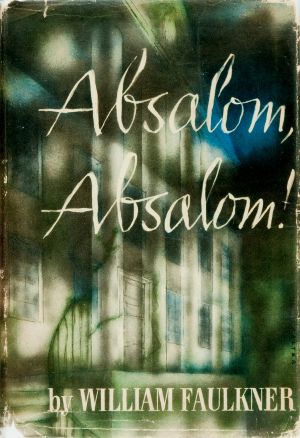
- First publication: Random House (New York, October 26, 1936), 384 pages
- Cover design: George Salter
- Genre: Southern Gothic, modernist novel
- Structure: In addition to the main text, a chronology, a genealogy, and a map of Yoknapatawpha County are appended (placement varies by edition)
- Principal corrected edition: Corrected Text, edited by Noel Polk (Vintage International, 1986, etc.)
Translations
This work has been widely translated into the world’s major languages. French translations appeared in the 1950s (Raymond Girard and others), German translations from the late 1940s, and Spanish translations circulated from around 1950, becoming one of the foundations of Faulkner’s reception in Latin America. It has also been translated into Italian, Russian, Chinese, Japanese, Portuguese, Hebrew, Korean, and other languages.
In the translations into each language, the handling of long sentences and the reproduction of colloquial speech often differ greatly according to the translator.
Reception
At the time of publication, the overly complex style and redundant narration were criticized, and sales were poor. After the Second World War, reevaluation advanced through reception in France and the publication of the anthology “The Portable Faulkner” (1946), and its status was established after the Nobel Prize. Today it is widely regarded as Faulkner’s masterpiece or as one of the most important novels of the twentieth century. In 2009 a panel for “Oxford American” selected it as “the best Southern novel of all time.”
Criticism of its difficulty remains, but the connection between experimental narration and historical consciousness, and its direct engagement with the problem of race, form the center of its evaluation.
Influence
This work and Faulkner’s body of writings have exerted a wide-ranging influence on world literature. Gabriel García Márquez was strongly aware of Faulkner and incorporated into his own work the multiplicity of narration and mythic historical narration rooted in place. Across the entire “Boom” generation of Latin American literature, Faulknerian senses of time and the mythologizing of locality resonate.
In Japan, Nakagami Kenji took Faulkner as an important point of reference in works set in the discriminated-against community of his origin, and influence on Ōe Kenzaburō has also been noted.
In African American literature, Toni Morrison and others critically inherited and transformed Faulkner’s representation of the South. Motifs such as the multiplicity of narration, the constructedness of history, and the myth of blood and land have widely resonated in subsequent American fiction and world literature.
Characters
Thomas Sutpen: The central figure of the story. Born a poor white in the mountains of western Virginia, he formed the “design” of building a dynasty after the formative experience, in his boyhood, of being insulted by a Black servant at a plantation. He became an overseer in Haiti, married Eulalia, the daughter of a plantation owner, and had a son, Charles Bon, but abandoned them upon learning of his wife’s mixed blood. Appearing in Jefferson in 1833, he acquired about 100 square miles of land from Native Americans and built “Sutpen’s Hundred.” Using a French architect and slaves, he raised a great mansion, married Ellen Coldfield, and had Henry and Judith. With a slave woman he had Clytie (Clytemnestra). He served as a colonel in the Civil War and declined afterward. Having rejected the daughter born of his relationship with Milly Jones, he was killed by Wash Jones (1869). He is narrated as a cold, strong-willed figure lacking human sympathy.
Charles Bon: Son of Sutpen and Eulalia. Mixed-race. Depicted as a refined figure. He formed a friendship with Henry at university and became engaged to Judith. Seeking recognition from Sutpen and being refused, he was shot dead by Henry (1865). He is the axis of the tragedy in which the taboos of incest and race intersect.
Henry Sutpen: Son of Sutpen and Ellen. He accepted Bon as a friend and did not break off the relationship even upon learning of the possibility of incest, but killed him upon learning of Bon’s mixed blood. After the war he lived in hiding at the mansion and died with Clytie in the fire of 1910.
Judith Sutpen: Henry’s sister. She loved Bon and continued to preserve his memory after his death. Possessing a strong will, she is compelled to silence amid the family’s collapse. She later dies of illness while nursing Charles Etienne.
Rosa Coldfield: Ellen’s sister. She calls Sutpen a “demon” and narrates with hatred. After Ellen’s death she received a proposal from Sutpen, rejected the engagement upon receiving a humiliating proposition, and lived for forty-three years in solitude and resentment. One of the narrators in 1909.
Quentin Compson: A young man who also appears in “The Sound and the Fury.” In 1909 he listens to Rosa’s narration, overlays his father’s accounts, and reconstructs the story with Shreve at Harvard. He is trapped by the Southern past and torn between love and hatred.
Jason Compson III (Mr. Compson): Quentin’s father. He adds fatalistic interpretations and narrates the story of Sutpen.
General Compson: Quentin’s grandfather. Regarded as Sutpen’s only friend.
Clytie (Clytemnestra): Daughter of Sutpen and a slave woman. She remains at the mansion, hides Henry, and ultimately sets the fire and dies herself.
Jim Bond: Son of Charles Etienne de St. Valery Bon. Mentally impaired, he remains as the last bearer of the Sutpen blood.
Wash Jones: A poor white. Having served Sutpen, he kills him after Sutpen rejects Milly, his granddaughter, whom he had impregnated.
Shreve McCannon: Quentin’s roommate at Harvard. A Canadian and an outsider to the South, he actively participates in the reconstruction of the story.
Ellen Coldfield: Sutpen’s second wife. Mother of Henry and Judith.
Others who support the story include Eulalia Bon, Goodhue Coldfield, the French architect, Milly Jones, and Charles Etienne.
Chronology
Based on the chronology Faulkner himself recorded as an appendix to the first edition, the principal events are arranged as follows (there is slight variation in the dating of details according to the edition).
| Year | Event |
|---|---|
| 1807 | Thomas Sutpen is born in the mountains of western Virginia. |
| 1817 | The Sutpen family moves down into Tidewater Virginia. |
| 1820 | Sutpen runs away from home at the age of fourteen. |
| 1827 | Marries his first wife in Haiti. |
| 1829 | Charles Bon is born. |
| 1831 | Sutpen learns of his wife’s mixed blood and repudiates wife and child. |
| 1833 | Sutpen appears in Jefferson, Yoknapatawpha County, acquires land, and begins building his house. |
| 1834 | Clytie is born. |
| 1838 | Sutpen marries Ellen Coldfield. |
| 1839 | Henry Sutpen is born. |
| 1841 | Judith Sutpen is born. |
| 1845 | Rosa Coldfield is born. |
| 1859–60 | Henry meets Bon at university and brings him home for Christmas to Sutpen’s Hundred. The relationship between Bon and Judith deepens. |
| 1860 | Sutpen reveals Bon’s identity to Henry; Henry repudiates his birthright and departs with Bon. |
| 1861 | The Civil War breaks out. Sutpen, Henry, and Bon go to war. |
| 1862 | Ellen dies. |
| 1864 | Goodhue Coldfield dies. |
| 1865 | Henry shoots Bon dead at the gates of Sutpen’s Hundred. Rosa moves to the mansion. |
| 1866 | Sutpen returns. He proposes to Rosa but makes a humiliating proposition, and Rosa leaves. |
| 1869 | Milly gives birth to a daughter. Because Sutpen rejects her, Wash Jones kills Sutpen. |
| c. 1870– | Bon’s mixed-race wife and son Charles Etienne visit the mansion. Etienne later lives at the mansion. |
| 1884 | Judith and Charles Etienne die of disease. |
| 1909 | Rosa summons Quentin and narrates. The two visit Sutpen’s Hundred and discover the hidden Henry. |
| 1910 | Rosa summons an ambulance; Clytie sets the fire. Henry and Clytie burn to death. Rosa also dies soon afterward. |
Search Link
Search for “William Faulkner Absalom, Absalom!” on Amazon.com
Full E-text Available on the Internet Archive

Synopsis (Contains Spoilers)
September 1909, Jefferson, Mississippi. The elderly spinster Rosa Coldfield invites Quentin Compson, who is about to enter Harvard University, into her room and begins to narrate the story of Thomas Sutpen. The room is closed off, and the scent of wisteria drifts. Rosa calls Sutpen a “demon” and relates how a stranger who appeared in the town in 1833 suddenly acquired land, built a huge mansion, and married her sister Ellen, making use of the family name. Henry and Judith are born; Henry becomes close to Charles Bon at university, and Bon becomes engaged to Judith. During the Civil War Henry serves with Bon and, at the end of the war, shoots Bon dead at the gates of Sutpen’s Hundred. Judith waits in her wedding dress.
Rosa also relates her own experience. After Ellen’s death Sutpen proposes to Rosa but makes the humiliating proposition that they first produce a male child and then marry; Rosa leaves. After the war Sutpen enters into a relationship with Milly, the granddaughter of the poor white Wash Jones, and rejects her because the child born is a daughter. Wash kills Sutpen with a scythe, and the situation reaches a still more tragic conclusion.
Quentin hears further accounts from his father. The father relates Sutpen’s origins. Growing up in the poor mountains, the experience of being turned away by a Black servant at the gate of a plantation gave birth to the “design” of building a dynasty of pure blood. Becoming an overseer in Haiti, he suppressed a rebellion, married the owner’s daughter, and obtained a son, Bon, but abandoned them upon learning of his wife’s mixed blood. In Jefferson he executes a new “design,” builds a mansion with slaves and an architect, and marries into the Coldfield family to obtain legitimacy.
In a cold room at Harvard, Quentin reconstructs the story with Shreve. The two fill gaps in the evidence with imagination and conjecture that Bon is Sutpen’s son, that Henry accepted incest yet could not accept mixed blood, and that Sutpen’s refusal to recognize Bon is the axis of the entire tragedy. Bon seeks recognition; Henry learns of his father’s refusal; ultimately the racial taboo precipitates the murder.
Quentin visits Sutpen’s Hundred with Rosa. It is discovered that Henry is living in hiding in the ruined mansion, protected by Clytie. About three months later, when Rosa returns with an ambulance, Clytie, mistaking them for the authorities, sets the fire and burns to death together with Henry. Only Jim Bond survives, and the Sutpen blood remains in a mixed-race descendant with disabilities.
The story ends with Quentin repeating to Shreve, “I don’t hate it.” The past continues to live through narration, and Quentin himself is drawn into that curse. Sutpen’s “design” was based on racial purity and patriarchal domination, but precisely that principle destroyed him. Southern history itself continues to be forever reconstructed amid the multiplicity of narration and the uncertainty of memory.