




















































































Overview
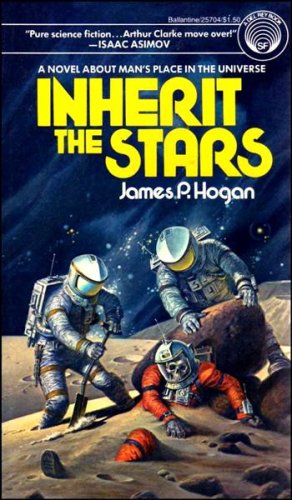
“Inherit the Stars“ is the debut novel by British science-fiction writer James P. Hogan . It is widely regarded as a masterpiece of scientific mystery in SF.
The story begins with the discovery of a human corpse in a spacesuit on the Moon. However, scientific examination reveals that the body died more than fifty thousand years ago.
To solve this astonishing mystery, the United Nations Space Authority gathers scientists from multiple disciplines. Through research drawing on physics, biology, linguistics, and planetary science, a shocking truth about the origin of humanity gradually emerges.
The novel places its emphasis not on character drama but on ideas and logical deduction. The narrative unfolds as a scientific investigation, and the structure resembles that of a pure mystery novel.
About the Author
James P. Hogan (1941–2010) was a British science-fiction writer. Before becoming an author he worked as an electronics engineer.
His works belong to the tradition of hard science fiction, characterized by rigorous scientific reasoning.
His major works are the “Giants” series, such as “Inherit the Stars” (1977) , “The Gentle Giants of Ganymede” (1978), and “Giants’ Star” (1981).
The “Giants” series is celebrated for its grand cosmic history and its exploration of the mystery of human origins.
Publication History
The first edition was published by Del Rey Books in the United Kingdom in 1977.
The United States edition was published by Baen Books in 1978.
Commentary
The most remarkable feature of the novel is its methodical accumulation of scientific evidence to solve a vast historical mystery.
Knowledge from physics, evolutionary biology, linguistics, and planetary science is combined in a logical chain of deductions.
This approach invites comparison with works such as “The Caves of Steel” (1953) by Isaac Asimov and “Golden Fleece” (1990) by Robert J. Sawyer.
The novel is widely regarded as a rare work in which the grand scale of science fiction and the logic of detective fiction are perfectly integrated.
Sequels
“Inherit the Stars” later became the first volume of the “Giants” series.
- “The Gentle Giants of Ganymede” (1978)
- “Giants’ Star” (1981)
- “Entoverse” (1991)
- “Mission to Minerva” (2005)
These sequels further explore the mysteries of the aliens called the Lunarians and the Ganymeans, and the deeper history of the Solar System.
Manga Adaptation
A manga adaptation of this work by Japanese manga artist Yukinobu Hoshino was serialized in the manga magazine “Big Comic” from 2011 to 2012 and later published by Shogakukan in four collected volumes.
This manga version is an adaptation that also incorporates episodes from the sequels “The Gentle Giants of Ganymede” and “Giants’ Star.”
Search Link
Search for “James P. Hogan Inherit the Stars” on Amazon.com
Main Characters
Victor Hunt
A British nuclear physicist and the central figure of the story. He becomes the coordinator of the Lunarian research project.
Gregg Caldwell
Director of NAVCOM (UN Space Command Navigation and Communication) and leader of the investigation.
Lyn Garland
Caldwell’s secretary, whose analytical insight contributes to the investigation.
Christian Danchekker
A biologist who strongly argues that the Lunarians originated on Earth.
Don Madsen
A linguist responsible for deciphering Lunarian language and records.
Francis Forsythe-Scott
An executive director of Metadyne.
Rob Gray
An engineer at Metadyne and collaborator of Hunt.
Charlie
The corpse in a spacesuit discovered on the Moon; a member of the Lunarian race.
Plot (Spoilers)
Prologue
The story begins with a scene in which two men flee across a barren landscape on a planet in the distant past.
One of the men, Koriel, leaves his companion—who can no longer walk—in a cave and sets out to bring back help.
The Body on the Moon
The main story begins when a corpse in a spacesuit is discovered on the Moon.
The body, nicknamed “Charlie,” is transported to Earth for examination.
Scientists discover several astonishing facts:
- The body is biologically almost identical to modern humans
- The death occurred about fifty thousand years ago
- The equipment found with the body is technologically advanced
These findings challenge all existing knowledge of human history.
Evidence of the Lunarian Civilization
Further exploration uncovers more artifacts and remains beneath the lunar surface.
Analysis of Charlie’s notebook and equipment reveals that he belonged to a civilization known as the Lunarians.
The researchers propose various hypotheses:
- A lost advanced civilization on Earth
- An origin on another planet such as Mars
- A human colonial civilization
However, no decisive evidence is found.
The Planet Minerva
Eventually researchers conclude that an Earth-like planet once existed in the Solar System.
This planet, named Minerva, orbited between Mars and Jupiter.
The Lunarians were the inhabitants of Minerva, and their civilization may have destroyed the planet in a catastrophic nuclear war fifty thousand years ago, leaving behind the asteroid belt.
The Ganymede Discovery
On Jupiter’s moon Ganymede, explorers discover a gigantic alien spacecraft and the skeletons of an extraterrestrial species called the Ganymeans.
Evidence suggests that these beings may have visited Minerva twenty-five million years earlier.
Hunt’s Hypothesis
Hunt proposes a bold hypothesis that integrates all known evidence:
- The Solar System once had a tenth planet, Minerva
- The Moon that now orbits Earth was once Minerva’s satellite
- Fifty thousand years ago Minerva exploded in a massive war
- Its moon was captured by Earth’s gravity
In other words, Earth’s Moon was originally the moon of Minerva.
Ancestors of Humans
Biological research leads to an even more startling possibility.
Human beings did not evolve on Earth but on Minerva.
After the destruction of their planet, surviving Lunarians migrated to Earth and became the ancestors of modern humanity.