













































































Overview
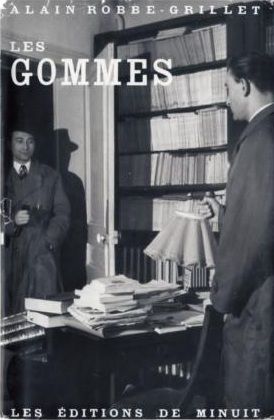
“The Erasers” (French original title: Les Gommes) is a novel by the French writer Alain Robbe-Grillet, published in 1953 by Les Éditions de Minuit. Set in a fictional port town (or a provincial city along a canal), it depicts the process by which Special Investigator Wallas pursues the truth of a “murder” that appears to be a political assassination. Although it takes the form of an inverted mystery (in which the crime is shown first and the investigation follows), it is a parody based on Sophocles’ “Oedipus Rex” and a work that thoroughly pursues the circularity of causality and the absurd.
This work is positioned as the pioneer of the Nouveau Roman. It rejects the depiction of characters’ inner lives and psychology as well as linear narrative progression, instead foregrounding the surface description of objects, shifts in point of view, the circularity of time, and the repetition of space. It is known for having been highly praised by Roland Barthes as “objective literature,” and it strongly resonates with the anti-humanist thought that followed structuralism. The technique of utilizing the conventions of the detective novel while dismantling them from within functions as a device that transforms the reader from a passive recipient into an active interpreter.
Plot Summary
The story begins with a shooting that occurs at 7:30 p.m. one night at the home of economics professor Daniel Dupont. It appears to be part of a series of assassinations by a terrorist organization, but the perpetrator, Garinati, misses his target, and Dupont is only wounded in the arm. With the cooperation of Doctor Juard, Dupont fakes his death. Special Investigator Wallas is dispatched and begins investigating the case, which has no body.
Wallas walks around the town, gathering testimony from witnesses and those involved while searching for the ideal eraser. As time becomes entangled and the same streets and scenes are repeated, the investigation turns into a labyrinth. Ultimately, when Dupont returns home to retrieve some papers, Wallas mistakes him for the culprit and shoots him dead in what he believes to be self-defense. The case is “completed” at exactly the same time, twenty-four hours after the first gunshot. The roles of detective and culprit are reversed, and the circle is closed.
Author’s Biography
Alain Robbe-Grillet (August 18, 1922 – February 18, 2008) was born in Brest, Brittany. Raised in a family of engineers, he graduated from the Institut National Agronomique and worked as an agricultural engineer in the fields of statistics and plant pathology, spending time in Morocco, Guinea, Martinique, and elsewhere. During the Second World War, he experienced forced labor in Germany.
He began writing in earnest around 1951. His first novel, “A Regicide,” was rejected by Gallimard, but “The Erasers” was published by Minuit and received the Fénéon Prize in 1954. With the support of Roland Barthes, he attracted attention and became a literary advisor at Minuit in 1955. Thereafter he published “The Voyeur” (1955), “Jealousy” (1957), “In the Labyrinth” (1959), and other works, becoming a central figure of the Nouveau Roman. He was also active as a film director and is known for works such as the screenplay for “Last Year at Marienbad” (1961). In 2004 he was elected a member of the Académie Française.
Relation to the Nouveau Roman
“The Erasers” is regarded as the practical starting point of the Nouveau Roman (New Novel), which emerged in France in the 1950s. It rejects the “psychology of characters,” “causal narrative,” and “human-centered attribution of meaning” that traditional novels had taken as premises, and instead foregrounds the description of objects and space themselves. As Barthes pointed out, it transforms the human being from subject into object and thoroughly describes visual surfaces. The stance that Robbe-Grillet himself later theorized in “For a New Novel” (1963) is already clearly present in this work.
Background of Composition
In 1951, while staying in Martinique, Robbe-Grillet fell ill and began working out the conception of this work on the ship returning to France for convalescence; he completed it in Paris. The work was born as an attempt to relativize the privileged status of the human being through the description of objects at a time when existentialist and humanist literature predominated after the war, and it reached publication through his encounter with Jérôme Lindon of Éditions de Minuit.
About the Title
The title “The Erasers” (gommes) refers to the ideal eraser that Wallas searches for as he goes around stationery shops throughout the town. The ideal is one that is neither too soft nor too hard, and that turns to powder and leaves no residue when used. Its brand name is remembered as “a word of three syllables whose second syllable is something like DI,” which suggests “Œdipe” (Oedipus) to the reader. The eraser functions as a metaphor for the erasure of traces, the erasure of memory, and the erasure of the story, while simultaneously serving as a device that implies the correspondence with “Oedipus Rex.”
Style
The style is concise and objective, yet produces complex effects through the repetition of details and shifts in point of view. Characters’ inner lives and psychological motives are scarcely narrated; instead, the shapes, colors, positions, and movements of objects are precisely described. As in the famous description of a tomato cross-section, everyday objects are presented with abnormal detail and refuse the attribution of meaning. Through free indirect discourse, the point of view moves smoothly among the characters, placing the reader in a state of gathering information like the detective while being unable to determine the overall picture. Time does not advance linearly; the same scenes and actions are repeated with subtle differences, embodying the circular structure.
Structure
The framework of a prologue, five chapters, and an epilogue is said to be conscious of the structure of Greek tragedy. Time is limited to roughly twenty-four hours, and space is confined to the limited streets and buildings of the town. The point of view is dispersed among multiple characters (Wallas, Garinati, Dupont, police officials, and others), placing the reader in a position of knowing the main facts of the case earlier than the detective. Yet the narrative refuses the elucidation of the truth or closed attribution of meaning. Repetition and displacement drive the narrative; temporally the circle is closed at the end, but on the level of interpretation it remains open.
Thematic Analysis
The central themes are the absence of fate and free will, the dismantling of the detective novel, and anti-humanism. While borrowing the structure of “Oedipus Rex,” it is not prophecy or oracles but mechanical repetition and chance that complete the tragedy. In the process of searching for the culprit, Wallas himself becomes the culprit. The roles of detective and culprit, victim and perpetrator, are interchangeable, and the privilege of the subject is lost.
The description of objects excludes the human being from the center of meaning. Characters possess no psychological depth and exist only as functions and movements. This style resonates with post-structuralist thought and anticipates the dismantling of the subject and the autonomy of the text. The circularity of time, the labyrinthine quality of space, and the erasure of traces (the eraser) indicate skepticism toward the certainty of history and memory. As a parody of the inverted mystery, it utilizes the genre’s promise of elucidating the truth while thoroughly rendering that elucidation itself futile and absurd.
Bibliographical Information (French Original)
- Original title: Les Gommes
- First edition: Éditions de Minuit (Paris, 1953), approximately 264 pages
- Genre: Nouveau Roman, parody of the inverted mystery, experimental novel
- Award: Fénéon Prize (1954)
- Major reprints: Various editions from Minuit (including the “Double” series)
Translations
The English translation by Richard Howard, “The Erasers” (Grove Press, 1964), has circulated widely. A German translation appeared as early as 1954 under the title “Ein Tag zuviel” by Gerda von Uslar, and was later also published as “Die Radiergummis.” A Spanish translation was issued in 1956 by Seix Barral as “La doble muerte del profesor Dupont,” and later reissued in 1986 by Anagrama as “Las gomas.” An Italian translation by Franco Lucentini, “Le gomme,” was published by Einaudi in 1961. Through these translations into the major European languages, the work played a role in broadening the international recognition of the Nouveau Roman.
Reception
At the time of publication there were comments that it was difficult and criticisms that it was “a novel of objects only,” but it attracted attention through Barthes’s support. As the starting point of the Nouveau Roman, it occupies an important position in literary history. Its experimentation that borrows the form of the detective novel is also valued for blurring the boundary between genre fiction and avant-garde literature. Its manipulation of time and point of view, as well as its anti-humanist gaze, are often discussed in connection with later critical theory.
Influence
This work and Robbe-Grillet’s oeuvre influenced experimental fiction both inside and outside France. The description of objects and the manipulation of point of view connect with later Nouveau Roman writers and with post-structuralist views of literature. In film as well, through Robbe-Grillet’s own directorial works and his collaboration with Alain Resnais, the dismantling of narrative was developed visually. In avant-garde literature and criticism in various countries, it has served as a point of reference when considering the relativization of the subject and the autonomy of the text.
Film Adaptation
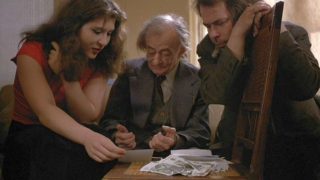
In 1969, the novel was adapted into a Franco-Belgian film co-directed by Lucien Deroisy and René Micha. Claude Titre played the role of Wallas, and the film was screened at the Directors’ Fortnight (Quinzaine des réalisateurs) of the Cannes Film Festival. While it attempted to visually reproduce the circular structure and shifts in point of view of the original work, it did not achieve commercial success.
Characters
- Wallas: Special investigator. He comes to the town to investigate the case. He continues searching for the ideal eraser and ultimately becomes the culprit himself, completing the case. He is testified to resemble Garinati in appearance.
- Daniel Dupont: Economics professor. He is wounded by the gunshot but fakes his death. He is later shot dead by Wallas.
- Garinati: Perpetrator for the terrorist organization. He failed to kill Dupont according to plan.
- Doctor Juard: Cooperates in Dupont’s faked death.
- Others: The police commissioner, witnesses, the woman proprietor of a stationery shop (said to be Dupont’s separated wife), and so on.
Search Link
Search for “Alain Robbe-Grillet The Erasers” on Amazon.com
Synopsis (Contains Spoilers)
At 7:30 p.m. one night, a gunshot rings out in the study of Daniel Dupont’s home. He was the ninth target in a series of assassinations by a terrorist organization, but the perpetrator Garinati misses, and Dupont is only wounded in the arm. With the cooperation of Doctor Juard, Dupont fakes his death, and the newspapers publish an obituary.
Special Investigator Wallas arrives in the town and begins the investigation. There is no body, and the testimonies contradict one another. Wallas walks around the town, visits those involved, and at the same time searches for the ideal eraser. Time becomes entangled, and the same streets and scenes are repeated. The clock seems to have stopped, and the distinction between yesterday and today becomes ambiguous.
As the investigation progresses, Dupont returns home to retrieve papers. Wallas mistakes this for the culprit’s return and shoots Dupont dead in what he believes to be self-defense. The gunshot rings out at exactly the same time, twenty-four hours after the first gunshot. The detective himself becomes the culprit, and the case is “completed.” While the circle is closed, the narrative ends by implying an unending cycle.