
































































































- Overview
- About the Author
- Commentary
- Summary of the Book
- Style and Structure
- Preface
- Chapter 1: Hesiod’s Lament
- Chapter 2: Capitalism’s Metamorphoses
- Chapter 3: Cloud Capital
- Chapter 4: The Rise of the Cloudalists and the Demise of Profit
- Chapter 5: What’s in a Word?
- Chapter 6: Technofeudalism’s Global Impact: The New Cold War
- Chapter 7: Escape from Technofeudalism
- Appendix 1: The Political Economy of Technofeudalism
- Appendix 2: The Madness of Derivatives
- Reception
- General Comments
- Search Link
Overview
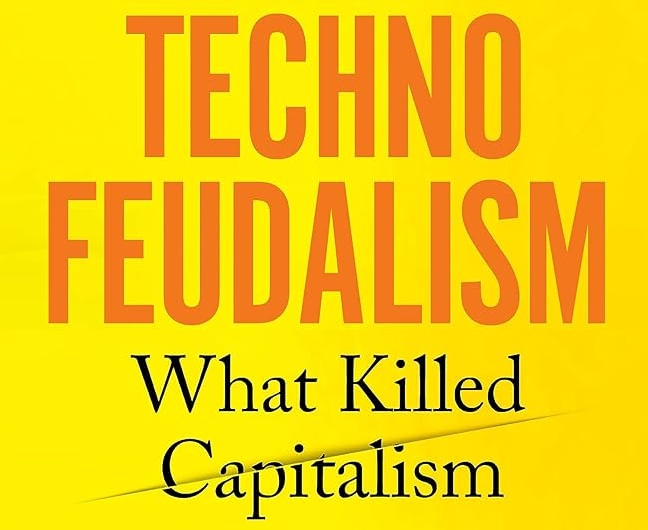
“Technofeudalism: What Killed Capitalism” is a book on economics for general readers by the Greek economist Yanis Varoufakis.
The book was first published in the UK in 2023 by The Bodley Head, an imprint of Penguin Random House. The US edition was published in 2024 by Melville House Publishing.
About the Author
Yanis Varoufakis was born in Athens in 1961. He studied economics in the UK, earning his doctorate from institutions including the University of Essex and the University of Birmingham.
He moved to Australia in 1988, where he taught at the University of Sydney, before returning to Greece in 2000 to teach at the University of Athens.
He became globally known as the Minister of Finance for the Syriza government during the height of the Greek debt crisis (2009–2018), particularly for his opposition to the austerity measures imposed by the EU.
His introductory economics book for the general public, “Talking to My Daughter About the Economy” (2013), has been published in over 25 countries and became a global bestseller.
He describes himself as a libertarian Marxist and is well known for his critiques of globalization, financial capital, and digital capitalism.
Commentary
Summary of the Book
This book analyzes the new phase of capitalism that has emerged since the 2008 financial crisis—and particularly since the 2010s. It posits that digital platform-based capital, owned by Big Tech companies such as GAFAM (Alphabet (Google), Apple, Meta (Facebook), Amazon, and Microsoft), has become the dominant form of the economic system. The author considers this shift as the end of capitalism and the transition to “technofeudalism,” seeking to identify the historical process of this new form of capital, analyze its problems, and propose a prescription for escaping from its domination.
Style and Structure
The book is written in the form of a letter to the author’s father. It serves as a response to a question posed by his father in 1993: how computer networks would change capitalism.
The writing is accessible to general readers without specialized economic knowledge.
The book consists of a Preface, seven chapters, and two appendices.
Preface
The preface outlines the author’s hypothesis that capitalism has transitioned into “technofeudalism” due to the transformation of capital into digital platform-based forms.
The author argues that platforms function like feudal fiefdoms; markets have been replaced by digital trading platforms, and profits have been replaced by “rents” paid to access these platforms and the cloud.
Chapter 1: Hesiod’s Lament
Chapter 1 begins with the author’s memories of being taught by his father about the relationship between humanity and technology, as well as the essence of capitalism. Here, the story of how the author came to form his own thoughts as a libertarian Marxist is told.
Chapter 2: Capitalism’s Metamorphoses
In Chapter 2, as the prehistory leading up to the birth of platform capital, the metamorphoses of capitalism that occurred from the post-WWII period to the 2008 financial crisis is described.
This includes the planned operations of large corporations by a group of experts called the “technostructure” by John Kenneth Galbraith in “The New Industrial State” (1967), the formation of attention markets driven by media advertising, the collapse of the Bretton Woods system in 1971 and the subsequent financialization of capital, and the fact that the vast amount of funds injected by central banks for economic reconstruction after the 2008 financial crisis flowed into Big Tech companies.
The author argues that this series of events weakened traditional market- and profit-centered capitalism and invited the dominance of platform capital.
Chapter 3: Cloud Capital
In Chapter 3, the author explains “cloud capital,” a unique concept of his that refers to what is known as platform capital, as follows:
He explains that in the 2000s, Big Tech privatized the internet, which was previously a public space akin to a “commons.” From the 2010s onward, they cemented their exclusive dominance over search, social networking services (SNS), e-commerce, and cloud services, thereby giving birth to “cloud capital.”
Cloud capital utilizes algorithms to adjust the preferences of platform users and creates desires, thereby modifying behavior and manipulating attention. It effectively turns users into “cloud serfs” who provide free labor—in the form of posts and data contributions—while the capital collects “rent” from them.
Markets, which were once spaces for free trade, have been replaced by closed areas within platforms, and the shared space of the internet has been transformed into “cloud fiefdoms” ruled by a small number of “cloudalists.”
Chapter 4: The Rise of the Cloudalists and the Demise of Profit
The author discusses the process by which the two pillars of capitalism—market competition and profit-seeking—were replaced by platforms and rent-seeking. He positions executives of Big Tech companies as a new ruling class, the “cloudalists.”
Examples include Jeff Bezos (Amazon), Elon Musk (Tesla, SpaceX, X), and Mark Zuckerberg (Meta).
Chapter 5: What’s in a Word?
This chapter defines the unique terminology used in the book, such as “cloud capital,” “cloudalists,” and “technofeudalism,” emphasizing the necessity of using new vocabulary to recognize societal changes.
Chapter 6: Technofeudalism’s Global Impact: The New Cold War
The author views the rivalry between the US and China as a struggle over control of platforms, framing it as a new Cold War. He argues that the global economy has shifted into a structure of division and conflict between two massive cloud empires.
Chapter 7: Escape from Technofeudalism
Chapter 7 is the presentation of the ideals for overcoming technofeudalism and a call for unity to realize them.
According to the author, the key to escaping is the realization of collective ownership of cloud capital.
This chapter concludes with the following slogan, modeled after “The Communist Manifesto” (1848) by Karl Marx and Friedrich Engels:
”Cloud serfs of the world, cloud proles, cloud vassals — unite! You have nothing to lose but your digital chains!”
Appendix 1: The Political Economy of Technofeudalism
This section organizes the technofeudalist hypothesis and its core concepts as economic theory based on classical economics.
Appendix 2: The Madness of Derivatives
This section explains the abnormalities of the derivatives market that contributed to the 2008 financial crisis, and how speculative funds from quantitative easing (QE) contributed to the formation of cloud capital.
Reception
The book has been published in over 25 countries and is widely read by general readers.
Among intellectuals, it has drawn particular attention from the Left and progressive circles. Reviews have appeared in “The Guardian,” “Financial Times,” and “The New Yorker,” and it has been discussed by prominent left-wing figures like Noam Chomsky and Slavoj Žižek.
General Comments
This is a provocative and controversial book.
It is a compelling read for those who share concerns about the monopoly of digital-based platforms by a few Big Tech companies such as GAFAM, the concentration of wealth, data exploitation, and algorithmic control, as well as the economic inequality and the threats to democracy and individual freedom that these issues bring about.
Varoufakis is correct in pointing out that the internet, which began as a distributed public space and was expected to serve as a tool for decentralization, has since transformed into “digital fiefdoms”—private territories effectively controlled by a handful of Big Tech companies.
As of 2026, Google dominates over 90% of the global market share in search. In social media, Meta’s Facebook and Instagram, ByteDance’s TikTok, and X (formerly Twitter) serve as the primary platforms. In e-commerce, Amazon boasts an overwhelming share in developed countries, while Alibaba and Taobao remain the largest players in China. Cloud infrastructure is largely oligopolized by Amazon Web Services (AWS), Microsoft Azure, and Google Cloud. Mobile OS markets are almost entirely split between Android (Google) and iOS (Apple). Video platforms are dominated by YouTube (Google), TikTok, and Netflix. Music streaming is dominated by Spotify, which maintains its position as the world’s largest platform, followed by Apple Music, Amazon Music, and YouTube Music. In China, Tencent Music (including QQ Music) holds an overwhelming market share.
Varoufakis’s explanation, which frames such dominance by platform capital as a form of feudalism, is intriguing as a metaphor.
We use these platforms simply because they are convenient, but the price we pay is the free provision of our personal data, which Big Tech exploits for profit. In essence, we are being exploited for our data by these companies.
However, Varoufakis’s arguments in this book tend to lean heavily toward political agitation from a libertarian Marxist perspective, lacking academic rigor.
The situation where platform-based capital from Big Tech has become a dominant form of the economic system should be understood as a new stage of capitalism rather than feudalism—as the Canadian philosopher Nick Srnicek famously termed “platform capitalism” (2017). This point has been highlighted by many reviewers.
The platform economy is a part of the overall economy, and traditional capitalist profit-seeking and competition remain dominant.
Shoshana Zuboff, professor emerita at Harvard Business School, has coined the concept of “surveillance capitalism” (2019) to describe the mechanism by which companies collect and analyze personal data provided for free through digital platforms on a massive scale, and generate profit by influencing consumer behavior.
While it is a fact that a small number of Big Tech companies monopolize platforms, we are able to move from one platform to another (although there are cases in some countries and regions, such as China, where state power prohibits, limits, or regulates the use of specific platforms). This is different from the situation in feudalism where serfs were bound to the land by “extra-economic coercion” (as noted by Karl Marx in “Capital”).
This book should be read as a work of social criticism that pursuits the power structure of platform capital by using the metaphor of “feudalism.” The appeal of this book lies not in its theories or its policy proposals, but in its ability to raise issues. It is an enlightening book that is also useful as a reference when viewed from the broad perspective of the relationship between capitalism and the internet.