




















































Overview
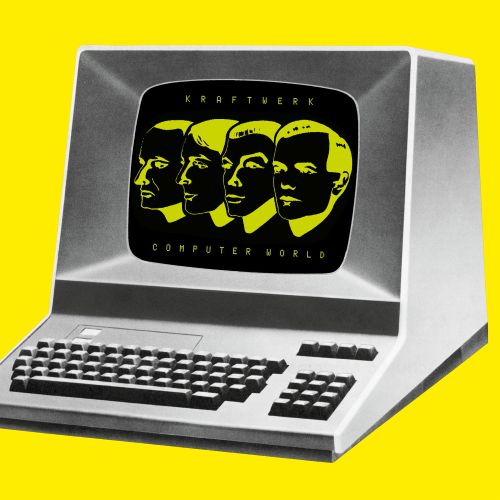
“Computer World” (German title: Computerwelt) is the eighth studio album by German electronic group Kraftwerk.
It is a concept album centered on the emergence of an information society based on computer technologies.
Background of the Production
Kraftwerk was formed in Düsseldorf, West Germany in 1970 by Ralf Hütter (voice, synthesizers, keyboards) and Florian Schneider (voice, synthesizers, flutes).
In the early 1970s, they developed an experimental form of rock combining improvisation, repetitive rhythms, and electronically processed sound in the context of Krautrock. During this period, acoustic instruments such as flute and organ also played significant roles.
With the 1974 album “Autobahn,” long-form composition, a clearly defined thematic focus, regular beats, and simple melodies were introduced, marking a transition from their early experimental Krautrock style to a more pop-oriented electronic sound built primarily on synthesizers and drum machines.
From “Radio-Activity” (1975) onward, the band consistently adopted a concept album approach.
“Radio-Activity” deals with the dual theme of radio waves and nuclear power, while “Trans-Europe Express” (1977) takes the Trans Europe Express (TEE) railway network as its subject. “The Man-Machine” (1978) focuses on the relationship between humans and machines.
Commentary
The album “Computer World” was recorded in Kling Klang Studio in Düsseldorf in 1979–1981, and was released on LP and cassette by Kling Klang (Germany), EMI and Warner Bros. Records (the U.S. and Canada) in 1981.
It was produced by Ralf Hütter and Florian Schneider.
As was the case with the two previous albums, “Computer World” was released in both German- and English-language editions.
It reached number 7 on the German Albums Chart, number 15 on the UK Albums Chart, and number 72 on the US Billboard 200.
This album was produced against the backdrop of the late-1970s spread of computer technology and the advancement of the information society, and it takes themes such as communication networks, calculators, and home computers as its subject matter. However, computers were not used in the production of this work. The primary production tools were analog synthesizers, hardware sequencers, drum machines, and vocoders.
The album is based on uniform tempos, mechanical rhythms, simple melodies, and repetitive structures. Sonically, it is characterized by clear and rigid tones primarily generated by analog synthesizers.
From a music-historical perspective, this work is an important reference point in the popularization of electronic music and the formation of club music. Its influence on hip-hop, electro, and later electronic dance music (EDM) as a whole has been substantial, and its danceable, funky sound in particular has had a significant impact on these genres.
From a retrospective perspective, “Computer World” can be regarded as a precursor to the rhythmic structures and sound design found in later techno and house music. Its influence is especially noted in Detroit techno, including artists such as Juan Atkins.
“Rolling Stone” magazine named “Computer World” the 10th greatest EDM album of all time in 2012.
“Pocket Calculator” was released as a single in 1981, and reached number 39 on the UK Singles Chart. In addition to the English and German versions, a French version titled “Mini Calculateur” and a Japanese version titled “Dentaku” were also produced.
Released in 1981 as a double A-side single, “Computer Love / The Model” reached number one on the UK Singles Chart.
In 2009, a remastered version of this album was released on CD, LP, and digital formats.
Track Listing
The total duration is 34 minutes 25 seconds.
Side One
- “Computer World” (“Computerwelt”) – 5:05
- “Pocket Calculator” (“Taschenrechner”) – 4:55
- “Numbers” (“Nummern”) – 3:19
- “Computer World 2” (“Computerwelt 2”) – 3:21
Side Two
- “Computer Love” (“Computer Liebe”) – 7:15
- “Home Computer” (“Heimcomputer”) – 6:17
- “It’s More Fun to Compute” – 4:13
Personnel
Kraftwerk
- Ralf Hütter – voice, vocoder, synthesizer, keyboards, Orchestron, Synthanorma Sequenzer, electronics, software
- Florian Schneider – vocoder, speech synthesis, synthesizer, electronics, software
- Karl Bartos – electronic drums, software
- Wolfgang Flür – software
Streaming Services
Search Links
Search for “Kraftwerk Computer World” on Amazon.com
Search for “Kraftwerk Computer World” on Apple Music