





















































Overview
“The Color of Pomegranates” (Armenian original title: Նռան գույնը; Russian title: Цвет граната; initial title: “Sayat-Nova”) is a 1969 avant-garde film from Soviet Armenia, directed and written by Sergei Parajanov.
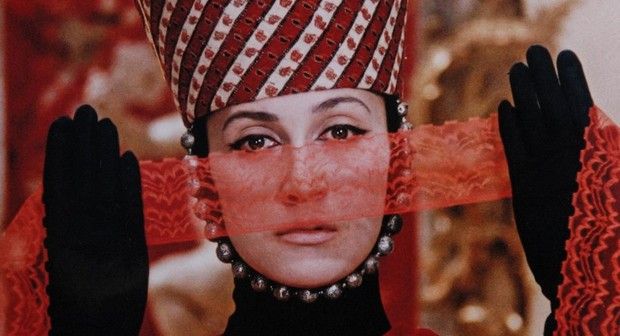
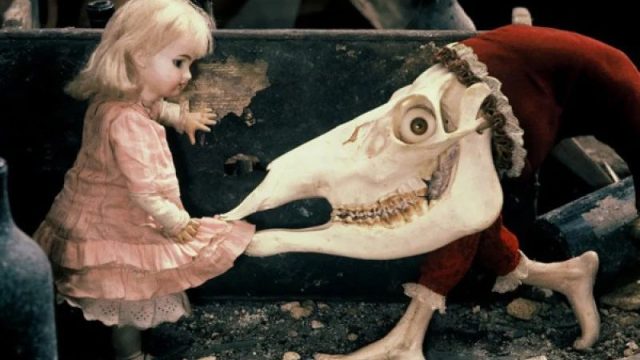
The film portrays the life of the eighteenth-century Armenian poet and troubadour (ashug) Sayat-Nova (born Harutyun Sayatyan, c. 1712–1795), almost entirely abandoning the grammar of the conventional biographical film in favor of a sequence of static tableaux (tableaux vivants). There is almost no dialogue; the narrative instead proceeds through the recitation of poetry, sacred chant, folk song, and highly stylized gesture and symbolic props.
Production: Armenfilm (Yerevan, Armenian Soviet Socialist Republic).
Director and screenwriter: Sergei Parajanov.
Cinematography: Suren Shakhbazyan.
Editing: Sergei Parajanov, Marfa (Maria) Ponomarenko. The version released within the USSR was re-edited by Sergei Yutkevich.
Production design: Stepan Andranikyan. Set decoration: Mikael (Mikhail) Arakelyan. Costumes: Elena Akhvlediani, Iosif Karalov, Jasmine Sarabjan, among others. Some costumes were designed by Parajanov himself.
Music: Tigran Mansurian (incorporating existing Armenian sacred chant, folk song, and ashug music).
Principal cast: Sofiko Chiaureli (playing five or six roles across genders, including the poet as a young man, the poet’s beloved Princess Anna, the poet’s muse, a mime, and the Angel of Resurrection), Melkon Alexanyan (the poet as a child), Vilen Galstyan (the poet in the monastery), Giorgi Gegechkori (the poet in old age), Spartak Bagashvili (the poet’s father), Medea Japaridze (the poet’s mother), and Hovhannes Minasyan / Onik Minasyan (Prince).
Language: Armenian (with some Georgian).
Format: 35mm color, aspect ratio 1.37:1 (Academy ratio).
Running time: approximately 77–79 minutes for the Armenian release version, approximately 72–73 minutes for the Yutkevich-edited version distributed within the USSR, and approximately 78 minutes for the 2014 restoration (figures vary somewhat between versions and sources).
The film followed Parajanov’s 1965 feature “Shadows of Forgotten Ancestors.” It is widely regarded today both as the first work in which Parajanov established his distinctive style and as one of the most radical films in cinema history.
Trailer
Plot Overview
“The Color of Pomegranates” has no plot bound by clear causal relationships. An opening title declares that the film is not “a biography of the poet” but “an attempt to recreate the poet’s inner world.” The work is divided into thematic chapters — “Childhood,” “Youth,” “The Prince’s Court,” “The Monastery,” “The Dream,” “Old Age,” “The Angel of Death,” and “Death” (chapter titles and their wording vary between versions) — each introduced by an intertitle quoting Sayat-Nova’s poetry.
In childhood, the boy grows up surrounded by books and church architecture, and glimpses the female body for the first time by peering into a bathhouse. In youth, he is summoned to the royal court, where his musical gifts are recognized, and he falls into a forbidden love with a princess named Anna (both the poet and his beloved are played by Sofiko Chiaureli). When this love ends in ruin, the poet enters a monastery and lives out his life as a cleric. In old age, he leaves the monastery to wander, and is finally led out of the world by the Angel of Death.
Rather than dramatic incident, it is the repetition and variation of visual motifs that provides the film’s structural skeleton: the recurring shot of a white lace bridal veil changing color, the recurring use of a shell and a feather as symbols of the feminine and the masculine, and the scene in which pomegranate juice seeping into cloth traces the outline of the map of the Armenian kingdom.
Commentary
Production Background
Parajanov repeatedly stated in later years that seeing Andrei Tarkovsky’s “Ivan’s Childhood” in 1962 was a shock that led him to abandon the socialist-realist manner in which he had previously worked. The first fruit of this conversion was his 1965 film “Shadows of Forgotten Ancestors,” which won international acclaim while also drawing the wariness of the authorities as a work that seemed to stoke Ukrainian nationalist sentiment.
Parajanov subsequently relocated his base of work from Ukraine to Armenia, where he undertook, as an Armenfilm project, a biographical film commemorating the 250th anniversary of Sayat-Nova’s birth (which fell in 1962). Filming took place in 1968, and Parajanov himself described the conditions as extremely poor: “There was no raw film stock, no Kodak materials, almost no lighting equipment, wind machines, or means of special effects.”
Parajanov took the approach of literally translating into images the figures that appear in Sayat-Nova’s poetry (a dagger, silk, brocade, a figure wandering in sackcloth and ashes), radically simplifying the events of the poet’s life, and dispensing with any explanatory framework or narration. He described his own style as inspired by “a chain of Persian miniatures” or by illuminated Armenian manuscripts.
Locations
Filming took place entirely on location. Within Armenia, the crew used Sanahin Monastery and Haghpat Monastery (founded in the tenth century, and the actual monastery in which Sayat-Nova himself spent his final years) in the northern province of Lori, as well as the Church of St. Hovhannes in Artavan and Akhtala Monastery. Within Georgia, filming took place at Alaverdi Monastery, the countryside surrounding the David Gareja monastery complex, and the Ikalto and Shuamta monastery complexes near Telavi. In Azerbaijan, the Old City of Baku and the fortress of Nardaran were used.
Haghpat Monastery is the one building in which Sayat-Nova, as a historical figure, actually spent a long period of his life, making it the single point at which Parajanov’s stylized fiction directly intersects with the poet’s documented biography.
Cinematography and Style
The film’s images are shot with an entirely static camera; pans, tilts, and tracking shots are almost never used. Figures face the camera nearly frontally and repeat slow, stylized gestures while remaining otherwise motionless. This is a striking contrast to Parajanov’s previous film, “Shadows of Forgotten Ancestors,” which relied heavily on vigorous tracking shots, and the shift is regarded as the moment at which Parajanov established himself as an auteur in the full sense.
The editing likewise relies on the repeated use of identical or slightly varied shots, producing a rhythm that echoes the repetitions of memory and of the poetry itself. Dialogue is extremely sparse, and the soundscape is instead built from sacred chant, ashug song, and ambient sound.
The device of having Sofiko Chiaureli take on (or refuse to distinguish between) both male and female roles is itself part of this formal strategy. Her performance is marked throughout by an affectless, deadpan quality that does much to establish the film’s overall androgynous, impersonal atmosphere.
Music and Sound Design
The film’s music and sound design were the work of a single composer, Tigran Mansurian, then in his twenties. By his own account, Mansurian worked on the score every day from eight in the morning until eight at night for three months, beginning on January 3, 1969. This was Mansurian’s first work on a feature-length fiction film.
Rather than composing a new set of themes for Sayat-Nova, Mansurian’s method was to extract sounds produced by traditional Armenian and Caucasian instruments — the tar, the kamancha, the dap (frame drum) — as decontextualized “fragments” or “sonic ornaments,” and to arrange them with the same density as the film’s visual composition. In Mansurian’s own words, the work was like “plucking one or two of the most beautiful feathers from the chicken that is folk music”; at times the instrumental sound is stripped so far from its original context that it is no longer recognizable as coming from the instrument that produced it.
In place of dialogue and explanatory narration, which are almost entirely absent, the film’s editing deliberately dissolves the boundary between music, ambient sound, and the human voice (singing, recitation, the intoning of verse). Mansurian applied the same authorial design even to silence itself: in the court scenes — the two sequences Parajanov referred to as the “Red Palace” and the “Blue Palace” — each is said to be built around its own distinct “silent background sound” anchored in a different consonant (“sh” and “s,” respectively).
Some sound sources were specified directly by Parajanov himself; the Georgian sacred polyphonic chant heard during the court hunting scene, for instance, was adopted at Parajanov’s own suggestion.
In Sergei Yutkevich’s re-edit for domestic Soviet distribution, the correspondence between music and image was also substantially altered. Mansurian has expressed strong displeasure that Yutkevich relocated sounds he had placed with strict scene-by-scene necessity to other, arbitrarily chosen scenes.
The importance of the film’s score has continued to be recognized into the twenty-first century. Between 2017 and 2018, the Parajanov-Vartanov Institute and the Film Foundation objected to planned screenings of the film without Mansurian’s original score — at Cinefamily in Los Angeles and at the Metropolitan Museum of Art in New York, both built around an unauthorized alternative soundtrack by the musician Nicolas Jaar — and the Metropolitan Museum subsequently cancelled its planned screening.
Thematic Analysis: Queerness and Androgyny
One of the most frequently discussed themes of the film is its representation of gender fluidity and androgyny. Sofiko Chiaureli plays five or six roles without regard to gender: the poet himself as a young man, his beloved Princess Anna, the poet’s muse, a nun, the Angel of Resurrection, and a mime. It has repeatedly been noted that having the same actress play both the poet and his beloved suggests their love is, in effect, “the splitting of a single soul.”
The visual code of the shell (a symbol of the feminine) and the feather (a symbol of the masculine), introduced in the childhood scene in which the young poet peers into a bathhouse, is subsequently taken up by multiple characters regardless of gender, unsettling the very boundary between male and female.
This representation of androgyny cannot be discussed apart from the biographical facts of Parajanov’s own life. Four years after this film was made, in 1973, Parajanov was arrested in Ukraine on charges of “homosexuality,” “rape,” and “distribution of pornography,” and sentenced to five years of hard labor (the charges are also said to have included “Ukrainian nationalism”).
Homosexual acts were a criminal offense under Soviet law at the time, and were treated within the regime’s ideology as a form of social pathology. In 2023, fifty years after his conviction, Ukraine’s Institute of National Remembrance formally rehabilitated Parajanov.
Among critics, the prevailing interpretation connects the film’s androgynous characterizations to the oppression Parajanov experienced throughout his life as a sexual minority. In parallel, critics have also read the film’s cross-cutting of Armenian, Georgian, Azerbaijani, and Russian cultural traditions as a gesture that disrupts the single ethnic and ideological unity imposed by the Soviet state, a point discussed alongside the film’s disruption of gender.
Censorship
From the moment of its completion, the film provoked prolonged friction with Goskino, the Soviet state film censorship body. Goskino chairman Alexei Romanov personally disliked the film and initially refused to permit its distribution outside Armenia. The authorities charged that Parajanov’s stylized, poetic mode of address was “incomprehensible to the masses” and failed to fulfill an educational function — that is, to correctly convey the historical life of Sayat-Nova.
As a result, Parajanov was compelled to remove all reference to the poet’s name from the film, including the original title “Sayat-Nova” itself, and the title was changed to “The Color of Pomegranates.” In place of the removed references, newly written, abstract, poetic intertitles (chapter titles) by the Armenian writer Hrant Matevosyan were substituted. The resulting Armenian release version, running approximately 77 to 79 minutes, is often described as the “director’s cut,” but this too was already a product of compromise with the censors; some scholarship (James Steffen) holds that it was shortened by a further twenty minutes or so from Parajanov’s original conception.
This Armenian version was released only within Armenia, in October 1969, and was not authorized for distribution elsewhere in the USSR or abroad. The filmmaker Sergei Yutkevich, who came from an avant-garde theater background and served on a Goskino script-review committee, held the film in high regard and attempted to break the deadlock with the authorities by re-editing it himself in order to secure wider distribution. Yutkevich created new, simpler Russian-language chapter titles, cut several minutes of footage containing religious content, and rearranged the order of certain sequences. This 72-to-73-minute Yutkevich version was approved for limited distribution within the USSR, and remained for a long time the only version in circulation in the West.
The behind-the-scenes documentary shot by Parajanov’s associate Mikhail Vartanov, “The Color of Armenian Land” (1969), was likewise banned from release at the time; some of its footage remained hidden for years, resurfacing only in Vartanov’s 1992 documentary “Paradjanov: The Last Spring.”
Release
The Armenian domestic release took place in October 1969. Yutkevich’s re-edited version was subsequently used for limited distribution within the USSR and was also the version through which the film was introduced abroad. In the West, the film long remained accessible only through unofficial bootleg copies or prints without subtitles; at the New York Film Festival in 1980, it was screened without English subtitles.
Restoration
For a long time the film could be seen only in the Yutkevich version reflecting the censors’ wishes, but the rediscovery of a print of the Armenian release version (the 77-minute version) set in motion a restoration effort aimed at a version closer to the original. The restoration was led by the World Cinema Project (of the Film Foundation, founded by Martin Scorsese), with the Cineteca di Bologna and its affiliated laboratory L’Immagine Ritrovata carrying out the work in cooperation with the National Cinema Centre of Armenia and Gosfilmofond of Russia.
The restoration is said to have originated from a meeting between representatives of the Parajanov-Vartanov Institute and the Film Foundation at a 2014 Parajanov and Vartanov retrospective held at the Busan International Film Festival. The new 4K digital restoration had its world premiere in the Cannes Classics section of the 67th Cannes Film Festival in 2014. Its American premiere took place on September 20 of that year at the Academy theater within the Los Angeles County Museum of Art (LACMA), and its East Coast premiere followed on October 2 at the 52nd New York Film Festival, introduced by Martin Scorsese himself. The critic James Quandt called the restoration “the holy grail of cinema.” Scorsese received the 2014 Parajanov-Vartanov Institute Award for this achievement.
Reception
Box Office
The film has no record of theatrical release aimed at general commercial exhibition, either within the Soviet Union or in the West. Within the USSR, only the Yutkevich version was distributed, and in limited fashion; in the West, the film remained accessible for a long time only through film festivals, cinematheques, and unofficial bootleg or university teaching prints. The film’s standing has therefore been established not by box-office measures but by the esteem of festivals, critics, and fellow filmmakers.
Critical Reception
The film is today widely recognized as one of the most important works in the history of cinema. On the review-aggregation site Rotten Tomatoes, a retrospectively compiled set of eighteen reviews yields an approval rating of 94 percent and an average score of 7.2/10. On the occasion of its 1980 New York Film Festival screening, Janet Maslin wrote in The New York Times that the film was elusive in any context, but that something this purely enigmatic possessed a magic of its own. “The Color of Pomegranates” was also selected for Cahiers du Cinéma’s annual top-ten list in 1982.
In the British Film Institute’s “Sight and Sound” critics’ poll, the film placed joint 84th in the 2012 edition and joint 122nd in the 2022 edition (joint 93rd in the 2022 directors’ poll).
The critic Gilbert Adair wrote that the film, in both style and content, gives the impression of having existed before the invention of cinema as a medium, and that no film historian who ignores it can be taken seriously.
Comments from Notable Figures
Mikhail Vartanov, a close associate of Parajanov, stated that apart from the film language introduced by Griffith and Eisenstein, and the language of Buñuel’s “Un Chien Andalou” — which was not generally accepted at the time — world cinema had discovered nothing revolutionarily new until Parajanov’s “The Color of Pomegranates.”
Michelangelo Antonioni called the film “astonishing in its sheer perfection of beauty,” and Jean-Luc Godard remarked that in the temple that is cinema, there is image, light, and reality — and that Sergei Parajanov was the master of that temple.
Andrei Tarkovsky was likewise among the film’s admirers; at the time of Parajanov’s 1973 arrest, he wrote in a letter to the Central Committee of the Communist Party of Ukraine defending Parajanov as “an irreplaceable artist.”
Influence
The film is said to have had a direct influence on numerous filmmakers, including Jim Jarmusch, Derek Jarman, and Mohsen Makhmalbaf. In particular, the device of casting Sofiko Chiaureli in a series of androgynous roles — the young poet, his beloved, an angel, a nun, a white-painted mime — has been described as anticipating Derek Jarman’s later casting of Tilda Swinton (in his films of the late 1980s).
Beyond the cinema, the film’s influence can be traced in Madonna’s 1995 music video for “Bedtime Story,” which contains visual quotations from the film, including a child in a fetal posture atop a five-pointed star and bare feet crushing grapes.
Lady Gaga’s 2020 music video for “911” has likewise been explicitly credited as drawing on the film’s influence.
In 2015, the musician Nicolas Jaar released, without authorization, an album titled “Pomegranates” billed as an unofficial “alternative soundtrack” to the film. A planned 2017 screening of the film at Cinefamily in Los Angeles, accompanied by a live performance by Jaar, was changed to a screening with the film’s original sound following objections from the Parajanov-Vartanov Institute and the Film Foundation.
Historical Position
“The Color of Pomegranates” appeared at the end of the 1960s, at a time when socialist realism remained the official aesthetic norm in Soviet cinema, as a work that departed fundamentally from the conventions of clear narrative progression, proletarian heroism, and ideological messaging. This departure took place against the backdrop of the reversal, then underway under Brezhnev, of the cultural “thaw” — that is, a tightening crackdown on dissident artists.
The film is also positioned as one culmination of the current in Soviet cinema known as “poetic cinema,” a lineage beginning with Alexander Dovzhenko and encompassing Parajanov’s own “Shadows of Forgotten Ancestors” as well as works by Sergei Gerasimov and Yuri Ilyenko, among others. At the same time, the film holds value as a record of the visual and religious culture specific to the Caucasus region, spanning Armenia, Georgia, and Azerbaijan — one that is not absorbed into a single Russian- or Soviet-centered cinematic canon oriented around Moscow.
Home Media
For a long time, the film’s home-media presence was built around the Yutkevich version. In the 1990s, VHS and DVD editions based on the Yutkevich version were released by, among others, Kino International in the United States. A subtitled DVD was also released in Russia by Cinema Council.
A Blu-ray containing the 2014 4K digital restoration (based on the Armenian version) was released in the United Kingdom by Second Sight Films on February 19, 2018, including both the Yutkevich version and the Armenian version. In the United States, the Criterion Collection released a Blu-ray on April 17, 2018, with supplements including Mikhail Vartanov’s behind-the-scenes documentary “The Color of Armenian Land” (1969), commentary by the Parajanov scholar James Steffen, and Daniel Bird’s documentary “The World Is a Window.”
Search Links
Cross-Search for “The Color of Pomegranates” on JustWatch
Search for “The Color of Pomegranates” on Amazon.com
Structure (Contains Spoilers)
The film is not a story bound by causal relationships but is instead organized as a sequence of tableaux (tableaux vivants) dividing the poet’s life into thematic sections. Each section is introduced by an intertitle quoting Sayat-Nova’s poetry. What follows is an overview of the principal sections and their content, based on the restored version and on scholarly accounts; the precise wording of chapter titles and scenes varies among the versions that survive.
Opening
Following the intertitle, “This film is not a biography of the poet. Rather, the filmmaker has attempted to recreate the poet’s inner world — through the trepidations of his soul, his passion, and his torment. It makes extensive use of symbols and allegories characteristic of the tradition of the medieval Armenian troubadour (ashug),” a line is spoken: “I am one whose life and soul are themselves torment.” An old book inscribed in an unknown script is shown, followed by three pomegranates on a white cloth seeping juice — establishing the visual vocabulary that runs through the entire film.
Childhood
Over intertitles reading, “There are three sacred aims: cherish the pen, cherish writing, cherish the book,” and, “A book must be cherished and loved, for it is both life and soul; without the written word, this world would be ruled by ignorance alone; a book must be read aloud so that all may hear it, for not everyone can read,” the poet as a boy is shown absorbed in illuminated manuscripts depicting saints and angels on the roof of a monastery. He also peers into an underground public bathhouse and sees the female body for the first time. The visual code introduced in this scene — a shell covering a woman’s breasts, a feather covering a man’s genitals — recurs repeatedly in later sections. The boy also watches as dyers pull bundles of dyed wool from vats and beat them against the ground; the colors of the dye match those of the Armenian flag.
Youth
Over the line “We searched for ourselves in one another,” the young poet (Sofiko Chiaureli) and his beloved (also played by Chiaureli) are shown offering rings to one another in a repeated and varied sequence of shots. A white lace bridal veil changes color, from white, signifying innocence, to red, signifying passion, to black, signifying death and loss.
The Prince’s Court
Over the lines “In this healthy and beautiful life, suffering was given to me alone. Why was it given?” and “We searched for a refuge for our love, but our path led instead to the land of the dead,” death rituals at the court are depicted. A goat-sacrifice ritual (matagh) is repeated three times, from an identical fixed camera setup, with three goats and three different witnesses. This is followed by a scene of monks mourning the death of the Catholicos, Father Lazarus, a senior cleric of the Armenian Church. The poet joins in digging a grave in the center of the church floor, but his work is disrupted when a flock of sheep is driven into the church. A woman in white (the poet’s beloved) tries to embrace the poet, but he covers his body with an embroidered carpet and refuses her.
The Monastery
Following Matevosyan’s chapter title, “How am I to protect my wax-built castles of love from your red-hot fires?,” having lost his love, the poet enters a monastery and chooses a clerical life. With the arrival of spring, the aged poet is shown holding a lamb, removing his robes to bask in the sunlight, and the other monks follow his example (this scene is substantially reduced and altered in the Yutkevich version).
The Dream
The film returns to the poet’s childhood memories, depicting mourning for his deceased parents.
Old Age: Leaving the Monastery
Over the intertitle “Clarity, obscurity — I have seen all things, and I have been abandoned by my own life,” the poet is shown dipping a cup into the church’s holy-water basin, only to draw up nothing — a symbolic scene that has been read as depicting the exhaustion of the poet’s powers.
The Angel of Death
The Angel of Death appears, blindfolded, leading a sheep on a rope. A woman in white (thought to be either the poet’s beloved or the Angel of Resurrection) is buried; over this scene are sung the words, “The world is a single window. I despise the glass fitted within it. Whoever looks through that glass will be burned.”
Death
The poet’s death is depicted symbolically, watched over by a female figure who is neither clearly his beloved nor clearly the Angel of Resurrection. The film closes with the lines: “A poet may die, but his muse does not. Whether I live or die, my song will awaken the crowd, and on the day of my departure, nothing shall vanish from this world.”
(According to the historical record, Sayat-Nova was killed in 1795 by the forces of the Persian ruler Agha Mohammad Khan, who invaded Armenia, for his refusal to renounce his faith. The film does not depict this historical event directly, presenting his death instead only as a stylized encounter with the Angel of Death.)