























































Overview
“Man Bites Dog” (French original title: C’est arrivé près de chez vous) is a 1992 feature film by Belgian directors Rémy Belvaux, André Bonzel, and Benoît Poelvoorde.
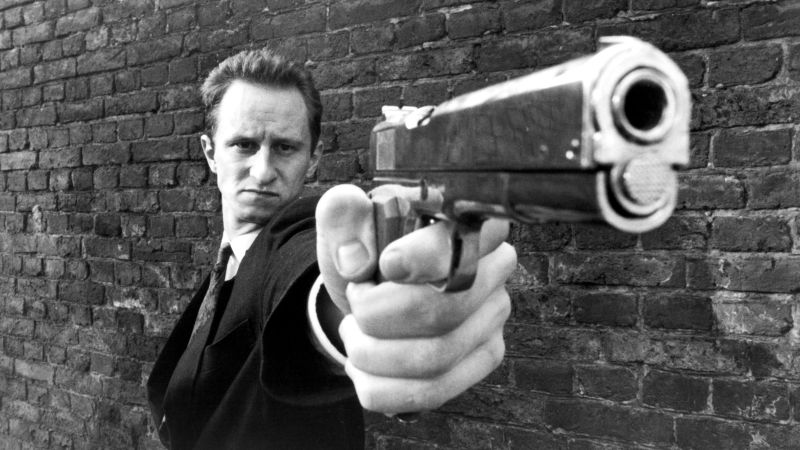
Set in French-speaking Belgium, it is a mockumentary-style dark comedy crime film that depicts a documentary film crew recording the daily life of a serial killer.
The French original title derives from the name of a local news column, “It Happened Near Your Home,” in the Belgian daily newspaper “Le Soir.”
The production company is Les Artistes Anonymes.
Directors and producers: Rémy Belvaux, André Bonzel, Benoît Poelvoorde.
Screenplay: Belvaux, Bonzel, Poelvoorde, Vincent Tavier.
Cinematography: André Bonzel.
Editors: Rémy Belvaux, Eric Dardill.
Music: Jean-Marc Chenut, Laurence Dufrene, Philippe Malempré.
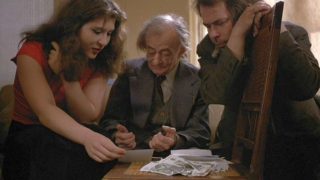
Main cast: Benoît Poelvoorde (Ben), Rémy Belvaux (Rémy, director), André Bonzel (André, cameraman), Jean-Marc Chenut (Patrick, first sound recordist), Alain Oppezzi (Franco, second sound recordist), Vincent Tavier (Vincent, third sound recordist), Jacqueline Poelvoorde-Pappaert (Ben’s mother), Nelly Pappaert (Ben’s grandmother), Hector Pappaert (Ben’s grandfather), Jenny Drye (Jenny, Ben’s old friend), Valérie Parent (Valérie, Ben’s girlfriend), Malou Madou (Malou, bar owner), Willy Vandenbroeck (Bobby, boxing trainer), among others.
Language: French.
Black and white, shot on 16mm film. Vista size (16:9). Running time: approximately 95 minutes (edited version: 92 minutes).
Trailer
Plot Summary
A film crew follows Ben, a Belgian serial killer who makes his living through robbery and murder, and records his daily life and crimes in documentary form.
The story centers on scenes of Ben repeatedly murdering various victims and disposing of their bodies, interspersed with everyday scenes of him interacting with family and acquaintances.
Initially acting as mere observers, the crew gradually loses its neutral stance as contact with Ben deepens. They seek financial support from him to cover production costs and eventually transform into active accomplices.
Commentary
Production Background
This film originated from activities at the Institut National Supérieur des Arts du Spectacle (INSAS) in Brussels. Belvaux had made a 20-minute short film featuring the character Ben as his graduation project, and the feature-length version is an expansion of that work.
Belvaux, Bonzel, and Poelvoorde were fellow film students. The project was born from the idea of shooting a documentary with no budget. Based on an original concept by Belvaux, the four—Belvaux, Bonzel, Poelvoorde, and Vincent Tavier—collaborated on the screenplay.
Belgian tabloid journalism and television documentary programs partly inspired the project. At its core, the film is a satire of media voyeurism and sensationalism.
The film was produced on an extremely low budget of approximately one million Belgian francs (roughly $33,000 at the time). Filming took about a year and a half and was carried out guerrilla-style using real locations, friends, acquaintances, and family members as extras, and minimal equipment.
The main shooting locations were around Brussels and Namur in Belgium.
Poelvoorde’s real mother and grandparents participated in the shoot believing it was a genuine documentary about their son, unaware that they were appearing in a fiction film centered on a serial killer.
Characteristics as a Film
The film is positioned within the mockumentary (fake documentary) genre.
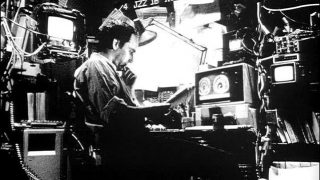
Its formal characteristics lie in the combination of 16mm black-and-white film shot handheld and direct sound recording. By thoroughly imitating the on-location shooting style of documentaries and excluding theatrical direction, it achieves a strong cinéma vérité appearance, yet the camerawork and editing are meticulously calculated.
The process by which the film crew descends into becoming accomplices serves as a powerful critique of the illusion of ethical neutrality in documentary filmmaking.
Another notable feature is the portrayal of the serial killer as a strangely charismatic figure who speaks eloquently with wit and sophisticated rhetoric. The film satirizes the media’s mechanism of turning violence into entertainment, yet viewers are drawn in by Ben’s charm and are thus confronted with their own complicity in consuming violence as entertainment.
Release
The film had its world premiere in May 1992 in the Critics’ Week (Semaine de la Critique) section of the Cannes Film Festival. It was also screened at the Toronto International Film Festival in September and the New York Film Festival in October of the same year. It opened in Belgium on August 20, 1992, in Ghent, and was released theatrically in France later that year. Its U.S. theatrical release was on January 15, 1993.
It grossed approximately $1.2 million in Belgium, over $2 million in France, and about $205,000 in the United States and Canada. Worldwide box office reached an estimated $3.5 million.
Awards and Nominations
At the 1992 Cannes Critics’ Week, it won three awards: the International Critics’ Prize (FIPRESCI equivalent), the SACD Award for Best Feature Film, and the Youth Award. It also received the André Cavens Award for Best Film from the Belgian Union of Film Critics (UCC). Additionally, at the 5th Yubari International Fantastic Film Festival in February 1994, Rémy Belvaux and André Bonzel received the Special Jury Prize.
Evaluation and Reception
The premiere at Cannes provoked strong divided reactions from critics. The film’s violent content, particularly the gang rape scene, sparked intense ethical debate, and it received an NC-17 rating in the United States.
Nevertheless, it earned high critical acclaim and is historically positioned as a pioneering work that connected the mockumentary format with themes of violence and crime.
Influence
The film expanded the possibilities of the mockumentary genre and exerted broad influence on subsequent works dealing with violence and crime. It has been noted for its kinship with Michael Haneke’s “Funny Games” (1997) and Daniel Minahan’s “Series 7: The Contenders”
(2001). Its low-budget fake-documentary approach also belongs to the lineage leading to “The Blair Witch Project” (1999) and the found-footage film cycle.
Benoît Poelvoorde became widely known as an actor both in Belgium and abroad through this film and went on to become one of the leading figures in French-language cinema.
Search Links
Cross-Search for “Man Bites Dog” on JustWatch
Search for “Man Bites Dog” on Amazon.com
Synopsis (Spoilers)
The film opens with Ben strangling a woman on a train.
Ben makes his living through robbery and murder. His methods typically involve strangling or shooting women, the elderly, postmen, and others to steal their money, then disposing of the bodies in canals or marble quarries.
A film crew shadows Ben, recording his daily life and crimes on film camera as a documentary. The crew consists of three members: director Rémy, cameraman André, and sound recordist Patrick.
Ben is a ruthless murderer who kills without hesitation for money, yet he is also a charismatic figure with a gift for witty and eloquent speech. He recites his own poetry, talks about architecture, enjoys classical music, and practices boxing.
Ben visits his old friend Jenny. In retaliation for a real estate developer forcibly evicting Jenny from the Sablon district due to urban redevelopment, he shoots the developer dead.
As a racist, Ben shoots an African immigrant working as a security guard at a construction site. He makes the crew dispose of the body.
Posing as a TV reporter, Ben visits an elderly woman living in an apartment. Noticing that she takes heart medication, he shouts loudly into her ear. The woman suffers a heart attack and dies.
Ben and the crew visit a coastal town, eat at a restaurant, and he becomes heavily intoxicated and vomits.
Ben visits his family home, a small shop run by his mother, and meets his mother, grandmother, and grandfather.
Ben visits his girlfriend Valérie, a flutist, and the two perform classical music together—Ben on piano and Valérie on flute.
Ben and the crew encounter Italian gangsters at an abandoned hideout and a shootout ensues, in which sound recordist Patrick is killed.
Franco joins the crew as the new sound recordist in Patrick’s place.
Ben and the crew break into a suburban mansion, beat a woman, shoot the man dead, and catch a fleeing young boy, suffocating him with a pillow. The crew assists Ben in the crime.
At the abandoned hideout, another shootout with Italian gangsters occurs and Franco is killed. Ben shoots a man named Ricardo Giovanni. Ben and the crew then come across another three-man documentary crew who were filming Giovanni with a video camera and shoot them as well.
Vincent joins the crew as the new sound recordist in Franco’s place.
Ben takes the crew to a bar run by his acquaintance Malou, where he makes a cocktail called “Petit Grégory” with an olive and a sugar cube. This scene is a black humor reference to the 1984 Grégory Villemin murder case in France. The way the olive is tied to the sugar cube derives from the fact that the 4-year-old Grégory was found floating in the river with his hands and feet bound.
After drinking all night at the bar with the crew, a drunken Ben walks through the streets loudly singing the song “Cinéma Cinéma” (composed by Jean-Marc Chenut).
Ben and the crew break into a house, attack a couple, hold a gun to the man, and gang-rape the woman. The next morning, the camera dispassionately records the images of the woman brutally stabbed to death with her internal organs exposed and the man shot dead.
Ben’s girlfriend and family receive death threats from the brother of Giovanni, whom Ben previously killed.
Ben is injured during boxing sparring and hospitalized. His mother and grandfather visit him.
After being discharged, Ben returns home to find his friends (Jenny, Valérie, and boxing trainer Bobby) throwing him a surprise birthday party.
The film crew presents Ben with a holster as a gift.
During the party, Ben suddenly shoots Bobby in the head, with blood splattering onto the faces of Jenny and Valérie. Jenny, with blood still on her face, hands Ben his gift (a stuffed bird).
After a failed attempt to attack a postman, Ben is arrested by the police and imprisoned.
Ben escapes from prison and rejoins the crew. At Valérie’s house, he discovers her dead with a flute inserted into her anus. At his family home, his mother has also been murdered.
While retrieving his belongings from the abandoned hideout in preparation for fleeing, Ben is shot in the head while reciting one of his poems to the camera. Director Rémy and cameraman André are also shot. Even after the camera falls to the floor, it continues to roll, capturing the moment when sound recordist Vincent is shot.