








































Overview
“Viy” (original Russian title: Вий) is a 1967 Soviet horror/dark-fantasy film co-directed by Konstantin Yershov and Georgi Kropachyov. Running time is approximately 76 minutes.
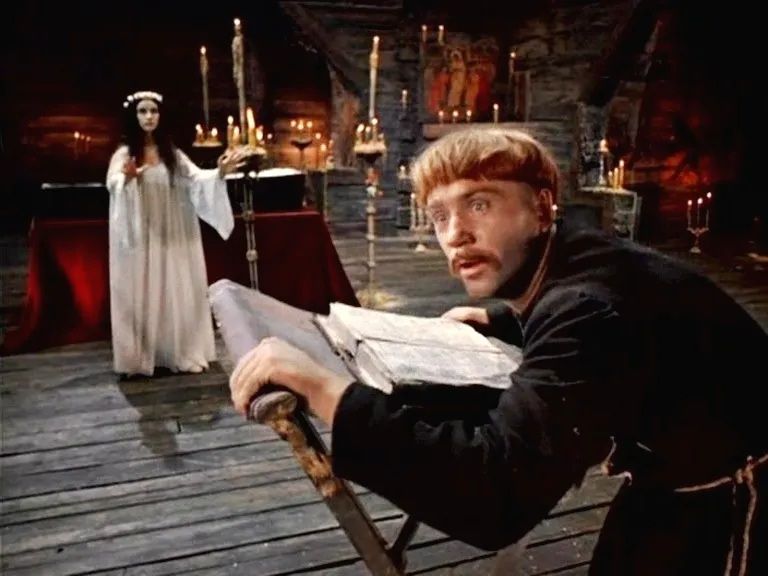
Based on Nikolai Gogol’s novella of the same name, the film depicts the ordeal of seminary student Khoma Brutus, who is made to spend three nights praying over the corpse of a witch he has beaten to death.
The budget was modest, at roughly 50,000 Soviet rubles, but the film’s extensive use of special effects made it visually distinctive.
Production: Mosfilm, Artistic Association “LUCH.”
Directed by: Konstantin Yershov and Georgi Kropachyov (a feature directorial debut for both).
Screenplay by: Konstantin Yershov, Georgi Kropachyov, Aleksandr Ptushko.
Based on: “Viy” by Nikolai Gogol.
Cinematography: Fyodor Provorov, Viktor Pishchalnikov.
Production design: Nikolay Markin. Special effects and artistic supervision: Aleksandr Ptushko. Costume design: Roza Satunovskaya. Sculptural design: Salla Mokil.
Music: Karen Khachaturian.
Main cast: Leonid Kuravlyov (as Khoma Brutus), Natalya Varley (as Pannochka, voice dubbed by Klara Rumyanova), Alexei Glazyrin (as the sotnik, a Cossack chieftain), Nikolai Kutuzov (as the old woman/witch), Vadim Zakharchenko (as Khalyava, Khoma’s friend), Pyotr Vesklyarov (in the dual role of the rector and Dorosh), Vladimir Salnikov (as Gorobets, Khoma’s friend), among others. The role of Viy was performed by circus acrobat Nikolai Stepanov.
Language: Russian.
Trailer
Watch the 4K Digitally Remastered Version on Mosfilm’s Official YouTube Channel
Gogol’s Original Story
“Viy,” included in the second volume of Gogol’s story collection “Mirgorod” in 1835, is a horror novella drawing on the folklore of Gogol’s native Ukraine. Set against the backdrop of Ukrainian Cossack society in the late eighteenth to early nineteenth century, it depicts the seminarian Khoma’s three nights of prayer over a witch’s corpse.
Gogol himself claimed the content was transcribed directly from folk material, but the titular demon Viy — a chthonic figure whose eyelids hang to the ground and who cannot see unless they are lifted — is considered to be, in effect, largely Gogol’s own invention.
Plot Summary
Students at a Kiev seminary set off for their summer break, and three of them lose their way one night on the open steppe.
Khoma Brutus, a student in the philosophy class, is attacked at a farmhouse where he has sought shelter, by an unsettling old woman. She climbs onto Khoma’s back and flies with him through the night sky.
Khoma beats the old woman savagely with a stick. She transforms into a beautiful young woman.
Terrified, Khoma flees back to the seminary. The rector tells him that a wealthy sotnik has named him as the one to say the final prayers for his dying daughter, Pannochka, and orders Khoma to go to the Cossack’s khutir (farmstead settlement).
Brought to the khutir by Cossacks, Khoma learns that the dead Pannochka is the very witch he beat.
Over three nights, Khoma is locked in the church and made to pray before Pannochka’s coffined corpse. He draws a “sacred circle” in chalk on the floor to shelter within, but Pannochka’s corpse rises from its coffin and summons various supernatural torments against him.
On the third night, Pannochka summons a massive demon called Viy.
Commentary
Production Background
The project originated with Mosfilm studio head Ivan Pyryev. Pyryev entrusted the film to Konstantin Yershov and Georgi Kropachyov, students at the Higher Courses for Directors of the Union of Cinematographers. Both were recommended by the head of that program, Leonid Trauberg.
Aleksandr Ptushko, who had spent many years working in special-effects and fantasy filmmaking, was brought onto the production partway through, joining as co-writer, art director, and special-effects director, and effectively became the core creative force behind the finished film.
In Soviet cinema of the time, works dealing with supernatural or religious subjects were regarded with suspicion under the state’s atheist ideology as reactionary or bourgeois, and horror as a genre was essentially unaddressed. The film’s ability to work around this constraint rested largely on its framing as an adaptation of a canonical work of literature by Gogol — a “screen version of a folk tale.”
Filming Locations
Principal location shooting took place in Ukraine. The seminary scenes were filmed at the Eletsky Monastery in Chernihiv, while the church scenes were shot at the Dormition Church in the village of Horokholyn Lis, Ivano-Frankivsk Oblast (destroyed by fire in 2006), and at the Church of St. George in Sedniv, Chernihiv Oblast, among other locations.
Interior scenes and the special-effects-heavy sequences set inside the church were shot for the most part on soundstages at Mosfilm in Moscow.
Structure
The film’s tone shifts markedly between its pastoral, largely comic first half and the dense, chaotic supernatural set pieces of the church-bound second half. This disjunction reflects the production process itself — shooting by two young directors, followed by extensive intervention from Ptushko partway through — and stands as a structural feature of the finished work.
Cinematographic Technique
Techniques Ptushko brought to the production include stop-motion animation, puppetry, suit performance, reverse motion, multiple exposure, and forced-perspective miniature composites.
The demon-summoning sequence inside the church runs to roughly ten minutes and features an airborne coffin, skeletons and demons crawling out of the walls and floor, and the massive figure of Viy himself.
In the scene where Khoma draws the “sacred circle” and shelters within it in the church, a 360-degree camera rotation is used to strong effect.
Varley’s physical performance inside the airborne coffin draws on her background as a circus trapeze artist.
For Viy’s appearances, a special costume was used, built from resin-soaked burlap, with plaster arms, hinged eyelids, and eyes made of reflective glass. Given the costume’s weight, a physically powerful circus acrobat was cast in the role.
On Film Adaptations of “Viy”
The earliest screen adaptation of Gogol’s “Viy” is generally considered to be a 1909 short film by director Vasily Goncharov; this film, along with reported adaptations from 1912 and 1916, does not survive. Setting aside Mario Bava’s Italian film “Black Sunday” (1960), this makes “Viy” (1967) the earliest surviving screen adaptation of the story.
“Black Sunday” credits Gogol’s “Viy” as its source, but its actual narrative — the execution of the seventeenth-century Moldavian witch Asa and her subsequent revenge — is substantially its own invention. “Viy” (1967), by contrast, is an adaptation that stays close to Gogol’s original, distinguished by its emphasis on visual effects and its expanded depiction of the demons.
The 2014 Russian-Ukrainian 3D co-production “Viy” directed by Oleg Stepchenko, internationally known as “Forbidden Empire,” is a heavily reimagined adaptation based on Gogol’s “Viy.”
Beyond the adaptations discussed above, a number of other films have also drawn on the story, including the Serbian (formerly Yugoslav) film “A Holy Place” (Serbian: Sveto mesto, 1990), the Russian film “Vedma” (English title: The Power of Fear, 2006), and the South Korean film “Evil Spirit; VIY” (2008).
Release
The Soviet premiere took place on 27 November 1967. The film became one of the top-grossing Soviet releases of 1968, with an estimated 32.6 million admissions.
Reception
Western awareness of the film was initially limited by Cold War-era distribution barriers, but it was progressively reassessed through home-video releases and digital restorations. The film has been included in “1001 Movies You Must See Before You Die” and retains cult status as the only officially produced horror film of the former Soviet Union.
Home Media
In 2001, Image Entertainment in the United States distributed a DVD produced by RUSCICO (Russian Cinema Council).
In 2019, Severin Films in the United States released the film on Blu-ray for the North American market.
In the United Kingdom, Eureka Entertainment released the film on Blu-ray in 2021 as part of its “Masters of Cinema” series.
Search Links
Cross-Search for “Viy” on JustWatch
Search for “Viy” on Amazon.com
Synopsis (Spoilers)
As the Kiev seminary (bursa) breaks for summer, philosophy student Khoma Brutus sets out for home with his friends Khalyava and Gorobets, but the three lose their way on the open steppe at night.
They come upon a farmhouse and ask for shelter. The old woman who answers puts Khoma up in the barn. She attempts to seduce him, but he refuses her. She hypnotizes him and, mounting his back, flies with him through the night sky.
Invoking the name of Christ, Khoma forces her down to the ground and beats her savagely with a stick. She transforms into a beautiful young woman.
Terrified, Khoma flees back to the seminary. The rector tells him that the daughter of a wealthy sotnik, named Pannochka, lies dying and has specifically requested Khoma’s prayers, and orders him to go to the Cossack’s khutir (farmstead settlement).
Khoma is brought to the khutir by Cossacks. By the time he arrives, Pannochka has already died, and Khoma realizes with horror that her corpse is the very witch he beat.
The sotnik orders Khoma to keep vigil over Pannochka’s body for three nights.
After the funeral, the Cossack Dorosh tells Khoma the story of a huntsman named Mikita, once bewitched by Pannochka and made to carry her “like a horse.”
First night. Khoma is locked in the church where Pannochka’s coffin has been placed. He begins his prayers. Pannochka’s corpse rises from the coffin and approaches him, but Khoma draws a “sacred circle” in chalk on the floor and shelters within it.
The next day, in order to bolster his courage, Khoma repeatedly tells himself, “A Cossack fears nothing!” He drinks vodka to shake off his terror and sings a rousing Cossack folk song.
Second night. The coffin rises into the air, and the witch, riding within it, attacks Khoma, but he shelters within the circle.
The next day, Khoma’s hair has turned entirely white from fear. He dances a Cossack dance (hopak) in the khutir’s square to the sound of a pipe.
Khoma appeals to the sotnik, pleading to be released from the vigil, but the sotnik tells him he will receive a thousand lashes if he refuses and a thousand gold coins if he completes it.
Khoma attempts to flee the khutir but is stopped by the Cossacks and brought back.
Third night. A drunken Khoma once again draws the circle and begins his prayers. Pannochka summons a multitude of demons, shouting “A curse upon you! With the wings of a bat! With the blood of a serpent! I curse you!”
The massive demon Viy, summoned by Pannochka, opens his evil eyes wide and points at Khoma. The demons breach the circle and attack him, and Khoma dies. Pannochka reverts to the form of the old woman and lies back down in the coffin.
The film ends with a scene at the seminary in which Khoma’s two friends discuss his death. Khalyava remarks, “They say all the women in Kiev are witches, you know.”