


















































- Overview
- Trailers
- Opening Videos
- Main Staff
- Game System
- Visuals
- Music and Sound
- Comparison with “Minecraft”
- Plot Overview (Story Mode)
- Characters (Story Mode)
- Comparison with the Previous Game “DQB1”
- Connection with “DQII”
- Theme Analysis: The Cyclical Structure of Creation and Destruction
- Reception
- International Expansion and Localization
- DLC List
- Official Website
- Search Link
- Story Mode Synopsis (Contains Spoilers)
Overview
“Dragon Quest Builders 2” (hereinafter referred to as “DQB2”) is a block-making RPG published by Square Enix. It is the sequel to “Dragon Quest Builders: Revive Alefgard” (2016, hereinafter referred to as “DQB1”), and development was handled by Omega Force of Koei Tecmo Games. It was released in Japan on December 20, 2018 for PlayStation 4 and Nintendo Switch, and in North America and Europe on July 12, 2019. Subsequently, the Steam version was released in December 2019, and the Xbox One and Windows 10 versions were released in May 2021.
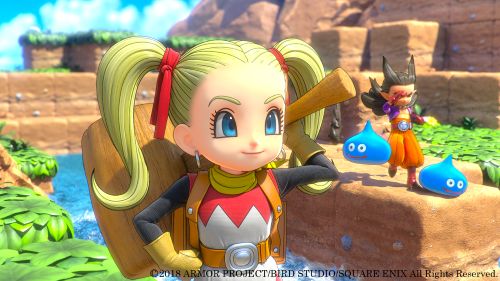
The genre is a “block-making RPG” that fuses action RPG elements with sandbox-style crafting. The catchphrase is “Build the world, break fate.” The setting is the world after the God of Destruction Malroth and High Priest Hargon were defeated in “Dragon Quest II: Luminaries of the Legendary Line” (1987, hereinafter referred to as “DQII”), depicting a situation in which the threat of the “Children of Hargon,” who worship destruction and forbid creation, is rising again.
The protagonist is an apprentice Builder who, together with the amnesiac boy Malroth, uses the deserted “Isle of Awakening” as a base to travel around various islands and restore the ruined world. Story mode and free building elements are organically integrated, and multiplayer for up to four players is also supported.
Trailers
Opening Videos
Main Staff
The general director was Yuji Horii, the director was Kazuya Niinou (Square Enix), and the development director was Takuto Edagawa (Koei Tecmo Omega Force). Producers included Noriyoshi Fujimoto, Takuma Shiraishi, and Tomohiko Sho. The scenario was written by Koya Tsukada, character designs were by Akira Toriyama, and the music was by Koichi Sugiyama. Art directors included Marina Ayano and Yoshikazu Takenouchi.
Whereas the previous game was a collaboration with ArtDink, this title had Omega Force handle development with the aim of enhancing action elements and systems.
Game System
The core of this game is the fusion of a craft system in which blocks are placed and destroyed to construct buildings and towns, and action RPG elements including combat with enemies, exploration, and material gathering. The world is composed of blocks; objects are destroyed with a hammer or similar tools to obtain materials, and tools, furniture, and buildings are created according to recipes.
In story mode, the protagonist uses the Isle of Awakening as a base to visit each island, solves problems on each island, and invites the residents of that island while developing the Isle of Awakening. On various “Explorer’s Shores,” materials for building are gathered, and residents and animals to invite to the Isle of Awakening are sought.
Combat with monsters is a real-time action format via symbol encounters, with weapon attacks as the basis.
After clearing story mode, free building can be focused on in “Buildertopia,” where there are no monsters.
Visuals
The visuals employ fully 3D graphics. All substances in the world, excluding items such as furniture, are composed of cubic blocks, and characters are depicted with proportions of approximately two to three heads tall.
Music and Sound
All music consists of quotations and arrangements of tracks from past Dragon Quest series games (composed by Koichi Sugiyama), with tracks from “DQII” and the Zenithian series (“DQIV,” “DQV,” and “DQVI”) being used particularly frequently.
All in-game dialogue is displayed as text, and character voices are implemented only as non-verbal voices (shouts, groans, emotional laughter, etc.).
Comparison with “Minecraft”
Whereas sandbox games represented by “Minecraft” (2011) are characterized by nearly unlimited freedom and player-driven goal setting, this series is positioned as a “story-driven craft RPG” with clear narrative progression and quest structures. In story mode, acts of creation are linked to the progression of the story and carry significance such as the restoration of the ruined world and the salvation of the residents.
In addition, by incorporating combat and growth elements as an action RPG and utilizing the world view, music, and character designs of the Dragon Quest series, it balances the openness of a sandbox with the narrative experience of a JRPG.
In “Minecraft,” players need to investigate what they can do in the game and set goals for what to do, whereas in this series, story mode serves as a tutorial for building, and the desire to create something naturally arises while following instructions and advancing building within the story.
Plot Overview (Story Mode)
In a world where the remnants of the Children of Hargon seek to eradicate Builders, the protagonist is captured on a cult ship. The ship sinks in a storm, and the protagonist washes ashore on the deserted “Isle of Awakening,” where they meet the amnesiac boy Malroth and the girl Lulu, who was also captured by the cult. Commissioned by the spirit-like Hairy Hermit of the island, they make the Isle of Awakening their base for development while visiting Furrowfield (restoration of the farm), Khrumbul-Dun (revival of the mining town), Skelkatraz (escape from the Children of Hargon’s prison), Moonbrooke (reconstruction of the fortress and battles with monster armies), and other islands, liberating them from the cult’s control. The story unfolds around the opposition of creation and destruction, ultimately leading to Malhalla.
Characters (Story Mode)
Main Characters
- The Builder (Protagonist): An apprentice Builder from Melchid. The player can choose the gender and set the name. A descendant of the legendary Builder who once restored a world covered in darkness. Possesses the power of creation and is regarded as an enemy by the cult.
- Malroth: An amnesiac boy. Possesses the power of destruction and acts as the protagonist’s companion. Has no talent for building but is skilled at fighting monsters and gathering materials.
- Lulu: A girl who, like the protagonist, survived the Children of Hargon’s ship. Formerly lived in the town of Rippleport; her father was a first-class Builder. Acts together with the protagonists on the Isle of Awakening.
- Hairy Hermit: A spirit-like hammerhood residing on the Isle of Awakening. Entrusts the development of the island to the protagonist.
- Captain: A middle-aged man who was caught in a storm and drifted to the Isle of Awakening. Takes the protagonist and Malroth to other islands on his ship.
Furrowfield
- Rosie: A girl living on Furrowfield. Self-proclaimed genius of farming. Struggles to revive the corrupted land and restore the former great farm.
- Bonanzo: A bearded man who works on the farm together with Rosie.
- Pastor Al: A magician-type monster serving as vice-governor of the Furrowfield diocese of the Children of Hargon. Ordered by Governor Brainy Badboon to destroy the village, but becomes interested in building after inspecting the farm and becomes a collaborator of the Builder.
Khrumbul-Dun
- Babs: The former signboard girl of a bar that once existed in the town of Khrumbul-Dun. Wishes to restore the motivation of the listless men of the town and rebuild the mine and the bar.
- Massimo: A roughneck who came to the town of Khrumbul-Dun with his partner Mills to help Babs. Skilled at ore mining but weak against monsters.
- Carlo: A man once known as a skilled blacksmith, but who quit the blacksmith’s trade after the Children of Hargon forbade building.
Skelkatraz
- Molly: An old woman who has been imprisoned on Skelkatraz for many years. From the town of Porth. Cooperates with the protagonist’s escape plan.
Moonbrooke
- Warwick: Captain of the kingdom’s soldiers. Gains hope of defeating the Hargon army through the protagonist’s visit.
- Anessa: General of the kingdom. Claims to be a believer of the Children of Hargon and, while fighting the cult’s forces, shows no intention of winning, but harbors hidden feelings.
- King: In “DQII,” he lost his life in the invasion by Hargon’s army, but survives in this world. While feeling a sense of dissonance about his own existence, he directs the reconstruction of the castle as king.
Comparison with the Previous Game “DQB1”
The previous game “DQB1” was set in Alefgard of “Dragon Quest” I–III (the Erdrick trilogy) and depicted a “what-if world” of “Dragon Quest I” in which “what if the hero had accepted the Dragonlord’s invitation,” whereas this game depicts the world after “DQII.”
“DQB1” had a structure in which an independent free-build-only mode was unlocked after clearing the story, but in “DQB2,” story mode and free-build mode are more closely integrated, and a structure of gradually developing the base Isle of Awakening was adopted. Free building can be done on the Isle of Awakening and other islands even during story progression, and after clearing the story, a free-build mode that begins with the selection of island types is unlocked.
In terms of systems, operability and building freedom have been greatly improved, and improvements that resolve inconveniences pointed out in the previous game have been widely implemented.
“DQB1” had a relatively high action difficulty and was also evaluated as being aimed at core players, whereas “DQB2,” through improved operability and reduced action difficulty, has become a more accessible game that many users, including casual gamers, can enjoy without stress.
The main improvements from the previous game are as follows:
- The upper limit on the height of stackable blocks increased from 31 to 100 layers
- Diagonal cutting of blocks became possible
- Addition of movement methods: dashing, underwater movement, and gliding with the “Winged Cape” became possible
- Addition of new tools:
- Builder’s Eye: Allows placement and destruction of blocks from a distance
- Gloves: Allows carrying objects without breaking them
- Builder’s Pencil: Scans structures and outputs blueprints
- Renovation Trowel: Swaps blocks in bulk
- Cutter: Shapes blocks into various forms
- Bottomless Pot: A tool for scooping and pouring liquids. Allows free setting of water sources
- Addition of an auto-build function in which residents automatically build based on blueprints
- Switching between third-person and first-person perspectives became possible
- Introduction of a system for collecting Builder’s Hearts to raise Build Level
- Introduction of an experience level system in which the protagonist levels up through combat with monsters
- Support for online and local communication (Switch version only) multiplayer. Up to four simultaneous players possible
- Addition of a “Photo Mode” for taking pictures
- Implementation of a “Bulletin Board” for posting and sharing photos
- Abolition of contact damage with enemy monsters
- Abolition of durability for equipment (weapons and armor), making them unbreakable
- Evolution of NPC behavioral AI
Connection with “DQII”
The setting of this game is the world after the God of Destruction Malroth and Hargon were defeated by the three heroes of Erdrick’s bloodline in “DQII.” The cult that inherits Hargon’s will forbids creation and spreads the doctrine of worshipping destruction. In the latter half of the story, it is revealed that this world itself is an illusory world created by Hargon.
Theme Analysis: The Cyclical Structure of Creation and Destruction
The central theme of this game is the binary opposition of creation and destruction and its sublation. The Children of Hargon regard destruction as absolute salvation and creation as evil, but the protagonist regards destruction as material gathering that is a prerequisite for creation, cyclically linking the two. Malroth, as the embodiment of destruction, comes to find meaning in creation through interaction with the protagonist.
The setting of the “illusory world” revealed at the end further deepens this theme as a cycle of the world’s ruin and regeneration. The illusory world created by Hargon faces the crisis of annihilation due to the will of destruction, but is established as a “real” world through the fusion of the Builder’s power of creation and Malroth’s power of destruction.
The structure in which acts of creation become the very condition for the world’s existence can be said to skillfully weave the meta-character of sandbox games into a story of the world’s ruin and regeneration.
Reception
This game received 37 points out of 40 in the cross-review of “Weekly Famitsu” and entered the Platinum Hall of Fame. Reviewers highly evaluated a proper evolution from the previous game, the point that the fun of building can be naturally acquired through kind and gradual introduction, the improvement in convenience through the addition of Builder tools, multiplayer support, the system in which residents’ joy is visualized as “Builder’s Hearts” and linked to base development, and the close connection between story and gameplay. In particular, comments such as “becoming absorbed in the fun of creating and feeling happy just by playing” were received, emphasizing the success of the fusion of acts of creation and story progression.
Outside Japan, on the review aggregation site Metacritic, it recorded an overall score of approximately 86 (for the PS4 version, etc.) and was rated “generally favorable.” The fusion of creation and story, major improvements from the previous game, charming character relationships (especially the bond between the protagonist and Malroth), and the improvement in building freedom and comfort were widely praised, while some pointed out the monotony of combat and the lack of depth in action elements.
Commercially, it was announced that worldwide cumulative shipments exceeded 1.1 million units as of August 2019. Domestic first-week sales in Japan were approximately 200,000 units centered on physical copies (with PS4 and Switch versions nearly equal), and it subsequently became a stable long-seller.
At the 2019 Japan Game Awards, it received the Award for Excellence in the Annual Game category, with the selection reason cited as “realization of multiplayer for up to four players. The fun of ‘building’ greatly powered up from the previous game, and a heartwarming story.”
Overall, its pioneering significance in fusing sandbox and JRPG genres has been widely recognized, and it is positioned as a successful work that further elevated the completeness of the previous game.
International Expansion and Localization
After the Japanese release, a Traditional Chinese version was released for PlayStation 4 in Hong Kong and Taiwan on January 24, 2019. On July 12, 2019, it was released in North America and Europe under the title “Dragon Quest Builders 2” for PlayStation 4 and Nintendo Switch, supporting English, French, German, Italian, and Spanish.
The Steam version was released in December 2019, and the Xbox One and Windows 10 versions were released in May 2021. In the Steam and Xbox versions, paid DLC Packs 1 through 3 are included with the main game.
Text (interface) supported languages vary slightly by platform, but the Steam version supports the following nine languages:
- Japanese
- English
- French
- Italian
- German
- Spanish
- Korean
- Traditional Chinese
- Simplified Chinese
DLC List
The main paid DLC are as follows (based on Japanese release timing).
- Pack 1 “Hotto Stuff Pack” (February 2019): Adds over 40 recipes for Japanese-style furniture, building materials, crops, etc., and a dedicated material island.
- Pack 2 “Aquarium Pack” (March 2019): Adds a fishing system, fish-rearing and aquarium-related items, and Angler’s Isle.
- Pack 3 “Modernist Pack” (May 2019): Adds over 70 recipes for modern building materials, furniture, equipment, etc.
Free DLC such as the New Year Pack were also distributed. In the Steam and Xbox versions, these paid DLC are included with the main game.
Official Website
Dragon Quest Builders 2 Official website (Square Enix)
Search Link
Search for “Dragon Quest Builders 2” on Steam
Story Mode Synopsis (Contains Spoilers)
Prologue: Children of Hargon’s Ship to the Isle of Awakening
The apprentice Builder protagonist is captured by the remnants of the Children of Hargon and awakens in the brig of a cult ship. While performing various tasks ordered by the cult on the ship, the ship is caught in a storm and sinks.
The protagonist washes ashore on the deserted “Isle of Awakening” and meets the amnesiac boy Malroth there. Reuniting with Lulu, who also survived the same ship, they are entrusted with the development of the island by the island’s spirit Hairy Hermit. Thereafter, the protagonist uses the Isle of Awakening as a base to travel around various islands, gathering materials and residents while developing the island.
Furrowfield
The first island visited, Furrowfield, was once a lush agricultural island, but under the control of the Children of Hargon the land had become corrupted and plants would no longer grow. The protagonist and Malroth cooperate with the residents to purify the corrupted land and revive the Deitree. In the decisive battle with Brainy Badboon, governor of the Furrowfield diocese, they use banana peels to trip Brainy Badboon and attack during the opening. After victory, the protagonist invites some of the residents to the Isle of Awakening and advances development based on agriculture.
Khrumbul-Dun
The next island visited, Khrumbul-Dun, is a desert and mining island. It once thrived with a gold rush, but the mines were closed by order of the Children of Hargon, causing the residents to lose motivation and the town to become desolate and lifeless. The protagonist digs through the mines, befriends the golem Goldirox, and mines various ores. In the battle with Madusa, governor of the Khrumbul-Dun diocese, they ride Goldirox to reflect rays and succeed in defeating her. The residents regain their motivation, and the protagonist obtains mining-related techniques and residents before returning to the Isle of Awakening.
Skelkatraz
The protagonist and Malroth are captured by the cult and sent to Skelkatraz as prisoners, but cooperate with prisoners and monsters they meet on the island to escape and leave the island.
Moonbrooke
Visiting the snow-covered Moonbrooke, the protagonist and Malroth reconstruct the castle together with the soldiers while confronting the cult’s threat, using magical weapons to repel enemies. In the decisive battle with Atlas, grand governor of the Moonbrooke diocese, they achieve victory by firing the “Mindein Cannon.”
Through the restoration of the kingdom, it gradually becomes clear that this world is an illusory world created by Hargon. Through the memories of the King of Moonbrooke, the origins of the illusory world and the fact that Malroth’s true identity is the God of Destruction Malroth are revealed.
Malhalla
Hargon, who exists as a ghost-like presence in this world, takes Malroth away and awakens him as the God of Destruction Malroth. Pursuing Malroth and leaping into a black vortex (a rift in space), the protagonist wanders into the space of dark wilderness known as “Malhalla.”
The protagonist builds an ark together with the monsters in order to help them escape from the collapsing Malhalla.
After confronting Hargon at Hargon’s Castle floating above Malhalla, the protagonist saves the personality of the boy Malroth from the body of the God of Destruction and, cooperating with the boy Malroth, defeats the God of Destruction.
The protagonist and Malroth combine their respective powers of creation and destruction to establish the illusory world as a real world.
Epilogue
Returning to the Isle of Awakening, the protagonist and Malroth continue the further development of the island together with their companions.