























































































- Overview
- Official PVs
- Main Staff
- Battle System and Magatama
- Story
- Main Characters
- Nocturne’s Innovations Within the Shin Megami Tensei Series
- Differences Between the Original and the HD Remaster
- Reception
- Release History and Localization Outside Japan
- Soundtracks
- HD Remaster DLC List
- Official Website
- Search Link
- Synopsis (Spoilers)
Overview
The “Shin Megami Tensei” series is a popular JRPG franchise typically set in present-day Tokyo, known for its system of negotiating with and recruiting demons as allies, its bleak and decadent worldview, and its multiple-ending structure, in which the story’s outcome branches according to the player’s choices.
“Shin Megami Tensei III: Nocturne” (hereafter “Nocturne”) is a role-playing game developed by Atlus as the third mainline entry in the “Shin Megami Tensei” series, released for the PlayStation 2 in Japan on February 20, 2003.
Arriving roughly nine years after “Shin Megami Tensei II” (1994), it is the first numbered entry to break from the direct narrative continuity of the previous two games, standing as a self-contained work.
The story begins with a catastrophic event known as the Conception, which destroys Tokyo and remakes it as the Vortex World, a realm overrun by demons. Caught up in the event, the protagonist becomes the Demi-Fiend, a being suspended between human and demon, and navigates the ruined city among survivors who each champion a Reason — a philosophy for what the reborn world should be — while deciding what kind of world he himself will choose. The game’s original marketing tagline — “Tokyo died, and I was born.” — is often cited as a concise statement of this premise.
On January 29, 2004, an expanded edition, “Shin Megami Tensei III-NOCTURNE Maniax,” was released, adding new scenarios, a guest appearance by Dante of Capcom’s “Devil May Cry,” a new dungeon, the Labyrinth of Amala, along with a new ending unlocked through it, and new demons and Fiends — as well as shorter load times, a difficulty selection, and improved hit rates for physical skills. On October 23, 2008, “Shin Megami Tensei III-NOCTURNE Maniax Chronicle Edition,” replacing Dante’s appearances with Raidou Kuzunoha of Atlus’s own “Devil Summoner” series, was bundled with the limited edition of “Devil Summoner: Raidou Kuzunoha vs. King Abaddon.”
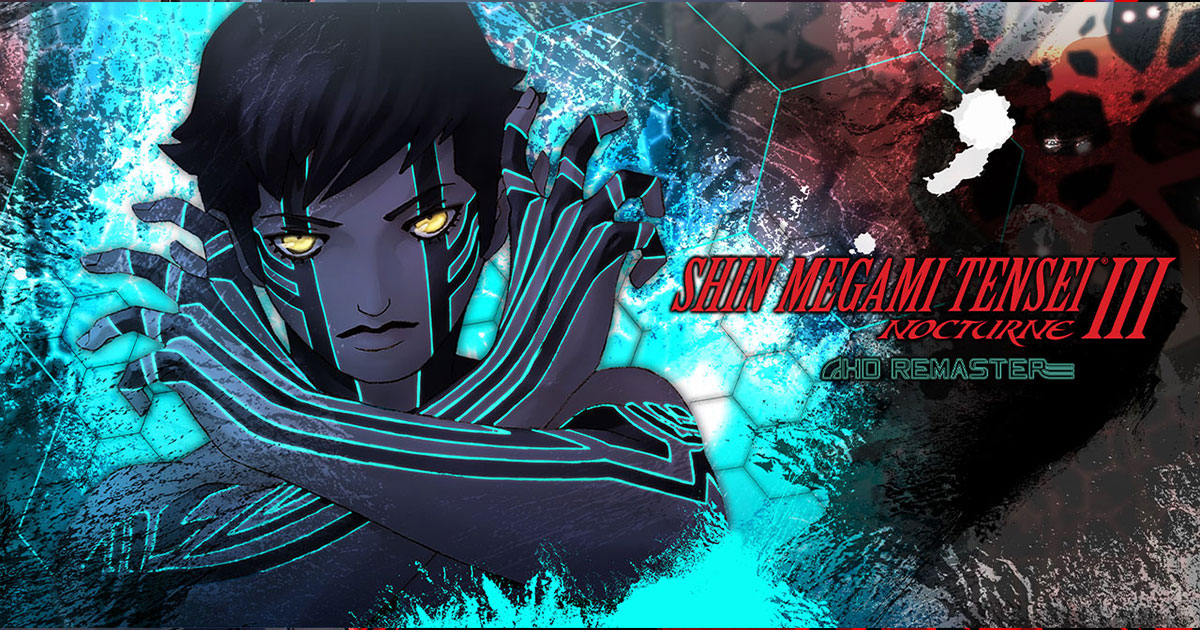
An HD remaster based on “Maniax Chronicle Edition,” “Shin Megami Tensei III Nocturne HD Remaster,” was released for Nintendo Switch and PlayStation 4 on October 29, 2020. A Steam release followed on May 25, 2021, based instead on the content of the original 2003 release. Content equivalent to “Maniax Chronicle Edition” (the appearance of Raidou Kuzunoha) is made available separately as the free “Chronicle Pack” DLC, while content equivalent to “Maniax” (the appearance of Dante) is made available as the paid “Maniax Pack” DLC.
Official PVs
Main Staff
Katsura Hashino served as chief director, Kazuma Kaneko as creative director — also handling character and demon design and art direction — and Koji Okada as producer.
The scenario concept and setting were credited to Hisashi Kimura, with the scenario itself written primarily by Shogo Isogai. Shigenori Soejima, as event art director, was primarily responsible for character design and event-related visuals. Event planning was handled by Shigeo Komori and Kazuyuki Yamai, who also served as field planning director.
Shoji Meguro served as main composer, with Toshiko Tasaki and Kenichi Tsuchiya as sound creators.
Yamai went on to direct the following year’s expanded edition, “Maniax,” as well as the 2020 HD Remaster.
Battle System and Magatama
Combat is a command-based, turn-based system triggered by random encounters. The Press-Turn system, introduced here for the first time in the series, allows a party to gain extra actions (half-turns) by exploiting an enemy’s elemental weakness or landing a critical hit, while an attack that is nullified, reflected, or absorbed costs the party its remaining turns. This system of offensive and defensive risk became the series’ signature mechanic, later carried forward into subsequent numbered entries and into the “Persona” series.
Because the protagonist is the Demi-Fiend, a being half human and half demon, he does not equip weapons or armor as protagonists of earlier entries did. Instead, he wears Magatama — crystallized fragments of demonic power — which alter his elemental affinities, the skills he can learn, and his stat growth. Allied demons now level up through experience points rather than remaining static, and demon fusion was expanded with Sacrificial Fusion, which allows a third demon to be consumed as material in a fusion.
Story
The story is set in Tokyo in the year 200X. The protagonist and his high school classmates Isamu Nitta and Chiaki Tachibana set out to visit their homeroom teacher, Yuko Takao, who is in the hospital. At the same time, a man named Hikawa has drawn scrutiny over the redevelopment of Shinjuku Medical Center and the construction of a communications tower there. Hijiri, a reporter for the occult magazine “Monthly Ayakashi,” has been chasing a prophecy tied to the Cult of Gaea and its Scripture of Miroku, which foretells that the world will be plunged into chaos.
Arriving at the hospital, the three find it deserted, and Isamu goes off in search of their teacher. In the basement, the protagonist runs into Hikawa and learns that Yuko is being groomed as the “Maiden” at the center of a new world’s creation. Summoned to the roof, Yuko tells him of the coming “Conception” — the rebirth of the world — and of her own role at its center. Moments later, every person in the hospital but the three of them dies as the Conception occurs.
A mysterious boy accompanied by an old woman in mourning dress gives the protagonist a corrupted Magatama bearing demonic power, and he survives as the Demi-Fiend, a being suspended between human and demon.
The theme of the Reason runs through the entire story. Amid the ruins, the human and demon survivors each champion a Reason — a philosophy for the world to come — and compete to see theirs realized. Chiaki comes to embody Yosuga, a Reason of survival of the fittest; Isamu embodies Musubi, a Reason of severing all ties to others and building a closed world of one’s own; and Hikawa embodies Shijima, a Reason of a silent, static order purged of chaos. The Demi-Fiend himself may refuse to commit to any of these Reasons, and it is left to the player to decide, ultimately, what kind of world he will choose — or whether he will reject the very idea of a Reason.
Main Characters
The Protagonist (The Demi-Fiend)
No formal name is given. A young man caught up in the Conception, who is transformed by a parasitic Magatama into the Demi-Fiend, a being suspended between human and demon. He fights by equipping Magatama rather than weapons or armor, and commands demons directly without the aid of a COMP device — a marked departure from the protagonists of earlier entries.
Isamu Nitta
A friend of the protagonist, one of the three classmates caught in the Conception. Over the course of the story he comes to embody Musubi, a Reason that severs all ties to others in favor of a closed world of one’s own.
Chiaki Tachibana
A friend of the protagonist, one of the three classmates caught in the Conception. Over the course of the story she comes to embody Yosuga, a Reason of survival of the fittest, in which only the strong are meant to endure.
Hijiri (Jōji Hijiri)
A reporter for the occult magazine “Monthly Ayakashi.” He had been pursuing the Cult of Gaea and its prophecy before the Conception, and becomes deeply entangled in the protagonist’s activities afterward. He is among the few who commit to no Reason.
Hikawa
Chief Technical Officer of the telecommunications firm Cybers Communications and a senior figure in the demon-worshipping Cult of Gaea. He is the architect of the Conception, and comes to embody Shijima, a Reason envisioning a silent, static order purged of all chaos and conflict.
Yuko Takao
The protagonist’s homeroom teacher. Caught up in the Conception while hospitalized, she is made the “Maiden” at the center of the new world’s creation.
Dante / Raidou Kuzunoha
A mysterious visitor who confronts the Demi-Fiend somewhere within the Vortex World. In the “Maniax” expansion of the original release, this role was filled by Dante of Capcom’s “Devil May Cry”; in the later “Maniax Chronicle Edition” and in the HD Remaster, it is filled by Raidou Kuzunoha, protagonist of Atlus’s own “Devil Summoner” series. The HD Remaster allows Dante’s appearance to be restored through the paid “Maniax Pack” DLC.
Nocturne’s Innovations Within the Shin Megami Tensei Series
Through its first two entries, the “Shin Megami Tensei” series had been built on Super Famicom hardware, exploring 3D dungeons from a first-person perspective. “Nocturne” moved the platform to the PlayStation 2 and rebuilt both towns and dungeons as freely explorable 3D spaces viewed from a third-person perspective. Seeing Kazuma Kaneko’s demon designs modeled in three dimensions for the first time was, for series fans at the time, a genuine shock.
The narrative innovation was just as significant: casting a protagonist who had always been human, in every prior entry, as the Demi-Fiend — a being half human and half demon — marked the series’ most singular turning point. Moving away from demon summoning mediated by a COMP device, in favor of a protagonist who wields demonic power directly, broadened the range of what a “Shin Megami Tensei” protagonist could be in the games and spin-offs that followed.
The system’s greatest contribution, however, was the Press-Turn battle system described above. Its clear, highly strategic logic — exploit a weakness and gain extra actions, get nullified, reflected, or absorbed and lose them — was not only adopted as a standard feature of later numbered entries, but also influenced the “1 More” system in “Persona 3” (2006), which can be seen as a development of the Press-Turn system. The move to demons that level up on their own, together with the introduction of Sacrificial Fusion — which incorporates a third demon into a fusion — also deepened the game’s demon-raising systems considerably.
In terms of narrative structure, “Nocturne” inherits from its predecessors “Shin Megami Tensei” (1992) and “Shin Megami Tensei II” (1994) a development in which the ending branches according to the player’s choices — a feature consistent across the series. In those two games, the story’s outcome was determined by which of three factions — Law, Chaos, or Neutral — the player sided with; “Nocturne,” building on this tradition, deepens this structure into a more layered, relativized conflict among the Reasons embodied by its various characters, branching in the end into six different endings.
Differences Between the Original and the HD Remaster
“Shin Megami Tensei III Nocturne HD Remaster,” released October 29, 2020, was developed under a stated policy of “respecting the original,” and alongside its graphical upgrades, made a number of improvements to controls and UI aimed at overall playability. Its principal changes and additions are as follows:
- High-definition (HD) graphics
- Added voice acting for event scenes (can be toggled on or off)
- Ability to change the difficulty setting mid-game
- Added the lowest difficulty option, “Merciful” (free DLC)
- Added a suspend-save function
- A skill-shuffle function and skill-inheritance function added to the demon fusion result screen (added via update version 1.02)
- Faster normal-attack animations during auto-battle (added via update version 1.02)
The total roster of 180 demons is unchanged from the PS2 Chronicle Edition, and the underlying game itself was not substantially reworked from the original or “Maniax.” The remaster’s character lies in a largely cosmetic refresh laid over an already-finished game design, rather than in any structural revision.
Reception
At its Japanese release, the original “Nocturne” received a score of 35 out of 40 in Weekly Famitsu’s Cross Review, earning a place in the magazine’s Platinum Hall of Fame. According to weekly sales rankings reported by Dengeki Online, it sold an estimated 150,000 copies in its first week, with cumulative sales reaching roughly 240,000 units (both figures approximate).
Outside Japan, the localized version based on the “Maniax” edition was released in North America in 2004 and in Europe in 2005, and was well received, holding an aggregate score of 82 on the review aggregator Metacritic (as of this writing). Western reviews generally praised the game’s bleak, unforgiving atmosphere, its dense soundtrack, and its highly strategic battle system, while its punishing difficulty — among the highest in the series — and a design in which the game ends the instant the protagonist himself is defeated, proved more divisive, drawing both criticism and praise. The desolate world that follows the Conception, harsher than the settings of earlier entries in the series, was likewise praised by some for its uncompromising bleakness and criticized by others as off-putting.
“Shin Megami Tensei III Nocturne HD Remaster” sold 52,481 copies on Nintendo Switch and 48,830 copies on PlayStation 4 in its Japanese retail launch week (October 29–November 1, 2020), for a combined opening of roughly 100,000 units. Atlus announced in April 2021 that combined packaged and digital sales across Japan and Asia had surpassed 250,000 units, and its 2022 financial results reported that worldwide sales had exceeded 600,000 units.
On the review aggregator Metacritic, as of this writing, the PC version holds a score of 79, the PlayStation 4 version 76 (with a user score of 7.8), and the Nintendo Switch version 75.
Within the series, “Nocturne” is often cited as a turning point. Its central elements — the Demi-Fiend as a half-human, half-demon protagonist, the Press-Turn battle system, and a branching structure built around multiple competing Reasons — laid the groundwork for the “Shin Megami Tensei” series that followed.
Release History and Localization Outside Japan
The original release of “Nocturne” (2003) was limited to Japan and was never released outside the country. The version localized for release outside Japan was based on the expanded “Maniax” edition (2004), which included new scenarios: it was released in North America on October 12, 2004, by Atlus USA as “Shin Megami Tensei: Nocturne” (dropping the “III” from the title), and in Europe on July 1, 2005, by Ghostlight as “Shin Megami Tensei: Lucifer’s Call.” At the time, the game itself had no full voice acting beyond battle vocalizations, and the localization of event scenes was carried out through text translation alone.
“Shin Megami Tensei III Nocturne HD Remaster” was first released for Nintendo Switch and PlayStation 4 in Japan, China, and South Korea on October 29, 2020, followed by a release for the same platforms across North America, Europe, and other regions on May 25, 2021. That same day also saw the series’ first-ever Steam (PC) release, launched worldwide simultaneously. As noted above, the Switch/PS4 versions and the Steam version differ in which content they take as their baseline, and the Steam version is also the first official release in the West to offer the original game itself.
All platforms support Japanese and English voice acting, switchable at any time. Text-language support is broader on Steam, which covers eight languages: Japanese, English, French, Italian, Spanish, German, Korean, and Traditional Chinese.
Soundtracks
The principal official soundtrack releases are as follows.
- “Shin Megami Tensei III-NOCTURNE” Original Soundtrack (released March 5, 2003, SME Visual Works / Aniplex, a double CD)
- Contains the game’s main score.
- “Shin Megami Tensei III-NOCTURNE Maniax” Soundtrack Extra Version (released February 4, 2004, Aniplex)
- An extra edition containing only the additional tracks introduced in the Maniax edition, including Dante-related music.
- “Shin Megami Tensei III NOCTURNE HD REMASTER Piano Arrange + Rare Soundtrack” (October 29, 2020, bundled with the HD Remaster box set, a double CD)
- Contains ten piano arrangements performed by the pianist known by the stage name Duke of Pianeet (real name Yui Morishita), along with twenty-seven previously unreleased rare tracks.
- “Shin Megami Tensei III NOCTURNE Sound Collection” (released December 16, 2020, Mastard Records, 5-disc CD set)
- Compiles the three releases above. Released simultaneously as a physical CD package and as a digital release.
HD Remaster DLC List
- MERCIFUL Difficulty (Free)
- Adds the game’s easiest difficulty mode.
- Chronicle Pack (Free)
- Adds the content of the Chronicle Edition to the Steam version, including the appearance of Raidou Kuzunoha of the “Devil Summoner” series.
- Maniax Pack (Paid)
- Replaces every appearance of Raidou Kuzunoha with Dante of “Devil May Cry.”
- Mercy and Expectation Map Pack (Paid)
- Adds two dedicated grinding maps: “Little Master’s Mercy,” for farming leveling-up items (Grimoires), and “Master’s Expectation,” for farming items that can be sold at shops for Macca.
- Shin Megami Tensei BGM Pack 1–4 (Paid)
- Allows the background music heard while exploring the overworld map and during battle to be swapped for tracks from other entries in the “Shin Megami Tensei” series (Pack 1: “Shin Megami Tensei”; Pack 2: “Shin Megami Tensei II”; Pack 3: “Shin Megami Tensei IV”; Pack 4: “Shin Megami Tensei IV: Final”).
Official Website
Search Link
Search for “Shin Megami Tensei III Nocturne” on Steam
Synopsis (Spoilers)
The Conception
In the year 200X, the protagonist and his high school classmates Isamu and Chiaki arrange to meet at Yoyogi Park Station on their way to visit their hospitalized homeroom teacher, Yuko. At the same time, a man named Hikawa, of the telecommunications firm Cybers Communications, has drawn scrutiny over the redevelopment of Shinjuku Medical Center and the construction of a communications tower there. Hijiri, a reporter for the occult magazine “Monthly Ayakashi,” has been chasing a prophecy tied to the Cult of Gaea and its Scripture of Miroku, which foretells that the world will be plunged into chaos.
The three arrive to find the hospital deserted, and Isamu goes off in search of their teacher. In the basement, the protagonist runs into Hikawa and learns that Yuko is being groomed as the “Maiden” at the center of a new world’s creation. Summoned to the roof, Yuko tells him of the coming Conception and of her own role at its center. Moments later, every person in the hospital but the three of them dies as the Conception occurs.
A mysterious boy accompanied by an old woman in mourning dress gives the protagonist a corrupted Magatama bearing demonic power, and he survives as the Demi-Fiend. Still within Shinjuku Medical Center, he encounters the fairy Pixie and takes her on as an ally, then defeats Forneus, the fallen angel who had claimed the building as its own.
Yoyogi Park to Shibuya
Leaving the hospital, the Demi-Fiend arrives at Yoyogi Park to find it overrun by fairies, its construction site transformed into a warped, alien space. Tokyo itself has become the Vortex World, a spherical realm centered on Kagutsuchi, the source of the destruction that reshaped it.
At a disco in Shibuya he crosses paths with Chiaki again, but she disappears in search of other survivors. At a terminal he reunites with Hijiri, who introduces him to the Amala Network, a strange transit system of corridors threaded throughout the Vortex World. Hijiri, having learned that a group calling itself the Assembly of Nihilo has surfaced in Ginza, pursuing “creation,” and that Hikawa is connected to it, sets off after Hikawa’s trail.
Ginza to Ikebukuro
In Ginza, an organization called the Assembly of Nihilo, under Hikawa’s command, is gathering Magatsuhi — the force needed to bring a Reason into being — from the Amala Network. The Demi-Fiend probes Hikawa’s activities there. In Ikebukuro, meanwhile, the Mantra Army, a demon force led by Gozu-Tennoh, is enslaving Manikins, remnants of humanity, in pursuit of a utopia meant only for the strong. Passing through the Harumi Warehouse and the Great Underpass of Ginza, the Demi-Fiend reaches Ikebukuro and reunites with Isamu there.
At Mantra Army headquarters, after prevailing in a trial by combat, the Demi-Fiend defeats the ogre-god Thor. The Mantra Army later launches an assault on the Assembly of Nihilo, but the Assembly counters by activating the Nightmare System, a device that uses Yuko as its medium to drain Magatsuhi across the battlefield, shattering the Mantra Army. Gozu-Tennoh is destroyed as his Magatsuhi is stripped from him, though his consciousness survives and he is later restored. Over the course of these events, Chiaki begins to articulate Yosuga, a paradise for the strong, and Isamu begins to articulate Musubi, a closed world severed from others, as Reasons of their own.
The Labyrinth of Amala to Kabukicho Prison
The Demi-Fiend is approached by a mysterious pair — an old gentleman and a lady in mourning dress — who ask him to recover the Menorah, flames of life housed on each level of the Labyrinth of Amala, from the Fiends who have taken them. At Kabukicho Prison he defeats the Fiend Mizuchi and frees Futomimi, a Manikin with the power to see the near future, and finds Isamu among the prisoners there — only for Isamu to vanish into the depths of the Amala Network. Following Futomimi’s prophecy, the Demi-Fiend heads to Ginza, where he reunites with Hijiri.
Asakusa to the Obelisk
With the Mantra Army’s collapse, the Manikins it once enslaved have begun rebuilding Asakusa. Before the sacred site of Mifunashiro, the Demi-Fiend meets Futomimi again, but is barred from entering. Hijiri, investigating the true nature of the Nightmare System, discovers that the Obelisk in Chiyoda is its core, a device for harvesting Magatsuhi, and asks the Demi-Fiend to shut it down.
The Obelisk is guarded by the Moirae Sisters — Clotho, Lachesis, and Atropos — but the Demi-Fiend defeats them and disables it. At the tower’s summit, he frees Yuko, who realizes she was used only as a tool to gather Magatsuhi for Hikawa, and who charges him, in the name of the goddess of freedom Aradia, to pursue a creation of his own.
Through Hijiri’s arrangement, the Demi-Fiend is transported deep into the Amala Network, where he reunites with Isamu, who speaks of Musubi — a world with all ties to others severed, belonging to no one but himself. Chiaki, meanwhile, has fully committed to Yosuga, a world for the strong alone, and Hikawa has likewise made clear his commitment to Shijima, a silent order purged of all chaos.
The Moment of Choice
Having confronted the champions of each Reason across the Vortex World, the Demi-Fiend spends the story’s final stretch choosing, again and again, whether to side with Isamu, Chiaki, or Hikawa. The ending the story reaches depends on which Reason, if any, these choices affirm most strongly:
- Musubi ending: siding with Isamu’s Reason and answering “yes” to his question deep within the Amala Network.
- Yosuga ending: siding with Chiaki’s Reason and answering “I understand” to her question at Mifunashiro.
- Shijima ending: siding with Hikawa’s Reason and answering that he will “keep watching as things are” to Hikawa’s question.
- Freedom ending: siding with none of the three Reasons, granting Yuko’s request at Yoyogi Park, and telling the goddess Aradia, both times she asks, that he does not fear her.
- Demon ending: siding with none of the three Reasons and failing to meet the conditions for the Freedom ending — telling Aradia that he does fear her, or declining Yuko’s request.
- True Demon ending: reaching the deepest point of the Labyrinth of Amala before entering the Tower of Kagutsuchi, which overrides every other condition above.
In every route, the Demi-Fiend ascends the Tower of Kagutsuchi, the core of the world, and faces a final battle drawn from among Ahriman, Noah, and Kagutsuchi — with Lucifer added to that lineup only on the route that reaches the True Demon ending — before deciding, by his own hand, what shape the new Tokyo will take.