













































































Overview
“Cluster & Eno” is a collaborative studio album by the German electronic music duo Cluster (Dieter Moebius and Hans-Joachim Roedelius) and the British musician Brian Eno. It was released in August 1977 by the German label Sky Records. The recording took place in June of the same year at Conny’s Studio.
While based in ambient music, the album is a collection of gentle and melodic instrumental pieces in which Cluster’s avant-garde and experimental electronic sounds intersect with Eno’s textural approach.
It consists of nine tracks with a total running time of approximately 36 minutes and 10 seconds. It is positioned as an important nodal point in the transitional period from kosmisch / krautrock to ambient. It has established a critical reputation as a work that anticipated the later development of ambient music in a form that preceded Eno’s own “Ambient 1: Music for Airports” (1978).
Background of Production
Cluster was formed in Berlin in 1971 as a successor to Kluster, which included Conrad Schnitzler. On albums such as “Zuckerzeit” (1974) and “Sowiesoso” (1976), the duo was shifting from motorik rhythms toward pastoral and minimal electronic sounds. Meanwhile, after leaving Roxy Music, Eno had already deepened his ideas about environmental music on “Discreet Music” (1975) and refined his approach of treating the studio as an instrument through collaborations with Robert Fripp and others.
The two parties first came into contact in 1975, when Eno joined Cluster on stage during a live performance in Hamburg. Having confirmed their shared exploratory interests, the three musicians later participated in a September 1976 session with Harmonia (Cluster plus Michael Rother of Neu!), which was released years afterward as “Tracks and Traces.” They then began full-scale collaborative recording in June 1977. Conny Plank’s studio was one of the centers of experimental music in Germany at the time, and the work is said to have proceeded in an open and improvisational atmosphere. The album “After the Heat” from the following year was also born from the same group of sessions.
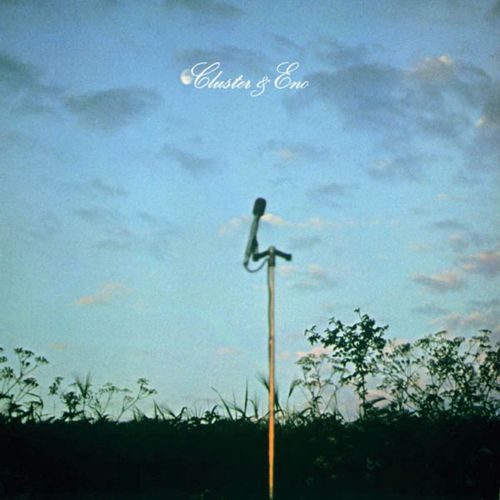
The jacket was designed by Cluster themselves and features a striking photograph of a microphone pointed toward the evening sky. It symbolizes an attitude of “listening” to environmental sounds and serves as a visual declaration that resonates with the ambient concept Eno would later theorize.
Production Methods
The album is primarily constructed around analog synthesizers, effect-processed guitar, piano, and minimal rhythmic elements. All three musicians are credited as composers, with no individual performance credits specified, yet Roedelius’s piano melodic lines, Moebius’s textures, and Eno’s sound processing and spatial design blend organically. Conny Plank served as engineer and co-producer, with J. Krämer assisting.
Guest musicians include Holger Czukay of Can on bass for “Ho Renomo,” and Asmus Tietchens (synthesizer) and Okko Bekker (guitar) on “One.” Overall, the music is based on loops and repetition while avoiding excessive reliance on drones, unfolding diverse moods and textures within short time frames. The balance between improvisational resonance and precise sound processing is characteristic. While pastoral, it evokes a subtle unease, setting it apart from mere “pleasant background music.”
Reception
At the time of its release, the album was primarily supported by specialized listeners of experimental and electronic music, and it gained wider recognition through later reevaluation.
AllMusic commented that the best of the album’s instrumental pieces are “too emotionally rich to waste as mere background music, evoking feelings of hesitancy and regret that rescue the music from mere vapid prettiness.” In particular, it cited the three tracks “Wehrmut,” “Steinsame,” and “Schöne Hände” as anticipating the later deepening of ambient music.
Pitchfork awarded the reissue 8.7 points and positioned the album as demonstrating that “the parties had developed along parallel paths but discovered something new and fresh by working together.”
Asmus Tietchens stated in the reissue liner notes that it was the “first ever ambient production on German soil,” regarding it as a practice that preceded Eno’s “Music for Airports.”
For Cluster as well, the album became an opportunity to attract international attention, and it is regarded as an important record of the late 1970s that is also linked to Eno’s Berlin-period activities (including his collaboration with David Bowie). As a work in which the afterglow of krautrock intersects with the buds of ambient, it is often evaluated as a masterpiece rich in warm emotion yet possessing a depth that does not remain mere healing.
Track Descriptions
1. “Ho Renomo” (5:07): A gentle opening track. Elegant piano melodies intertwine with crisp guitar, supported by Holger Czukay’s understated bass. The sonic dialogue among the three creates a space that is pastoral and open.
2. “Schöne Hände” (Beautiful Hands, 3:03): Characterized by watery synthesizer effects, Moog vibrato, and a shivering rhythmic pattern. A representative track in which Eno’s sound processing fuses with Cluster’s minimal propulsion.
3. “Steinsame” (Stone Seeds, 4:06): Effect-processed guitar plays a slow figure over a dark, almost funereal synthesizer melody. A gloomy and meditative atmosphere dominates, giving the track a particularly emotional depth within the album.
4. “Wehrmut” (Wormwood, 5:01): Pensive piano intersects with floating synthesizers, unfolding slowly at a delayed tempo while inviting hesitancy and nostalgia.
5. “Mit Simaen” (1:30): A very short interlude-like piece centered on Roedelius’s piano.
6. “Selange” (3:30): Based on a rhythmic pattern, with piano and synthesizer adding light decoration, producing a pleasant sway within minimal repetition.
7. “Die Bunge” (3:45): Electronic sounds suggestive of bird calls and frog voices evoke a strange wetland or otherworldly marsh. A percussive rhythm resembling horse hooves appears, where cartoonish humor and uncanny elements coexist. A unique track in which Cluster’s playfulness intersects with Eno’s environmental sound approach.
8. “One” (6:06): The longest track on the album, with pronounced Indian musical influences. Sitar-like drones, effect-processed guitar noise, and exotic percussion layer to form an early ethno-ambient space. The participation of Asmus Tietchens and Okko Bekker enriches the texture, presenting a hypnotic and trippy development.
9. “Für Luise” (For Luise, 3:20): A track based on piano that is angelic yet somewhat dark. Its quiet and introspective atmosphere gently closes the album as a whole.
Tracklist
Total approximately 36:10 (based on the original LP; slight differences in notation may appear on reissues). All tracks composed by Brian Eno, Dieter Moebius, and Hans-Joachim Roedelius.
- Ho Renomo – 5:07
- Schöne Hände – 3:03
- Steinsame – 4:06
- Wehrmut – 5:01
- Mit Simaen – 1:30
- Selange – 3:30
- Die Bunge – 3:45
- One – 6:06
- Für Luise – 3:20
Personnel
Cluster & Eno
- Hans-Joachim Roedelius
- Dieter Moebius
- Brian Eno
Additional Musicians
- Holger Czukay – bass (“Ho Renomo”)
- Okko Bekker – guitar (“One”)
- Asmus Tietchens – synthesizer (“One”)
Production
- Conny Plank, Cluster – production
- Conny Plank – engineering
- J. Krämer – assistant engineering
- Cluster – cover
Streaming Services
Search Links
Search for “Cluster & Eno” on Amazon.com
Search for “Cluster & Eno” on Apple Music