








































































Overview
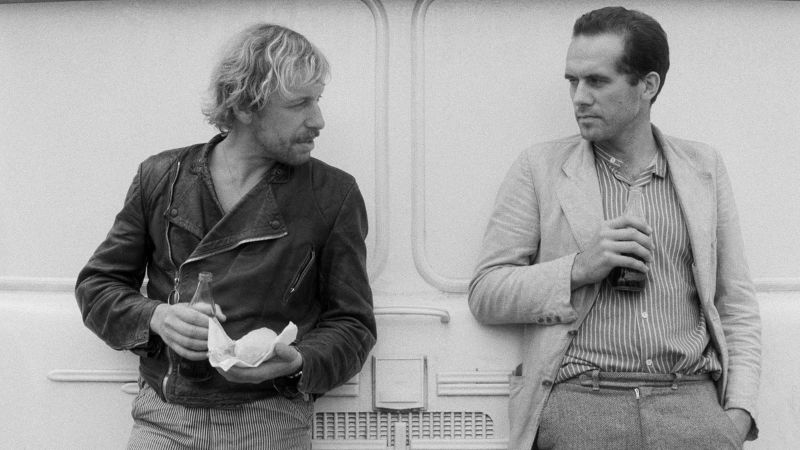
“Kings of the Road” (German title: Im Lauf der Zeit, “In the Course of Time”) is a 1976 West German road film directed, written, and produced by Wim Wenders. Running approximately 175 minutes.
A travelling film-projector repairman and a child psychologist recently separated from his wife move south through the border region between East and West Germany, stopping at small-town cinemas along the way.
The film is the third and final entry in Wenders’ informal Road Movie Trilogy, following “Alice in the Cities” (1974) and “The Wrong Move” (1975).
Production: Wim Wenders Produktion, in cooperation with Westdeutscher Rundfunk.
Director, screenwriter, and producer: Wim Wenders.
Directors of photography: Robby Müller, Martin Schäfer.
Editor: Peter Przygodda.
Music: Axel Linstädt, performed by Improved Sound Limited.
Cast: Rüdiger Vogler (Bruno Winter), Hanns Zischler (Robert Lander), Lisa Kreuzer (Pauline, cinema cashier), Rudolf Schündler (Robert’s father), Marquard Bohm (the man who lost his wife), Hans Dieter Trayer (Paul, Robert’s childhood friend), Franziska Stömmer (the old cinema owner), Patrick Kreuzer (the boy).
Language: German. Format: 35mm black and white, aspect ratio 1:1.66.
Trailer

Plot Summary
Film-projector repairman Bruno Winter travels alone along the inner German border in a converted furniture van, maintaining the equipment of small-town cinemas.
One morning beside the Elbe River, he watches a man drive a Volkswagen Beetle directly into the water. The driver is Robert Lander, a child psychologist who separated from his wife the day before. Bruno finds the gesture amusing and nicknames the man “Kamikaze.” Robert, with nowhere to go, climbs into Bruno’s van.
The two travel south through the Zonenrandgebiet—the border strip—stopping at cinemas along the way. They encounter a man devastated by his wife’s suicide; Robert visits his father’s printing company; Bruno has a brief romance with Pauline, a cinema cashier; and they make a detour to a Rhine island where Bruno spent his childhood.
At the end of the journey, they spend a night together in an abandoned former US Army observation post facing East Germany’s death strip, and talk. The next morning it is time for them to part.
Commentary
Production Background
While shooting “The Wrong Move,” Wenders encountered many landscapes and locations across West Germany that the existing script left no room to film. He resolved to make his next film as a travelling production in which the itinerary itself would serve as the organizing structure.
The route Wenders planned in advance ran along more than eighty small-town cinemas in the Zonenrandgebiet, the border strip running from Lüneburg in the north to Hof or Passau in the south. At the time, the spread of television was dealing a severe blow to independent cinema exhibition in the region, and closures were mounting.
There was almost no script. Only the opening scene in which Bruno and Robert meet was written in advance; every subsequent sequence was devised on the evening before filming, in discussion between Wenders, Vogler, Zischler, cinematographer Robby Müller, and assistant director Martin Hennig. The crew was small. Shooting took place over four months, from July 1 to October 31, 1975.
The production budget was DM 730,800 (approximately US$315,000 at the time), including a DM 250,000 screenplay premium from the Federal Ministry of the Interior. The film was the first production of Road Movies Produktion, the company Wenders had newly founded. The film is dedicated to Fritz Lang.
Locations
The film was shot entirely on location along the inner German border corridor, proceeding from north to south. Towns mentioned or visited in the course of the film include Wolfsburg, Helmstedt, Schöningen, Machtlos, Friedlos, Ostheim vor der Rhön, Haßfurt, and Hof.
The Roxy cinema in Helmstedt, which appears in the film, is still in operation today—the only cinema from the film that survives.
Two episodes are set away from the border corridor. The sequence at Robert’s father’s printing company was filmed in Ostheim vor der Rhön, Bavaria. The Rhine island sequence was filmed on an actual island near the Loreley—the Bacharacher Werth.
Cinematography
Wenders and Müller shot in black and white. The camera was an ARRI 35 BL; negative stock was Kodak Plus-X and Four-X; prints were made on ORWO positive stock.
Shooting proceeded chronologically along the route. Müller’s camera operates primarily in long takes with slow pans and minimal cutting.
Natural light was used wherever possible.
Point-of-view editing—cutting between a glance and its object—is deliberately suppressed. This editing approach, executed by Peter Przygodda, maintains a consistent observational distance from both characters and landscape.
Record of Disappearing Cinemas
Although a fiction film, “Kings of the Road” can equally be viewed as a documentary record of the landscapes and border regions of the West German interior in 1975.
Almost all the cinemas that appear in the film have since closed, and the footage of their interiors, equipment, and operators has become an irreplaceable historical document.
The Colonization of the Subconscious
The line Robert delivers in the abandoned observation post—”The Yanks have colonized our subconscious”—is spoken in the context of Bruno’s account of hearing the melody of Elvis Presley’s “Mean Woman Blues” running through his head during an argument with a woman: an instance of how thoroughly American popular culture has shaped the emotional vocabulary available to them.
The line has become one of the most frequently quoted statements in critical writing on postwar West German cultural identity.
The film’s soundtrack—mixing Improved Sound Limited’s original compositions with American rock and roll singles—enacts the very condition the line names.
The Absence of Women
The film contains no women as characters who drive the narrative; women are treated as an absence.
Robert and Bruno encounter a man whose wife has died by suicide. Robert, separated from his wife, repeatedly tries to call her but cannot even talk to her. Bruno’s romance with Pauline lasts a single night, and he continues his journey alone. At the root of Robert’s conflict with his father lies the figure of his dead mother.
Songs
Songs played on Bruno’s portable record player include “The More I See You” by Chris Montez (1966), “Just Like Eddie” by Heinz (1963), and “King of the Road” by Roger Miller (1965).
In the scene where Bruno meets Pauline at a fairground, “So Long” by Crispian St. Peters (1966) plays over the loudspeakers.
Early in the film, in a café scene between Bruno and Robert, Bruno sings a line from Robert Johnson’s “Love in Vain” (1939)—”When the train left the station / With a suitcase in my hand”—known through the Rolling Stones’ cover version (1969).
Release
The film’s West German premiere was in Berlin on March 4, 1976. Its international premiere was at the Cannes Film Festival in competition on May 26, 1976.
Awards and Nominations
- 1976 Cannes Film Festival — FIPRESCI Prize (unanimous)
- 1976 Chicago International Film Festival — Gold Hugo (Best Film)
- 1976 Cannes Film Festival — Palme d’Or (nomination)
4K Digital Restoration
In 2014, ARRI Film & TV Services Berlin carried out a digital restoration of the film, scanning the original negative at 4K resolution, retouching it, and correcting the color grading.
Home Media
The film was released on VHS in 1987. In 2008, Axiom Films (UK) issued a DVD with English subtitles (Region 2).
In 2016, the Criterion Collection (US) released a three-disc box set, “Wim Wenders: The Road Trilogy,” containing 4K digital restorations of all three films in the trilogy, on both DVD and Blu-ray.
Evaluation and Influence
On its release in 1976, “Kings of the Road” was received primarily by critics and festival audiences rather than the general public; its nearly three-hour runtime and lack of conventional plotting placed it outside mainstream commercial distribution.
The film has since come to be regarded as one of the foundational texts of New German Cinema and a defining example of the road movie as a form.
The German “Lexikon des Internationalen Films” described it as combining “the captivating clarity and epic serenity of a classic Bildungsroman with the mythic qualities of American genre film.”
Among filmmakers, Jim Jarmusch, Abbas Kiarostami, and Gus Van Sant have each cited the film as a direct influence on their work.
Search Links
Cross-Search for “Wim Wenders Kings of the Road” on JustWatch
Search for “Wim Wenders Kings of the Road” on Amazon.com
Synopsis (Spoiler Alert)
Prologue
Bruno Winter is repairing a projector in a small provincial cinema. The cinema’s elderly owner reminisces about his earlier career as a cinema musician during the silent era, recounting how he accompanied screenings of Fritz Lang’s “Die Nibelungen” (1924) and Fred Niblo’s “Ben Hur” (1925).
The Elbe River — Wolfsburg area — Helmstedt
Bruno has parked his converted furniture van beside the Elbe River near Langendorf, Lower Saxony, close to the Dömitz bridge, and is shaving outside. The van’s cab still bears the word “Umzüge” (Removals) in large letters; the flatbed carries repair tools, projector parts, and a portable record player.
Robert Lander had separated from his wife the day before, in Genoa. He accelerates a VW Beetle and drives it into the river. Bruno watches him climb out soaking wet and laughs. He lends Robert dry clothes and nicknames him “Kamikaze.” Robert, with no destination, becomes Bruno’s passenger.
The two pass through Kühnsche and Lüchow, move into the Wolfsburg area, and continue to Helmstedt, where Bruno services equipment at the Roxy cinema.
Schöningen Area
Near Schöningen, Lower Saxony, in the vicinity of a derelict lignite mining and industrial site, Robert and Bruno encounter a man whose wife has just driven her car into a tree and killed herself.
Robert’s Father’s Printing Company
Robert travels alone to his father’s printing company in Ostheim vor der Rhön, Bavaria. His mother died eight years ago; Robert has not seen his father since. His father has lived alone since her death, running a small local newspaper from the printing company. Robert holds his father responsible for dominating and suppressing his mother.
Over the course of a night, Robert sets a message to his father in type on the composing machine and prints it as a newspaper extra. The headline reads: “WIE EINE FRAU ACHTEN KOENNEN” (Wie eine Frau achten können—How to respect a woman)—printed without a question mark.
Bruno Meets Pauline
Bruno meets a woman named Pauline at a travelling fairground in a provincial town. Pauline works as a cashier at a small cinema called the Post-Lichtspiele.
That night, a pornographic film is showing at the Post-Lichtspiele. Bruno clashes with the projectionist, whom he finds masturbating during the screening; the projectionist storms off. Bruno takes over the projection. Bruno and Pauline spend the night together at the cinema.
The following morning, Bruno drives to Robert’s father’s printing company to pick Robert up, and they set off together again.
The Rhine Island
Robert borrows a BMW motorcycle with a sidecar from Paul, a childhood friend. Bruno rides the motorcycle with Robert in the sidecar to the Rhine, and they visit a derelict house on the Bacharacher Werth—a river island near the Loreley—where Bruno grew up with his mother.
Haßfurt, Bavaria
Bruno services equipment at the C&C cinema in Haßfurt, Bavaria.
Near Hof, Bavaria
Bruno and Robert spend a night in an abandoned former US Army observation post near the Bavarian Forest, close to the border near Hof, Bavaria.
Drinking beer, they talk about women and loneliness, and after an increasingly heated argument, come to blows.
The next morning, Robert is gone. He has left a note: “Es muss alles anders werden. So long. R.” (Everything has to change. So long. R.)
At a station, Robert gives an empty suitcase and a pair of sunglasses to a boy, and receives a notebook from him in return.
Robert boards a train and catches sight of Bruno’s van traveling alongside on a parallel road.
Epilogue
Bruno arrives at the Weiße Wand Lichtspiele (White Screen Cinema) in Haßfurt, Bavaria, and repairs its projection equipment. The elderly woman who owns the cinema says she cannot show the exploitative films that distributors now offer, and announces she has decided to close the cinema she inherited from her father. Outside the entrance, the neon sign has partially failed, leaving the letters: “WW, E, N, D.”