




















































Overview
“Boudu sauvé des eaux” (literally, Boudu Saved from the Waters; English release title: “Boudu Saved from Drowning”; hereafter “Boudu”) is a 1932 French film directed by Jean Renoir.
Running times vary across sources, ranging from 80 to 85 minutes. Pathé’s 2010–2011 restoration is listed at 85 minutes in official materials such as those of the Cannes Film Festival.
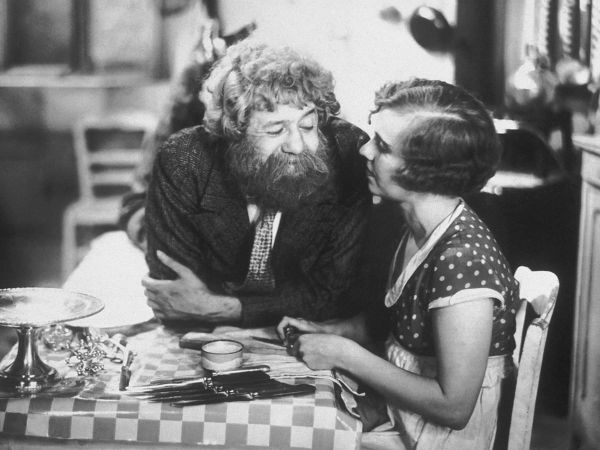
The film is a satirical comedy about the cohabitation of a bourgeois household and a vagrant, beginning when the secondhand bookseller Lestingois rescues the tramp Boudu after his suicide attempt in the Seine and, out of a sense of obligation, takes him into his home. It is based on a play first performed in 1919 by René Fauchois, and was produced by Michel Simon. For Renoir, it belongs to the early sound period, following “On purge bébé” (1931) and “La Chienne” (1931).
Production: Les Films Sirius, Les Productions Michel Simon.
Director and screenwriter: Jean Renoir (with uncredited adaptation assistance from Albert Valentin).
Based on: René Fauchois (play, “Boudu sauvé des eaux,” first performed 1919).
Cinematography: Marcel Lucien, Georges Asselin.
Editing: Suzanne de Troeye, Marguerite Renoir.
Sound: Igor B. Kalinowski.
Music: Raphaël. The film also makes use of Johann Strauss II’s “The Blue Danube,” “Sur les bords de la Riviera” (On the Shores of the Riviera; lyrics by Marcel Bertal, music by Léo Daniderff), and a song with lyrics written by Renoir himself.
Principal cast: Michel Simon (Boudu), Charles Granval (Édouard Lestingois), Marcelle Hainia (Emma Lestingois), Séverine Lerczinska (Anne-Marie, the maid), Jean Gehret (Vigour), Max Dalban (Godin), Jean Dasté (a student customer at the bookshop), Jacques Becker (a poet on a bench by the river).
Distribution: Établissements Jacques Haïk (1932 release); later reissues distributed by Pathé.
Language: French.
Format: 35mm black-and-white; aspect ratio 1.19:1, a standard used briefly during the early transition to sound before being superseded by the Academy ratio.
Trailer
Plot Summary
Boudu, a tramp in Paris who has lost his dog and grown disgusted with society itself, throws himself into the Seine from the Pont des Arts. Édouard Lestingois, a secondhand bookseller who witnesses the act through a telescope, dives in to save him and brings him home.
Lestingois, a liberal-minded bourgeois, sets out to reform Boudu into a respectable citizen: he has him shaved, groomed, and dressed in fine clothes. Boudu, however, repays this kindness by upending the household’s order at every turn. He pursues the maid Anne-Marie and eventually enters into a relationship with Lestingois’s wife, Emma, as well.
When a lottery ticket given to Boudu by Lestingois wins a large sum, a marriage between Boudu and Anne-Marie is arranged to keep up appearances. But during the wedding party on the Marne, held aboard a boat, the vessel capsizes; Boudu seizes the opportunity to swim away, shedding his bourgeois trappings and returning to the unmoored freedom of a vagrant’s life.
Commentary
Production Background
In 1919, Fauchois presented his play “Boudu sauvé des eaux” at the Théâtre des Célestins in Lyon, playing the role of Lestingois himself opposite Fernand-René as Boudu. The play enjoyed modest success and was revived with the same cast in 1923. The turning point came on March 30, 1925, at the Théâtre des Mathurins in Paris, when Michel Simon took on the role of Boudu for the first time. Simon’s performance shifted the play’s center of gravity decisively from Lestingois to Boudu, and the production became a sensation—though Simon himself performed the role on stage only about thirty times in total.
Simon later became deeply involved, from the screenplay stage through shooting, in Jean Choux’s film “Jean de la lune” (Jean of the Moon; 1931), and its success led him to become a producer in his own right. He then turned to a film adaptation of “Boudu,” still fresh in the public’s memory, and brought in Jean Renoir to direct. The two had already worked together on the silent film “Tire au flanc” (The Sad Sack; 1928), “On purge bébé” (1931), and “La Chienne” (1931); given their mutual respect and strong independence of temperament, no clear hierarchy was established between them.
The screenplay, credited to Renoir with uncredited contributions from Albert Valentin, departs from the play in significant ways. Where the play gives Lestingois the initiative as Boudu’s redeemer, steering him back toward social norms, the film abandons this narrative of bourgeois reform altogether and instead centers on Boudu’s untamable, uncontrollable nature. The ending, too, was substantially rewritten: the play closes at the wedding, while the film adds Boudu’s escape amid the capsizing of the boat. A pastoral prologue was also newly inserted, likening Lestingois to the god Pan and Anne-Marie to the nymph Chloé, and during the wedding scene Boudu himself is addressed by the name of the fertility god Priapus—layering a mythological framework over the film’s bourgeois-comedy material.
Fauchois reportedly reacted to the film with strong displeasure and had a new act written for a subsequent stage revival in an attempt to reclaim his own interpretation. According to Renoir’s memoir “Ma vie et mes films” (My Life and My Films), decades later Fauchois had occasion to see the film again, was struck by the audience’s enthusiastic response, and ultimately conceded—in a statement published in the November 1955 issue of the magazine “Cinéma 56″—that the film “Boudu,” as “a very free adaptation” of his play, belonged to Renoir.
Filming took place in the summer of 1932, at the Épinay studio outside Paris, in the Bois de Boulogne, along the banks of the Seine, and at Chennevières-sur-Marne on the Marne.
This was the only film Michel Simon produced under his own name; Jean Gehret is credited as co-producer.
During production, Renoir and Simon were summoned by the Paris police prefecture over scenes considered potentially disruptive to public order. Whether some of the scenes in question had actually been filmed remained uncertain for a long time, until their existence was confirmed during the 2010–2011 restoration, as discussed below.
Characteristics
The defining feature of “Boudu” is its complete shift of dramatic weight from Lestingois to Boudu. For Renoir, what Boudu embodies is not “disorder as the opposite of order” but freedom, insolence, and insubordination in themselves. Michel Simon’s own life—he had been a boxer, held right-leaning anarchist sympathies, was a lecherous collector of a vast pornography collection, and was known for an unabashed sexual candor—is frequently read as continuous with the character he plays. Renoir himself called Simon “a genius as an actor” and said the film was conceived to make use of that talent.
As noted above, the pastoral prologue casting Lestingois as Pan and Anne-Marie as Chloé, together with the wedding scene in which Boudu is addressed as the fertility god Priapus, overlays this bourgeois-comedy subject with a framework drawn from Greek myth—another of the film’s most distinctive traits. The theme of eroticism is not confined to any single character: Lestingois, Emma, Anne-Marie, and Boudu are all portrayed as candidly surrendering to physical desire, and most of the scenes in which music is heard are tied to sexual tension or fulfillment.
Cinematography
The film relies heavily on long takes and keeps the number of cuts to a minimum. The camera follows characters’ movements through gentle pans and movement within the frame, deliberately avoiding shot/reverse-shot editing that would fragment the exchange of glances. This approach aims to depict characters’ actions without breaking them apart, maintaining an observational distance throughout.
Particularly celebrated are the shots, taken before Boudu’s suicide attempt, of Simon walking through actual Parisian crowds—filmed from distant windows or from inside inconspicuous parked cars so that passersby remained unaware they were being photographed. These shots are a technical feat and, at the same time, sharpen the contrast between an individual cast out of society and a crowd that regards him with near-total indifference.
Critics have also noted the influence of Impressionist painting—specifically that of Renoir’s father, Auguste Renoir—on the film’s compositions; the wedding scene on the Marne, in particular, evokes the play of light and water found in paintings such as “La Grenouillère” and “La Seine à Asnières.”
Locations
Filming took place in central Paris (the Pont des Arts, the Quai de Conti, and the secondhand bookshops of the Latin Quarter), at the Épinay studio outside Paris, in the Bois de Boulogne, and at Chennevières-sur-Marne on the Marne, where the film’s closing scenes are set. The Marne, where the wedding and the boat’s capsizing were filmed, was a leisure destination frequently painted by the Impressionists, and the location itself overlaps with the sites depicted in the Auguste Renoir paintings mentioned in the section on cinematography.
Thematic Analysis
The film is structured around the opposition between bourgeois order and a freedom that refuses to be subordinated to it. The critic Jacques Lourcelles has written of water as a recurring motif across Renoir’s body of work, one that endures beyond any human life and, through its winding course, resists domestication. The structure by which Boudu arrives from the water and, after his stay in the Lestingois household’s “nest,” returns to the water once more can be read against this motif.
The critic Richard Boston has taken issue with Pauline Kael’s reading of Boudu as a 1960s-style hippie figure, arguing instead that Boudu has never “rejected” existing values in any deliberate sense, and is better understood as what the French call “marginal”—someone existing at society’s margin. For Boston, Boudu belongs alongside the tramp kicked around by Chaplin, Laurel and Hardy, the Marx Brothers, and Tati’s Monsieur Hulot: an “agent of chaos” who cannot be made subject to order or discipline, and an archetype who acts out desires the audience itself harbors but suppresses.
The theme of eroticism is likewise central to the film. The critic André Bazin observed that nearly every scene in which music plays is bound up with the satisfaction of sexual desire, and the film’s frankness in depicting love and sex was striking for its time.
Release
The film premiered in France on November 11, 1932, at the Colisée cinema in Paris.
Its American theatrical release was long delayed, not arriving until 1967, thirty-five years after production. Its Japanese theatrical premiere came later still, on March 26, 1977, distributed by France Eiga-sha.
Reception
The initial response was unfavorable: both critics and audiences found the film somewhat absurd, needlessly drawn out, and difficult to read in its intentions, and interest in it gradually waned.
Critical reception, too, was largely negative or indifferent at the time of release.
No figures documenting the film’s initial box-office performance in verifiable form could be found, and its early commercial performance remains unknown.
It should be noted that the story, repeated by Michel Simon himself, that the film was pulled from Parisian cinemas after only three days when angry audiences tore up their seats, has not been substantiated by later research. What actually occurred appears to have been a milder puzzlement and lack of comprehension, rather than any riotous rejection.
The process by which the film achieved its status as a classic was a gradual one. André Bazin’s writing on Renoir, the film’s reassessment in the pages of “Cahiers du Cinéma,” and the Nouvelle Vague filmmakers’ regard for Renoir as a spiritual father all contributed to its rehabilitation. Its 1967 American release was widely praised, and a review by Andrew Sarris appeared in the March 1967 issue of “Cahiers du Cinéma in English.” The critic Pauline Kael described the film as at once an affectionate fable about a bourgeoisie trying to reform an early hippie-like figure and a photographic record of a vanished France.
The film now holds a place among those rated at 100 percent on the review-aggregation site Rotten Tomatoes. As critics such as Henri Agel have argued, it is frequently cited as a demonstration of André Bazin’s theory of cinematic realism—his emphasis on the long take and deep focus as tools of mise-en-scène.
Historical Position
“Boudu” is among Renoir’s earliest sound films, following “On purge bébé” (1931) and “La Chienne” (1931).
It stands as a film made prior to Renoir’s Popular Front-era, socially engaged work: “The Crime of Monsieur Lange” (1936), the Popular Front propaganda film “La Vie est à nous” (Life Is Ours; 1936), and “Grand Illusion” (1937).
The film’s emphasis on the long take and deep focus is frequently cited as an early instance of the “cinema of realism” that André Bazin would later theorize, and on this point “Boudu” is one of the grounds on which the Nouvelle Vague filmmakers came to revere Renoir.
Home Media
Part of the original nitrate negative—particularly the sound negative—had been lost, and the surviving magnetic tape suffered from degraded high-frequency reproduction due to age. In 2010–2011, under Pathé’s supervision, a 2K digital restoration was carried out by L’Immagine Ritrovata in Bologna and Digimage in Paris, based on the original nitrate negative and a surviving duplicate protection element.
The restoration recovered the 1.19:1 aspect ratio used briefly in the early sound era. It also restored a scene cut from the original release—Boudu spitting on Balzac’s “Physiologie du mariage” (The Physiology of Marriage)—based on material uncovered during preparatory research by N.T. Binh, a consultant on Pathé’s catalogue restoration program. Until then, the scene had only been referred to in dialogue, and its existence on film had not been confirmed.
In North America, a Region 1 DVD was released by the Criterion Collection in 2005.
In France, a DVD was released by Pathé Distribution/Fox Pathé Europa in 2006, followed by a 2K-restored Blu-ray from Pathé in 2014.
In Japan, a DVD was released by IVC in 2000, followed by a Blu-ray, also from IVC, in 2016.
Remakes
The film has been remade twice. The first is the 1986 American film “Down and Out in Beverly Hills,” directed by Paul Mazursky, in which Nick Nolte plays the Boudu-equivalent role opposite Richard Dreyfuss and Bette Midler. The film was well received and spawned a short-lived television series in 1987.
The second is the 2005 French film “Boudu,” directed by Gérard Jugnot from a screenplay by Philippe Lopes-Curval, with Gérard Depardieu in the title role.
Other Notable Topics
Some have located the cinematic origin of the Boudu figure in the closing scene of Renoir’s previous film, “La Chienne” (1931), in which Michel Simon’s protagonist, Maurice Legrand, disappears into the streets of Paris as a vagrant.
The performance of Charles Granval, a member of the Comédie-Française who was otherwise selective about film work, has also drawn critical attention. His restrained interpretation of Lestingois is credited with keeping the film from collapsing into a simple piece of anarchist propaganda, preserving instead a characteristically Renoirian balance that gives due weight to both sides of the conflict.
Search Links
Cross-Search for “Boudu Saved from Drowning” on JustWatch
Search for “Boudu Saved from Drowning” on Amazon.com
Synopsis (Spoilers)
Prologue
The film opens on a pastoral fantasy in which the bookseller Édouard Lestingois, costumed as the god Pan, pursues the maid Anne-Marie, cast as the nymph Chloé.
Boudu’s Suicide Attempt
Boudu, a Parisian tramp who has lost his dog, Black, and grown disgusted with society itself, throws himself from the Pont des Arts into the Seine. Lestingois, watching through binoculars from his window, dives in to rescue him and brings him back to his combined bookshop and home.
Living with the Lestingois Household
Lestingois attempts to reform Boudu, having him shaved, groomed, and dressed in fine clothes. Boudu, however, ignores all propriety and turns the household upside down. When he pursues the maid Anne-Marie and asks her for a kiss, he teases her by claiming he was once kissed by a dog he used to keep.
Before long, Boudu forces his way into the bedroom of Lestingois’s wife, Emma, and wins her over despite her resistance. During this scene, the camera pulls away from the two of them to a mural of a Zouave soldier painted on the wall.
The Lottery Win and the Arranged Marriage
The lottery ticket Lestingois gave to Boudu turns out to be a substantial winner. To preserve appearances, a marriage between Boudu and Anne-Marie is arranged. Boudu resists at first but ultimately accepts.
The Wedding on the Marne and Epilogue
The wedding is held on the Marne, with a party aboard a boat. Amid the festivities, the boat capsizes, and Boudu uses the confusion to swim away. Shedding his bourgeois trappings, he returns to the unmoored life of a vagrant, drifting with the current toward no particular destination.