

































































- Overview
- Trailer
- Synopsis
- Commentary
- Motivation for Production
- Historical Background
- Digital Video Shooting
- Fusion of Fiction and Documentary
- Elimination of Dramatic Development
- “Ren Xiaoyao” (1998) by Richie Jen
- References to “Pulp Fiction”
- “Brindisi” (from Verdi’s “La Traviata,” Act I)
- News Footage from 2001
- On the Early Trilogy
- Release
- Original Soundtrack (Japan-Exclusive Release)
- Search Links
Overview
“Unknown Pleasures” (2002, original Chinese title: Ren Xiaoyao) is a coming-of-age drama film directed by the Chinese filmmaker Jia Zhangke, and his third feature-length work. It portrays the stagnant everyday lives of young people in a provincial Chinese city in the early 2000s, shot on digital video.
It is an international co-production between Japan, China, France, and South Korea.
The project was planned and produced by T-Mark (Japan) and Hu Tong Communication (Hong Kong).
Production companies are Office Kitano (Japan), Bitters End (Japan), Lumen Films (France), and E-Pictures (South Korea).
Directed and written by Jia Zhangke.
Starring Zhao Tao, Zhao Weiwei, and Wu Qiong.
Cinematography by Yu Lik-wai.
Edited by Chow Keung.
Languages are Jin Chinese (Shanxi dialect) and Standard Chinese (Mandarin).
113 minutes.
Trailer
Synopsis
Set in Datong, Shanxi Province, China, in 2001, “Unknown Pleasures” centers on two unemployed nineteen-year-old youths, Xiao Ji (Wu Qiong) and his close friend Bin Bin (Zhao Weiwei).
Datong had once prospered as a coal-mining city, but with the decline of the coal industry, it became filled with unemployed people.
Xiao Ji lives with his father in a small apartment. Bin Bin’s mother works at a textile factory.
On television, news reports announce Beijing’s successful bid to host the 2008 Summer Olympics and China’s accession to the WTO (World Trade Organization). Meanwhile, Xiao Ji and Bin Bin drift through their days, smoking and roaming aimlessly on a motorcycle.
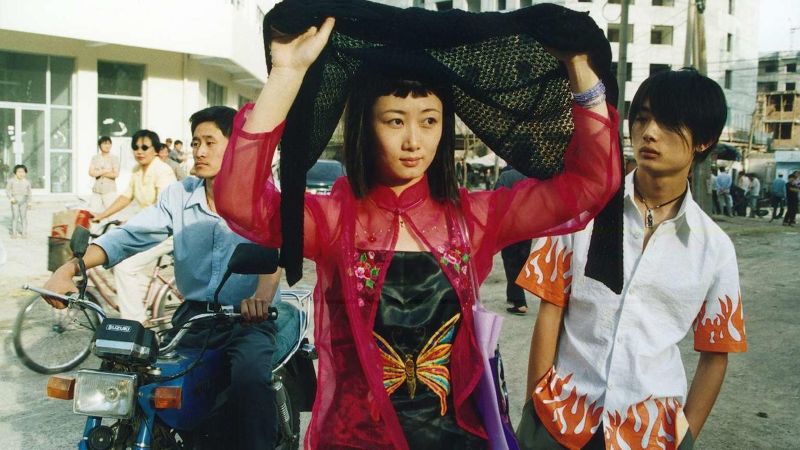
Xiao Ji becomes infatuated at first sight with Qiao Qiao (Zhao Tao), a singer and dancer working as a promotional girl for “Mongolian King Liquor,” a liquor company. He persistently pursues her, which leads to conflict with her patron and lover, the loan shark Qiao San (Li Zhubin).
Qiao Qiao and Qiao San were formerly a student and a physical education teacher whose romantic relationship was exposed, resulting in their expulsion from the high school.
Qiao Qiao is financially supporting her father, who is hospitalized for a long period.
Bing Bing has a girlfriend named Yuen Yuen (Zhou Qingfeng), who is a student preparing to take the entrance exam for a university in Beijing.
Xiao Ji grows closer to Qiao Qiao; they share meals, go to clubs, and spend time together in a hotel room. However, she eventually leaves him.
Bin Bin undergoes a military examination in hopes of joining the People’s Liberation Army, but he is rejected after it is discovered that he has hepatitis.
Yuan Yuan passes her university entrance exams. Bin Bin borrows money to buy her a mobile phone.
Xiao Ji and Bin Bin then plan a bank robbery. Xiao Ji takes Bin Bin on his motorcycle to a branch of the China Construction Bank, and Bin Bin enters the bank with a fake bomb strapped to his chest.
Commentary
“Unknown Pleasures” is a striking coming-of-age film that depicts the loneliness and sense of confinement experienced by young people with no clear future, set in a provincial industrial city in China in 2001 against the backdrop of rapid marketization under the country’s Reform and Opening-Up policies.
Motivation for Production
Jia Zhangke has stated that the motivation for making “Unknown Pleasures” came from being inspired by the young people living under the one-child policy whom he observed in Datong, Shanxi Province, where he had filmed his short documentary “In Public” (original Chinese title: Gonggong Changsuo, 2001).
Jia Zhangke stated the following at a press conference:
“At first it was the bleak and lonely buildings that attracted me. When I saw the streets filled with lonely, directionless people, I became interested in them.” (Taipei Times, 2002)
Historical Background
Set around 2001, the film unfolds during a period of rapid transformation in China, marked by its accession to the WTO and the accelerating shift toward a market economy and globalization. In the late 1990s, large-scale layoffs resulting from the restructuring of state-owned enterprises had a lasting social impact, particularly in provincial cities. At the same time, coastal regions experienced rapid growth, accompanied by an influx of capitalist consumer culture and foreign pop culture, widening economic and cultural disparities with inland areas.
Young people who came of age in this environment, shaped by the one-child policy, developed a strong sense of individuality while also facing uncertainty and a pervasive sense of stagnation about their future. Meanwhile, social control was tightening, as exemplified by the government’s crackdown on Falun Gong beginning in 1999. This coexistence of increasing liberalization and strengthened state control was a defining feature of Chinese society at the time.
Digital Video Shooting
Jia first introduced digital video in “In Public,” and “Unknown Pleasures” was also shot entirely on digital video.
The film’s visual style is characterized by the coarse image quality typical of digital video.
The use of lightweight and highly mobile digital video cameras enabled an improvisational mode of shooting and a documentary-like approach that captures real landscapes in a direct, material manner.
Fusion of Fiction and Documentary
“Unknown Pleasures” was shot in Datong, Shanxi Province, in just 19 days.
The film combines fiction with a strong documentary texture through its use of real locations and non-professional actors.
Wu Qiong, who plays Xiao Ji, was in fact an unemployed young man at the time.
In “Unknown Pleasures,” the desolate landscape of the industrial city is not merely a backdrop to the narrative but becomes a primary subject in its own right.
Through the extensive use of long takes and static camera setups, the characters are treated as part of the urban spacel and become objects of documentary-like observation and recording.
Elimination of Dramatic Development
“Unknown Pleasures” deliberately avoids conventional cinematic language that expresses characters’ inner lives through narrative development.
A defining feature of the film is the elimination of dramatic development. Rather than narrative progression driven by the passage of time, it emphasizes stagnation and repetition.
The conflict between Xiao Ji and Qiao San over Qiao Qiao comes to an abrupt and anticlimactic end with Qiao San’s death in a traffic accident.
The relationship between Bin Bin and Yuan Yuan shows no development at all; they never even kiss, and their relationship ends without progression.
Bin Bin attempts a bank robbery, but the security guard sees through the fact that the bomb strapped to his chest is fake, and the robbery ends in failure.
“Ren Xiaoyao” (1998) by Richie Jen
The original Chinese title of “Unknown Pleasures,” “Ren Xiaoyao,” is derived from a song of the same name by the Taiwanese singer and actor Richie Jen. The song was released in 1998 as the theme song for the Taiwanese TV drama “The Return of the Condor Heroes,” and became a major hit in mainland China.
“Ren Xiaoyao” roughly means “to live freely without constraints,” and the phrase originates from “Xiaoyaoyou” (Free and Easy Wandering), a concept found in the writings of Zhuangzi, referring to a state of spiritual freedom unbound by worldly restrictions.
The song appears three times in the film:
- A scene in which Qiao Qiao dances to the song at a promotion event for Mongol King Liquor.
- A scene in which Bin Bin and Yuan Yuan sing the song together in a video room.
- An ironic final scene in which Bin Bin, having been arrested, sings the song in a police station while handcuffed.
This song is also used in the film’s end credits.
References to “Pulp Fiction”
The film contains sequences that appear to pay homage to “Pulp Fiction” (1994) directed by Quentin Tarantino.
In a scene where Xiao Ji and Qiao Qiao are eating at a restaurant, Xiao Ji talks about an American film he recently watched on DVD. When he imitates a robbery scene from the film and shouts “Freeze!”, the scene cuts to the two of them dancing in a club. In the club, a techno track sampling the surf rock version of “Misirlou” (1962) by Dick Dale & His Del-Tones—famously used in “Pulp Fiction”—is playing.
Qiao Qiao’s bob-cut wig also evokes imagery associated with “Pulp Fiction.”
“Brindisi” (from Verdi’s “La Traviata,” Act I)
In several scenes, including the opening, a man sings the “Brindisi” from Act I of the opera “La Traviata,” composed by Giuseppe Verdi. The man is played by director Jia Zhangke himself.
The “Brindisi” was a piece frequently used in Chinese media around 2001 to amplify the celebratory atmosphere surrounding events such as the announcement of Beijing as the host city for the Olympics and the country’s accession to the WTO.
News Footage from 2001
One of the distinctive features of “Unknown Pleasures” is the frequent insertion of Chinese TV news footage from its 2001 production period. These include the following:
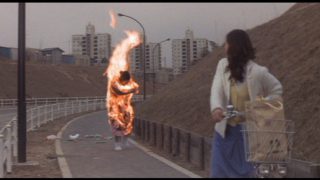
- The Tiananmen Square self-immolation incident (January 23, 2001)
- Shijiazhuang Bombing (March 16, 2001)
- Interrogation footage of Zhang Jun, a notorious criminal arrested in 2000
- The Hainan Island incident (a mid-air collision between U.S. and Chinese military aircraft) (April 1, 2001)
- Beijing’s selection as the host city for the 2008 Summer Olympics (July 13, 2001)
- China’s decision to join the WTO (November 10, 2001)
- The development of the expressway connecting Beijing and Datong
On the Early Trilogy
This film is the third feature by the director, following “Xiao Wu” (1997) and “Platform” (2000), both set in Fenyang, Shanxi Province—the director’s hometown—and is sometimes regarded as the final installment of an unofficial “hometown trilogy.”
In this film, Wang Hongwei reprises the character Xiao Wu, whom he previously portrayed in “Xiao Wu.”
Release
“Unknown Pleasures” was produced as an independent film without undergoing censorship by the Chinese government. As a result, it did not receive official approval for theatrical release in China and circulated through unofficial channels.
This film was officially selected for the Competition section of the 55th Cannes Film Festival (2002).
Original Soundtrack (Japan-Exclusive Release)
In 2002, the original soundtrack for “Unknown Pleasures” was released as a Japan-exclusive edition by Rock Records Japan.
It includes songs used in the film such as “Ren Xiaoyao” by Richie Jen, as well as dialogue and ambient sounds from the film, and “Brindisi” sung by director Jia Zhangke himself.
The CD is in CD-Extra format and contains the theatrical trailer as a bonus video.
Search Links
Cross-Search for “Jia Zhangke Unknown Pleasures” on JustWatch
Search for “Jia Zhangke Unknown Pleasures” on Amazon.com