




















































































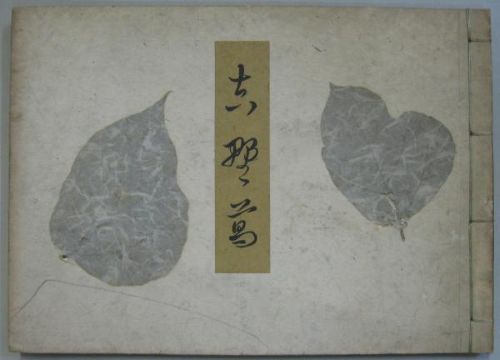


Overview
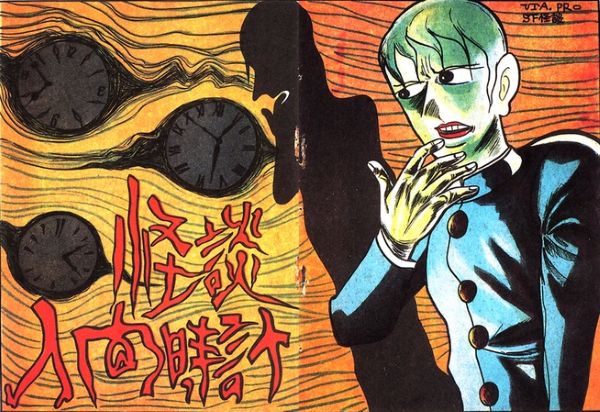
“Human Clock” (original Japanese title: Ningen Dokei) is a manga by the Japanese manga artist Seiichiro Tokunami (1934–2009; at the age of thirty, he changed the reading of his surname from “Tokunan” to “Tokunami”). It was published in August 1962 by Akebono Shuppan as a kashihon (rental) manga drawn specifically for publication.
It is a surreal horror manga about a junior high school boy who lives in a watch and clock shop in Kanda, Tokyo. After a bicycle accident, he withdraws from the world and becomes caught up in a bizarre phenomenon in which human beings turn into clocks.
At the time of its publication, it failed to gain popularity and went out of print. Later, however, its peculiar form of expression (described in detail below) earned it a reputation as a strange and singular book. For a long time it was a phantom work, with secondhand copies traded at high prices, but after a later reappraisal it was reissued (described in detail below).
Author Biography
Seiichiro Tokunami (born June 1, 1934; died December 24, 2009) was born in Osaka. In early childhood he contracted diphtheria and developed pituitary dwarfism, and as a result his growth stopped at about 4 feet 7 inches (140 cm).
In 1953, he joined the East Japan Manga Study Group, led by Shotaro Ishimori, and took part in its self-publishing (doujin) activities. After graduating from a high school in Osaka, he made his debut as a manga artist in 1955, when Tokodo of Osaka published “Kage wo Kiru Samurai (Samurai Who Cuts Shadows)” and “Arashi no Kengo (The Swordsman of the Storm)” as kashihon manga.
He subsequently worked mainly for Akebono Shuppan, but as the rental book industry declined, he gave up manga in 1963. Afterward he worked as a company employee and was also active as a Sunday painter.
Long forgotten as a manga artist, he was reappraised from the late 1990s onward, and his major works, including “Human Clock,” were reissued by Ohta Publishing.
In 1998, Ohta Publishing released his autobiography, “Kokyaku: Kokuhekisha no Jiden (The Solitary Guest: Autobiography of a Wall-Weeper).”
Changes in Style
According to the commentary that the fringe culture researcher Takeo Udagawa contributed to the reissue of this work (Ohta Publishing), Tokunami’s career as a manga artist lasted eight years, from 1955 to 1963, and can be divided into the following four periods according to changes in his style.
- First period (1955–59): The period from his debut, when he produced period dramas (jidaigeki) in a drawing style reminiscent of Osamu Tezuka, until he settled on Akebono Shuppan as his base of activity.
- Second period (1960–61): The period when he published short youth manga under the name Seiichi Ichikawa. From this time, a jagged style of drawing and an approach that peers into the dark side of the human psyche began to stand out.
- Third period (July–September 1962): The period when he released a series of avant-garde works in rapid succession, including “Bakeneko no Tsuki (The Moon of the Supernatural Cat),” “Neko no Mofuku (The Cat’s Mourning Clothes),” and “Human Clock.” These are characterized by absurd narrative content and an Expressionist form.
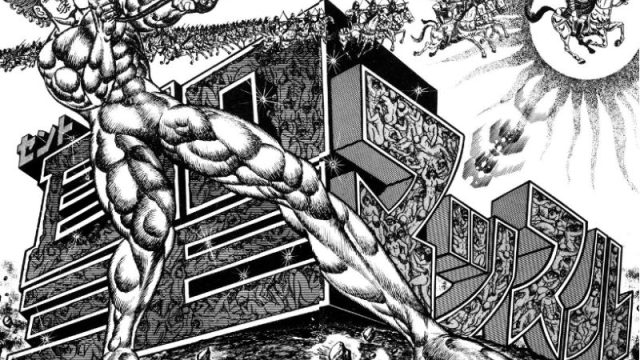
- Fourth period (October 1962–63): The period when he drew works about Sengoku-era warlords (“Toyotomi Hideyoshi,” “Tokugawa Ieyasu,” “Oda Nobunaga,” and “Date Masamune”), but failed to gain popularity and decided to retire as a manga artist and return to his hometown.
Reissues
- In 1979, Komae Kobo published a limited reissue of “Human Clock” in 450 copies.
- In 1996, Ohta Publishing published a reissue under the title “Kaidan Ningen Dokei (Ghost Story: Human Clock).” It also includes “The Cat’s Mourning Clothes,” another of Tokunami’s works, which Akebono Shuppan had published in July 1962. It was released as an e-book in 2017.
English Edition
An English edition of this work is scheduled to be published in October 2026 by the American publisher Living the Line, under the title “Human Clock.” The author’s surname is written “Tokunami,” following his name change. Ryan Holmberg handled the curation and translation. The English edition of “The Cat’s Mourning Clothes” is also included.
Commentary
Pioneering Nature
It is the commonly accepted view that the genre of surrealist, absurdist manga in Japan was pioneered in the late 1960s by the short stories Yoshiharu Tsuge published in the monthly manga magazine “Garo,” especially “The Swamp” (1966) and “Screw Style” (1968). Tokunami’s third-period works, however, were published several years before these, and are a rare example of works that were rediscovered only in later years. “Human Clock” in particular depicts an absurd world in which human beings turn into clocks, rendered in a surreal style of drawing, and it has been reappraised as an avant-garde work for its time, unparalleled among manga before Tsuge.
“A Drug to Read”
When this work was reissued by Ohta Publishing, the obi (book jacket band) carried the advertising copy “This is a ‘drug to read,'” and indeed the work gives readers an experience like a hallucination induced by drugs.
The Strangeness of Its Form: Expressionist Drawing and Temporal Discontinuity
What characterizes “Human Clock” is not the fear of its narrative content, told as a “ghost story,” but the strangeness of its form.
The strangeness of the work’s form arises from its distinctive style of drawing, which evokes the influence of Expressionism, and from a sense of time that is discontinuous, as if torn to shreds.
Expressionist Drawing
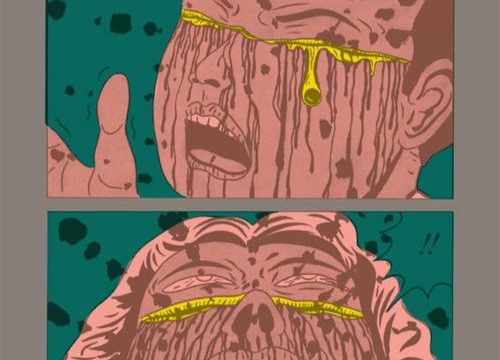
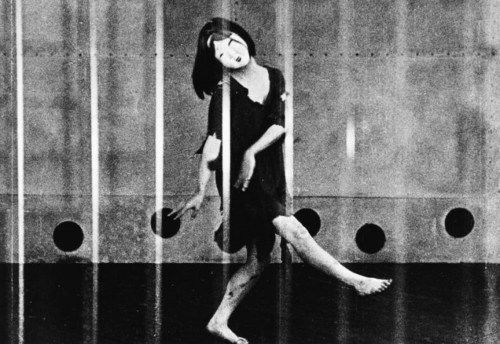
In this work, as in Expressionist painting, human bodies, objects, landscapes, and so on are intentionally drawn in distorted forms. The appearance and character of the figures are constantly in flux, and the identity of each character is not maintained from one panel to the next.
Temporal Discontinuity
In ordinary manga, panels function as units that advance the story along the passage of time, and continuity arises as readers fill in the blank space between panels (the gutter). In this work, however, each individual panel takes on the character of an Expressionist painting depicting an inner landscape, so the temporal connections between panels become tenuous, and readers are left with the impression that the flow of time within the work is being fragmented by the panel layout and is flickering intermittently.
The art critic Noi Sawaragi discusses in detail this temporal discontinuity in the commentary he contributed to the reissue (Ohta Publishing). Analyzing Tokunami’s work in relation to the form peculiar to manga, which consists of multiple discontinuous panels, Sawaragi states that the secret of its appeal lies in “a flickering image of the world that appears and vanishes, vanishes and appears” and “the singular sense of time produced from it.”
Reference to La Mettrie’s Man-Machine Theory
The idea of human beings turning into clocks in this work is thought to have been inspired by the “man-machine theory” of Julien Offray de La Mettrie, a physician and philosopher of Enlightenment France known as a proponent of mechanistic materialism.
At the beginning of the work, the following epigraph, based on a reference to La Mettrie’s “L’Homme Machine (Man a Machine)” (1747), is displayed.
The body is nothing but a clock,
and the new wet nurse is its clockmaker.
Man is nothing but a machine!
— La Mettrie
The first and second lines quote a sentence from La Mettrie’s book: “The body is nothing but a clock whose clockmaker is the newly formed chyle. (Le corps n’est qu’une horloge, dont le nouveau chyle est l’horloger.)” However, “chyle” has been mistakenly rendered as “wet nurse”.
The third line is based on the core claim that La Mettrie repeatedly makes in the book: that “man is a machine.”
Reference to Clifford D. Simak’s “Skirmish” (1950)
In the work, there is a scene in which the protagonist tells his parents that he once read a story in a science fiction magazine about machines rebelling against humans. He refers to it as “a paper by Clifford B. Simatta,” but what is being referenced here is the short story “Skirmish” (1950, original title: Bathe Your Bearings in Blood!) by the American science fiction writer Clifford D. Simak. A Japanese translation of this story was published in the August 1962 issue of the magazine “S-F Magazine.” Tokunami is thought to have referred to this Japanese translation.
Search Link
Search for “Seiichiro Tokunami Human Clock” on Amazon.com
Plot Summary (Spoilers)
At the beginning, there is the epigraph, based on the reference to La Mettrie’s “L’Homme Machine (Man a Machine)” described above.
On the title page spread, the title “Human Clock” is preceded by the subtitle “Ghost Story.”
Tadashi Koe, a junior high school boy, is the only son of parents who run a watch and clock shop in Kanda, Tokyo.
On his way home from school, Tadashi collides with a bicycle, and the crowd of onlookers that gathers around him fills him with intense fear. He becomes a misanthrope and stops going to school. Learning of this, his mother decides to hire a private tutor for him.
Tadashi’s only friends are clocks. Twice a day, at twelve o’clock, both noon and midnight, he looks forward to the dance of the clocks with mechanical figures that move at those times.
One day, all the clocks in the shop break down and no longer run even when wound. Odeko, a woman who works at the shop, is frightened by this strange occurrence, and quits, saying, “The clocks have stopped working for humans.”
Tadashi remembers having once read a story about machines rebelling against humans (a paper by Clifford B. Simatta that had appeared in a science fiction magazine), and tells his parents about its contents.
A university student named Mukai begins working as Tadashi’s tutor, but Tadashi’s parents dismiss him when they learn of his violent behavior toward Tadashi (pinching his cheeks at the beginning and end of each lesson).
A man (the incarnation of a wall clock) with a mustache and a face like a round pocket watch begins teaching Tadashi as his new tutor.
While Tadashi’s parents are away on a trip, the tutor, saying that Tadashi’s parents asked him to, forces Tadashi to study for long hours every day.
The parents return from their trip. The mother has contracted a strange illness in which the long and short hands of a clock grow out of her head.
Every time Tadashi puts on the wristwatch given to him by the tutor, he loses consciousness and wanders into a dreamlike other world, the “Land of Clock People.”
Two years later, Tadashi passes his high school entrance examination, and the family leaves Tokyo for the countryside for the sake of the mother’s recuperation.
At a housewarming meal in their new home, the parents invite the tutor. Tadashi had realized that the tutor was a clock person. Tadashi’s own body, too, had already turned into a clock a year earlier, and his organs had been replaced with gears and springs.
A large swarm of rats, which have a habit of gnawing on hard objects, attacks Tadashi and the tutor. Gnawed by the rats, the two are reduced to the wreckage of old wall clocks.