



















































- Overview
- Trailer
- Film Data
- Plot Summary
- Commentary
- Search Links
- Synopsis (Spoilers)
Overview
“The Evil Dead” is a 1981 American supernatural horror film written and directed by Sam Raimi. It is Raimi’s feature directorial debut, starring Bruce Campbell. The story concerns five Michigan State University students who spend a vacation at a cabin in the mountains of Tennessee and are attacked by evil spirits after discovering an ancient book and a recording tape in the basement.
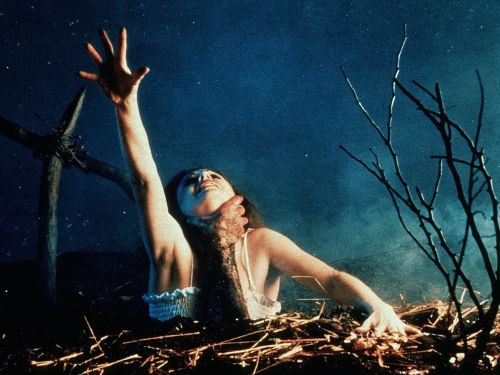
What is particularly noteworthy in the film’s production process is that it is a completely independent production, made with funding and staff centered on friends and family from the Detroit suburbs of Michigan. Raimi used the short film “Within the Woods,” which he shot in 1979, as a prototype for investors and raised the production funds for the feature.
The domestic box office in the United States at the time of release was poor, but a screening at the 1982 Cannes Film Festival where Stephen King highly praised it became a catalyst, and its evaluation spread through circulation in the European video market. Today, it is established as a representative work of low-budget horror and splatter films, and as a worldwide cult classic. Together with the sequels “Evil Dead II” (1987) and “Army of Darkness” (1992), it is called the “Evil Dead” trilogy, and it became the starting point of a franchise that has expanded into films, television series, games, and stage productions, including the 2013 reboot.
Trailer
Film Data
- Original title: The Evil Dead
- Director: Sam Raimi
- Screenplay: Sam Raimi
- Producer: Robert Tapert
- Executive producers: Bruce Campbell, Sam Raimi, and others
- Production company: Renaissance Pictures
- Distributor: New Line Cinema (United States)
- Cinematography: Tim Philo
- Editing: Edna Ruth Paul
- Music: Joe LoDuca
- Special makeup and special effects: Tom Sullivan
- Cast: Bruce Campbell (Ash Williams), Ellen Sandweiss (Cheryl Williams), Richard DeManincor (Scott / credited as Hal Delrich), Betsy Baker (Linda), Theresa Tilly (Shelly / credited as Sarah York), and others
- Voice cast: Bob Dorian (voice of Professor Knowby, uncredited), Sam Raimi (voice of the evil spirits, uncredited)
- Release dates: October 15, 1981 (premiere screening at the Redford Theatre in Detroit) / April 15, 1983 (nationwide release in the United States)
- Running time: 85 minutes
- Country of production: United States
- Language: English
- Production budget: approximately $375,000 (according to Raimi’s statement)
Plot Summary
Five Michigan State University students—Ash Williams, his girlfriend Linda, his sister Cheryl, his friend Scott, and Scott’s girlfriend Shelly—spend a weekend at an unoccupied cabin deep in the mountains of Tennessee.
In the cabin’s basement, they discover an ancient book said to be bound in human skin and a recording tape left by an archaeologist. When Scott plays the tape, the incantation written in the ancient book is recited, releasing the evil spirits lurking in the woods.
The evil spirits successively possess the trees of the forest and the bodies of their companions, forcing the five into a situation where they have no choice but to kill one another inside the cabin, isolated from the outside world.
Commentary
Production Background
Sam Raimi and Bruce Campbell had been friends since childhood and had been making low-budget short films together on Super 8. Among them were comedy works, but through shooting suspense scenes they strengthened their inclination toward horror, and after studying horror films at drive-in theaters, they decided to produce a feature-length horror film.
What Raimi chose for fundraising was a short film as a “prototype.” “Within the Woods,” shot in 1979 for approximately $1,600, starred Campbell and Ellen Sandweiss and included scenes that would later be recreated in the feature. As a result of showing this short and soliciting investments, approximately $90,000 was first raised, and work on the feature began. The amount Raimi initially estimated as necessary was over $100,000, but the final cost reached approximately $375,000.
The working title during production was “Book of the Dead,” said to derive from Raimi’s interest in H. P. Lovecraft. Irvin Shapiro, who later handled distribution in Europe, recommended a change, saying that this title sounded like a boring film, and from among several proposals “The Evil Dead” was selected as “the least bad.”
In casting, Campbell, who had undertaken the commitment of remaining throughout the entire shooting period as a producer, took the role of Ash. The other actors were recruited through an advertisement in the “Detroit News,” and Betsy Baker was one of the applicants. Sandweiss appeared following her role in the short. Most of the staff were friends and family of Raimi and Campbell.
In editing, Joel Coen participated as an assistant to Edna Ruth Paul and is said to have edited the barn scene outside the cabin himself.
Characteristics
This film takes the form of a “closed-space horror” in which human relationships collapse through possession by evil spirits. Explanatory settings are kept to a minimum, and the origin of the evil spirits and the history of the ancient book are only fragmentarily indicated through the audio of the tape.
Another characteristic is the coexistence of the brutal depictions of splatter and black-comedy exaggeration. That Raimi was an avid fan of the American vaudeville/comedy group the Three Stooges is reflected in the later-mentioned shooting ingenuity (“Fake Shemp”), and the buds of the comedic quality that becomes prominent in the later sequels can already be seen in the excessive gore expressions of the first film.
Cinematography Techniques
Shooting was done with Kodak 16mm film and rented cameras, and after completion it was blown up to 35mm. The director of photography was Tim Philo.
Because of budget constraints a camera dolly could not be used, and shooting was carried out with low-budget equipment made by themselves. The “Vas-O-Cam,” in which the camera is slid on long wooden rails, is one example.
For the point-of-view of the evil spirits staring at the characters in the woods, the so-called “Shaky-Cam” was used, in which the camera is attached to a wooden board and two camera operators run around. It is an inexpensive substitute for the Steadicam. Raimi himself is said to have shot while running through swamps and fallen trees. The long take at the end, in which it rushes through the cabin and attacks the protagonist, was shot with the camera mounted on a bicycle.
In terms of direction, unstable compositions using Dutch angles and wide-angle lenses were employed, and the cinematography that implies “the presence of invisible evil” has been highly evaluated by critics.
“Fake Shemp,” in which staff members act as substitutes for background figures when the actors are absent, was also frequently used. This name derives from the use of substitutes after the death of Shemp Howard of the Three Stooges. Raimi’s younger brother Ted Raimi also served as a substitute in many scenes.
Location
The shooting location was a cabin near Morristown, Tennessee. Initially, shooting in Royal Oak, Michigan, Raimi’s hometown, was considered, but it is said that Tennessee was the only state favorable to the production, so it was decided on that location.
During the shooting period, 13 staff members stayed overnight in the cabin, and poor living conditions continued. Campbell later looked back on this shoot as “about 12 weeks of joyless toil.” In the final stages the situation became such that they burned the cabin’s furniture for warmth, and shooting ended on January 23, 1980. After that, four days of additional shooting were conducted to supplement the missing cuts.
After release, intruders successively entered the cabin used for shooting, and it was burned down by the owner in 1982. Currently only the chimney remains.
Special Effects and Special Makeup
Special makeup and special effects were handled by Tom Sullivan. The work centered on foam latex modeling and stop-motion animation, and the clouded white eyes of the possessed characters were expressed with thick glass contact lenses. Putting them on took about 10 minutes, and they could be worn for only about 15 minutes.
The blood was based on corn syrup (Karo brand) with food coloring added, and Sullivan is said to have added coffee to it.
The scene at the end in which the corpses rapidly decay and dissolve is by stop-motion animation. The sound effects were recreated afterward, and sounds such as stabbing a dead chicken were recorded as the sounds of flesh being destroyed.
Thematic Analysis
As a narrative framework, this film takes a Lovecraftian structure in which “reciting a forbidden text brings about supernatural calamity.” However, no moral fault is set in the protagonists’ actions, and the attack of the evil spirits originates from the accidental event of the recording tape being played out of curiosity. In this respect, it keeps a distance from the ethical scheme in which evil arrives as retribution for sin.
The point that the recording tape becomes the medium of the calamity indicates the connection between media technology and the supernatural, in which reproducible audio media activates the spell.
Regarding the setting of an ancient Sumerian document, there is also a study (an essay by Lorenzo Verderame, 2020) that discusses representations of the ancient Near East together with “The Exorcist” (1973).
The theme of possession functions as the collapse of human relationships, in which the bodies of those close become enemies. The survivor Ash is placed in the position of having to injure and kill his own kin—his girlfriend Linda and his sister Cheryl—with his own hands. In this respect the first film bears a grim tragic quality, in contrast to the sequels that have a strong comedic tendency.
The depiction of nature is also characteristic, with the forest itself drawn as the agent of harm. On the other hand, the scene in which the trees attack and rape Cheryl has divided evaluation from the time of release to the present, and BBC’s Martin Granville has called it “ill-advised.”
Release
From the viewpoint of criticism and research, this film is discussed as being positioned in the lineage of “Night of the Living Dead” (1968) and “The Texas Chain Saw Massacre” (1974), and similarities to the surreal expressions of Georges Franju and Jean Cocteau’s “Orpheus” (1950) have also been pointed out.
The premiere screening held on October 15, 1981, at the Redford Theatre in Detroit was a production inspired by the exhibition methods of William Castle, known as the “master of gimmick films,” and included such devices as having an ambulance waiting outside the venue. Approximately 1,000 spectators are said to have gathered.
Raimi thereafter showed the work around to film people, and it caught the eye of Irvin Shapiro, known for the distribution of “Night of the Living Dead.” With Shapiro’s support, this film was screened out of competition at the 1982 Cannes Film Festival. Stephen King, who saw this screening, praised this film as “the most ferociously original film of the year.” This appraisal was used in publicity.
In the United Kingdom, Stephen Woolley took on the distribution, and publicity of an unusual scale for a low-budget film was conducted. In the United States, receiving King’s evaluation and others, New Line Cinema acquired the domestic distribution rights and released it nationwide on April 15, 1983. The release took the unusual form of simultaneous rollout in theaters and on VHS.
Reception
In terms of box office, the domestic opening weekend gross was limited to approximately $108,000 in 15 theaters, and it was initially regarded as a “disappointment.” Thereafter evaluation spread by word of mouth, and it recorded approximately $2.4 million domestically. Regarding the worldwide box office, there are sources that put it at approximately $2.66 million and sources that put it at approximately $29.4 million, and they do not agree. In 1990 Raimi stated that this film “did very well overseas and did very poorly domestically,” and said that the investors received a return of about five times their investment.
In terms of criticism, it received generally favorable evaluations from the time of release. Bob Martin, editor of “Fangoria” magazine, evaluated it before release as a work that stood apart from ordinary low-budget horror. “Variety” magazine, in its 1982 review, evaluated it as the peak of low-budget gore expression and shock effects, and praised the powerful and original camerawork. In the United Kingdom, Kim Newman, Richard Cook, Julian Petley and others gave favorable evaluations and highly evaluated the black-comedy elements.
At the time of writing this article, on Rotten Tomatoes 86% of 85 reviews are positive (average 7.70/10), and on Metacritic it is 71/100 based on 11 reviews.
Censorship and Regulation
This film initially received an X rating in the United States and was later re-rated NC-17 (many recent soft releases are unrated).
In the United Kingdom, 49 seconds were cut for the theatrical release and it received an X rating. In the early 1980s video market, it was listed among the “video nasties” due to campaigns by anti-media groups, and after the enactment of the Video Recordings Act in 1984 the video version was banned. In 1990 an additional 66 seconds were cut and it was re-released on video with an 18 certificate, and in 2000 the complete version received an 18 certificate for both theatrical and video. In some countries, theatrical release or video sales are still prohibited.
Other Notable Matters
The success of this film became the starting point of the careers of Raimi, Tapert, and Campbell. Raimi thereafter directed “Darkman” (1990), the “Spider-Man” trilogy (2002–2007), and others, and Campbell has made cameo appearances in all films of the “Spider-Man” trilogy.
Home Media
The first VHS was released in 1983 in the United Kingdom by Thorn EMI. In 1998, a special edition restored from the negative was released by Anchor Bay (VHS) and Elite Entertainment (LaserDisc).
The DVD was released by Anchor Bay on January 19, 1999. In 2002 the “Book of the Dead” edition containing a latex replica of the “Book of the Dead” produced by Tom Sullivan was released, and in 2007 the three-disc “Ultimate Edition” was released.
As high-definition versions, Blu-ray was released in 2010, and the 4K UHD Blu-ray was released by Lionsgate on October 9, 2018. Furthermore, to coincide with the 45th anniversary of the release, a steelbook edition of the 4K UHD Blu-ray by Sony Pictures Home Entertainment was released on July 7, 2026.
Sequels and the “Evil Dead” Series
Overview of the Trilogy
The two sequels following the first film were both written and directed by Raimi, with Bruce Campbell playing Ash Williams. The trilogy is characterized by increasing comedic quality with each work and the expansion of the stage and narrative scale, progressing from the grim horror of the first film to slapstick horror-comedy and then to adventure fantasy-comedy.
Evil Dead II (1987)
The sequel “Evil Dead II” is a so-called “remake-like sequel” that reconstructs the plot of the first film with a larger budget. Ash heads to the cabin again, and after killing his possessed girlfriend Linda and the possession of his own right hand, he comes to fight with a chainsaw attached to his right arm. The style that combines grotesque depictions with slapstick comedy has been highly evaluated critically, and there are many evaluations that it is superior to the first film.
Army of Darkness (1992)
In the third film “Army of Darkness,” the stage moves to 14th-century medieval Europe, and Ash fights the army of evil spirits seeking the “Book of the Dead.” The United States release was in 1993. The style completely shifts to comedy-fantasy, and Ash’s catchphrases and banter became the characteristics of the work. Critically it was generally well received, but it did not achieve the box-office success of the previous two films.
Subsequent Developments
Even after the trilogy the series has developed intermittently.
2013: “Evil Dead.” Directed by Fede Álvarez, with Raimi, Campbell and others participating in production. It is positioned as both a remake and a sequel to the first film, and has a grim style that excludes humor.
2015–2018: Television series “Ash vs Evil Dead.” Raimi served as executive producer, and Campbell returned in the role of Ash.
2023: “Evil Dead Rise.” A new work directed by Lee Cronin, in which Campbell does not appear.
2026: “Evil Dead Burn” (released July 10). A sequel to “Evil Dead Rise.” Directed by Sébastien Vaniček.
In addition, games, comics, the musical “Evil Dead: The Musical” (2003–), and others have been developed. In Italy, several unofficial sequels bearing the Italian title of the first film, “La Casa” (The House), were produced.
Search Links
Cross-Search for “The Evil Dead” on JustWatch
Search for “The Evil Dead” on Amazon.com
Synopsis (Spoilers)
Arrival at the Cabin
Five Michigan State University students—Ash Williams, his girlfriend Linda, his sister Cheryl, his friend Scott, and Scott’s girlfriend Shelly—head in Ash’s beloved Oldsmobile to an unoccupied cabin deep in the mountains of Tennessee. Along the way they cross a bridge that looks ready to collapse and arrive at the cabin. On the front porch, a swing is moving even though no one is touching it. When Scott grabs the front door key, the swing stops.
Cheryl’s Drawing
Indoors, while Cheryl is drawing a picture of an old mantel clock, the clock hands stop, and she hears a whispering voice saying “Join us.” The next moment, Cheryl’s hand moves against her will and draws a picture of a book with a face on the cover. Cheryl is disturbed but does not confide in anyone.
The Basement, the Ancient Book, and the Tape
During dinner, the trapdoor in the living-room floor leading to the basement suddenly opens. When Scott goes down, in the basement are an ancient book said to be bound in human skin (the Sumerian Book of the Dead called “Naturom Demonto”), a ceremonial dagger, and a tape recorder left by archaeologist Professor Knowby.
Scott brings the tape recorder up to the living room and plays Professor Knowby’s recording tape. Professor Knowby talks about the Book of the Dead he discovered at the ruins, “bound in human skin and written in human blood,” and says that reciting the spells of that book will resurrect the evil spirits.
Cheryl, feeling fear, shouts to stop the playback, but in the recording the professor recites the spell and awakens the evil spirits. A tree branch breaks through the window and invades.
Ash gives a pendant as a present to his girlfriend Linda.
Cheryl and the Trees
That night, eerie noises are heard from the woods, and Cheryl goes outside to investigate. There she is attacked and raped by trees possessed by the evil spirits. Cheryl flees back to the cabin and, in a state of confusion, demands to return to town. Ash tries to take her out by car, but the bridge is broken and they cannot proceed, so the two return to the cabin.
Cheryl’s Possession
From the continuation of the recording tape, Ash learns that the only way to defeat those possessed by the evil spirits is to dismember the body.
Cheryl is possessed by the evil spirits and says, “You will die! Like the others before you, one by one, we will take you.”
Cheryl stabs Linda’s ankle with a pencil and slams Ash against a shelf. Scott throws Cheryl down into the basement and shuts the door, locking her in.
Shelly’s Possession and Death
The evil spirits break through the window of Shelly’s room and possess Shelly. Shelly attacks Scott. Scott dismembers Shelly’s body with an axe, and Scott and Ash bury Shelly’s corpse in the ground.
Linda’s Possession
Linda is also possessed by the evil spirits and laughs in a high-pitched voice.
Scott says he will return to town alone and leaves the cabin, but he is attacked by the trees of the forest, is seriously injured, and returns to the cabin.
Linda and Cheryl in the basement return to their original forms to deceive Ash and pretend to have regained their sanity, but they immediately return to the forms of the evil spirits.
Linda sings toward Ash, “We’re gonna get you. We’re gonna get you. Not another peep. Time to go to sleep.”
Ash drags Linda outside the cabin.
Scott’s Death
Ash tells Scott that when the sun rises they will all go home, but Scott is already dead.
Linda’s Burial
Linda attacks Ash with the dagger. Ash stabs and kills Linda with the dagger and tries to dismember her with a chainsaw, but he cannot cut the Linda who has returned to the form of his former girlfriend, so he digs a hole outside the cabin and buries her.
Linda rises from the earth and attacks Ash. Ash cuts off Linda’s head with a shovel. The headless corpse sprays blood and covers Ash. Ash shakes off the headless corpse and returns to the cabin.
The Final Battle
Cheryl forces open the trapdoor and escapes from the basement. Scott’s corpse is also possessed by the evil spirits, and Cheryl and Scott attack Ash.
Ash is grabbed by the leg by Scott and becomes unable to move, but he uses Linda’s keepsake pendant to reel in the Book of the Dead that has fallen on the floor and throws it into the fireplace fire. When the book burns, the bodies of Cheryl and Scott stiffen and rapidly decay and dissolve. Large appendages burst from the two corpses, and Ash becomes covered in blood. The voices of the evil spirits saying “Join us” recede.
Dawn
Night ends, and Ash staggers out of the cabin. As Ash walks in the woods, the point-of-view of the evil spirits approaches at furious speed from the depths of the forest, rushes through the cabin, and attacks him. With Ash’s scream, the film ends.