



























































Overview
Claude Debussy’s “String Quartet in G minor, Op. 10” (1893) and Maurice Ravel’s “String Quartet in F major” (1902–03) are two representative works of French modern chamber music. They are often performed and recorded as a pair, as they illustrate the tension between impressionistic sonic sensibilities and classical formal awareness at the turn of the century. Both are the only string quartets by their respective composers and share common features such as cyclic thematic treatment, modal harmony, and diverse handling of string instrument tone colors.
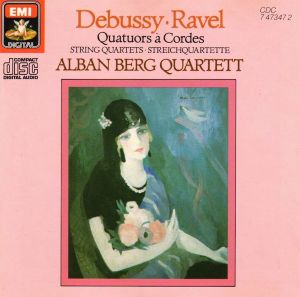
The Alban Berg Quartett is a string quartet founded in Vienna in 1970, with a core repertoire spanning Central European works from the Viennese Classical period to the Second Viennese School. This recording represents an engagement by an ensemble rooted in the German-Austrian performance tradition with the two major French modern string quartets.
Brief Biographies of the Composers
Claude Debussy (1862–1918) studied at the Paris Conservatoire and won the Prix de Rome in 1884. Starting from Wagner’s influence, he relativized the functional harmonic framework of tonality by employing whole-tone scales, modes, and parallel chords, establishing his own musical language in works such as “Prélude à l’après-midi d’un faune,” “Pelléas et Mélisande,” and “La mer.”
Maurice Ravel (1875–1937) also studied at the Paris Conservatoire and was a pupil of Gabriel Fauré. Characterized by lucid writing and refined orchestration, he is known for works such as “Jeux d’eau,” “Gaspard de la nuit,” and “Boléro.” Although often grouped with Debussy under the label of “Impressionism,” he occupies a distinct position through his orientation toward classical forms and technical refinement.
Compositional Background
Debussy: Composed in 1893 and premiered on December 29 of the same year by the Ysaÿe Quartet at a concert of the Société Nationale de Musique in Paris. The work is dedicated to the Ysaÿe Quartet. This is Debussy’s only string quartet, positioned as his response to the tradition of “absolute music” since Beethoven. While connected to the lineage of cyclic form associated with Franck and others, it exhibits characteristics in modality and tone-color treatment that lead to his later language.
Ravel: Composed between 1902 and 1903 and premiered on March 5, 1904, by the Heymann Quartet at the Société Nationale de Musique. It is dedicated to Fauré. It is widely noted that the work was strongly conscious of Debussy’s quartet, yet Ravel places greater emphasis on classical balance and the close interrelation of themes. In a letter dated March 4, 1904, just before the premiere, Debussy, having learned of Ravel’s intention to make changes regarding volume, urged him not to change anything (apart from a slight adjustment to the viola). This anecdote is often cited as an indication of their relationship at the time.
Overall Characteristics of the Works
Both works are written for the standard string quartet instrumentation (first and second violins, viola, and cello) and follow a four-movement structure. Both employ a cyclic formal principle in which the principal theme of the first movement is transformed and recalled in subsequent movements. Modal melodies and diverse playing techniques such as mutes, pizzicato, and sul ponticello determine the character of the works through changes in tone color.
In Debussy, a modal theme runs through the entire work, resulting in a free and fluid overall structure. In Ravel, clearer thematic contrasts and a classical sense of form are maintained, with features of meticulous writing and transparency.
Commentary on Individual Movements
Debussy: String Quartet in G minor, Op. 10
- First movement: Animé et très décidé — A movement that presents the cyclic theme of the entire work. A rhythmic and forceful theme is developed within the framework of sonata form.
- Second movement: Assez vif et bien rythmé — A scherzo-like movement that makes extensive use of pizzicato over a rhythm marked by the viola. The theme is a transformation of the cyclic theme from the first movement.
- Third movement: Andantino, doucement expressif — A slow movement for muted strings. It has a serene and introspective character and forms the lyrical center of the work.
- Fourth movement: Très modéré – En animant peu à peu – Très mouvementé et avec passion — Beginning with a slow introduction, it takes up the themes of the entire work once more and leads to a passionate conclusion.
Ravel: String Quartet in F major
- First movement: Allegro moderato – très doux — In sonata form. The first theme is presented softly and developed in relation to a contrasting second theme.
- Second movement: Assez vif – très rythmé — A light scherzo-like movement based on pizzicato. A melodic, slower section is placed in the middle.
- Third movement: Très lent — A slow movement with mutes. Recollections that evoke thematic material from the first movement are interwoven, and an introspective atmosphere predominates.
- Fourth movement: Vif et agité — A finale characterized by tremolo and rapid motion. The cyclic theme is recalled, summarizing the work.
Principal Recordings
The coupling of the two works has become a standard combination in recording history. Notable recordings include the following:
- Quartetto Italiano (recorded 1965, Philips): Long regarded as a reference recording for its balanced lyricism and clear ensemble. Recorded in Vevey, Switzerland.
- Juilliard String Quartet (recorded 1959, RCA): A direct interpretation with strong forward drive. Later re-recordings also exist.
- Melos Quartet (recorded 1979, Deutsche Grammophon): Highly regarded for its precise ensemble and natural recorded sound.
- Quatuor Ébène (recorded 2008, Virgin Classics / Erato): A recent representative recording that combines vitality and delicacy, and received Gramophone Awards (including Record of the Year). It also includes Fauré’s string quartet.
In addition, French ensembles such as the Parrenin Quartet and many contemporary quartets have also recorded the works.
Commentary on the Alban Berg Quartett Recording
About the Performers
The Alban Berg Quartett was founded in Vienna in 1970. The founding members were Günter Pichler (first violin), Klaus Maetzl (second violin), Hatto Beyerle (viola), and Valentin Erben (cello).
Gerhard Schulz took over as second violin in 1978, and Thomas Kakuska as viola in 1981. The lineup of Pichler, Schulz, Kakuska, and Erben continued for a long period from 1981 to 2005.
The ensemble established an international reputation with a repertoire centered on the Viennese Classical period and the Second Viennese School (Berg, Webern), including complete recordings of Beethoven’s string quartets. After Kakuska’s death in 2005, Isabel Charisius became his successor, but the quartet disbanded in 2008.
Recording Data
Recorded at the Evangelical Church in Seon, Switzerland: Debussy in April 1984 and Ravel in December 1984. The producers were Gerd Berg for Debussy and John Fraser for Ravel. The balance engineer was Johann-Nikolaus Matthes. The label was EMI (Angel / HMV, etc.).
Characteristics
The characteristic of this recording lies not in bringing the color or atmosphere of French modern music to the forefront, but in emphasizing structural clarity rooted in the Central European quartet tradition and the treatment of polyphonic voices. Balance among the four parts, including the inner voices, is maintained, and the cyclic relationships of the themes are easily audible as dialogue between the parts. Compared with the fluent and songful performances of the Quartetto Italiano or the lighter tone colors found in French ensembles, it gives an impression of more tension-filled, solid construction. In Debussy, the fluid structure based on thematic transformation is emphasized; in Ravel, the classical sense of form and the precision of the writing stand out.
Release History
Released on LP and CD in 1986. Subsequent reissues have continued, including the EMI Classics “Great Recordings of the Century” series (with Stravinsky works coupled) and reissues after the transition to Warner Classics.
Critical Reception
In criticism, the structural clarity and technical finish are highly regarded, while some listeners who seek lyricism or French coloristic qualities have noted a somewhat restrained quality.
In the April 1986 issue of “Gramophone,” James Methuen-Campbell compared the Alban Berg Quartett’s interpretation with those of the Quartetto Italiano (Philips) and the Chilingirian Quartet (EMI Eminence), evaluating it as follows:
While the Chilingirian takes a more retrospective and romantic approach, the Alban Berg Quartett is “exploratory, highly spontaneous” and “more than the other two succeed in allowing the listener to participate in the unfolding of the music.” On the technical side, he stated that “the very complex and demanding scores are realized in playing of the highest standard,” praising the emphasis on ensemble unity rather than foregrounding the individuality of each player.
Regarding the recording, he highly evaluated it as “The Alban Berg Quartet’s recording is of demonstration quality and has a very wide dynamic range,” positioning it as one of the particularly outstanding achievements among digital recordings of the time.
Streaming Services
Search Links
Search for “Debussy Ravel String Quartets Alban Berg Quartett” on Amazon.com
Search for “Debussy Ravel String Quartets Alban Berg Quartett” on Apple Music