















































Overview
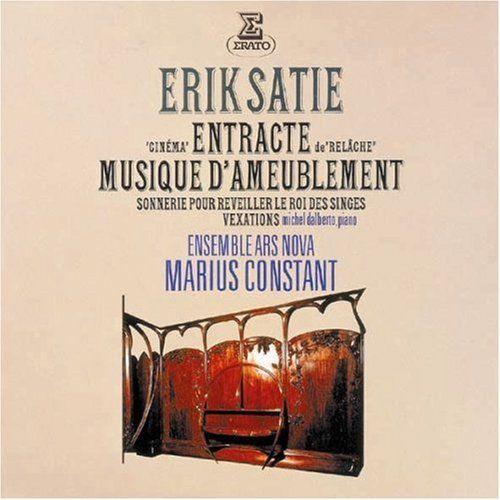
“Entracte; Musique D’Ameublement; Sonnerie Pour Réveiller Le Roi Des Singes; Vexations” is a collection of six short works by the French composer Erik Satie. It was released as an LP in 1981 on the French label Erato.
The album contains “Cinéma,” the music Satie wrote for the film “Entr’acte” (from the ballet “Relâche”); “Sonnerie pour réveiller le bon gros Roi des Singes,” a short piece for two trumpets; three orchestral miniatures collectively known as “Musique d’ameublement” (“Furniture Music”); and “Vexations,” an unusual keyboard piece bearing the instruction that its single phrase be repeated 840 times. “Vexations” is an early work, composed in Satie’s mid-twenties; the remaining pieces all date from his final years.
The conductor is Marius Constant, with the Ensemble Ars Nova performing (A1, B1–B3). “Vexations” is played as a solo by the pianist Michel Dalberto (B4). The “Fanfare” is performed as a duet by trumpeters Bernard Jeannoutot and Pierre Thibaud (A2).
Biography of the Composer
Erik Satie (1866–1925) was a French composer born in Honfleur, Normandy. He received formal training at the Paris Conservatoire but left early, supporting himself as a pianist at the Montmartre cabaret Le Chat Noir while developing his own compositional voice. Known for the “Trois Gymnopédies” (1888) and the “Gnossiennes,” he nonetheless continued to renew his musical language throughout his life, re-enrolling at the Schola Cantorum in his forties to study counterpoint anew. From the 1910s onward he associated with avant-garde figures such as Jean Cocteau, Pablo Picasso, and Francis Picabia, producing stage works including the ballets “Parade” (1917) and “Relâche” (1924). His anti-Wagnerian austerity, humor, and taste for repetition exerted a pioneering influence on multiple currents of twentieth-century music, from Dadaism to later minimalist and ambient music. He died in Paris in 1925.
Track Listing
A1: “Cinéma,” Music from “Relâche” – 18:10
A2: “Sonnerie pour réveiller le bon gros Roi des Singes” – 1:00
B1: “Tenture de cabinet préfectoral” – 6:00
B2: “Tapisserie en fer forgé” – 3:02
B3: “Carrelage phonique” – 2:26
B4: “Vexations” – 9:40
Instrumentation
- “Cinéma” (A1): Orchestra (Ensemble Ars Nova)
- “Sonnerie pour réveiller le bon gros Roi des Singes” (A2): Two trumpets
- The three pieces of “Musique d’ameublement” (B1–B3): Small ensemble (Ensemble Ars Nova)
- “Vexations” (B4): Solo piano
About the Performers
This recording centers on performances by the conductor Marius Constant (1925–2004) and the Ensemble Ars Nova, the contemporary-music ensemble he founded in 1963.
Constant, born in Romania, studied at the Paris Conservatoire and held posts in the music production department of French Radio (ORTF) and as music director of the Paris Opéra; he was thoroughly versed in the twentieth-century repertoire.
Michel Dalberto (b. 1955), who performs the “Vexations” solo, was still a pianist in his mid-twenties at the time of this recording, having already won the Clara Haskil Prize in 1975 and the Leeds International Piano Competition in 1978.
The trumpeters in the “Fanfare,” Bernard Jeannoutot and Pierre Thibaud, are both eminent figures of French wind playing.
The recording was made in February 1980 at the Église Notre-Dame du Liban in Paris.
Commentary
Musical Characteristics
The pieces gathered on this album differ from one another in date of composition, instrumentation, and origin, but they are united by a preoccupation that runs throughout Satie’s output: a tendency toward repetition and a suppression of expressive display.
“Cinéma” is built from short motifs stacked in repetitive layers that correspond to the fragmented visuality of silent film; “Musique d’ameublement” pursues the “backgrounding” of listening through the monotonous repetition of the same patterns; “Vexations” pushes this same impulse to its extreme, thematizing the sheer act of mass repetition of a single motif as a form in itself.
The “Fanfare” is an exceptionally short piece of occasional music, but it too embodies Satie’s characteristic wit through the gap between its exaggerated title and its concise musical content.
Taken as a whole, the collection consistently rejects nineteenth-century dramatic construction and organic development in favor of a stance built from fragmentation, repetition, and quotation.
About the “Musique d’Ameublement”
“Musique d’ameublement” is the collective name retroactively given to the following group of pieces, which Satie composed for different purposes between 1917 and 1923.
1. The first realization of the “furniture music” concept (1917)
- “Tapisserie en fer forgé” (“Wrought-Iron Tapestry”)
- “Carrelage phonique” (“Phonic Tiling”)
2. Incidental music for a play by Max Jacob (1920)
- “Chez un ‘Bistrot'” (“At a ‘Bistro'”)
- “Un salon” (“A Salon”)
These two pieces were composed as incidental music for Max Jacob’s play “Ruffian toujours, truand jamais,” and were premiered in 1920 at the Galerie Barbazanges during a performance of that play. Their scores went missing for decades and were not rediscovered and published until the late 1990s. At the time this album was made (recorded in 1980), the two pieces were unknown, and they are accordingly not included here.
3. A commission for Mrs. Eugène Meyer Jr. (1923)
- “Tenture de cabinet préfectoral”
Track-by-Track Commentary
A1. “Cinéma”
“Cinéma” is the music Satie composed for the short film “Entr’acte,” directed by René Clair and screened during the intermission of the ballet “Relâche” (premiered 4 December 1924 at the Théâtre des Champs-Élysées). “Relâche” was produced by the Ballets Suédois, with a scenario by Francis Picabia and choreography by Jean Börlin, under the direction of Rolf de Maré.
Fragmentary melodic motifs are repeated by the orchestra, with successive layers of sound appearing and dissolving in a manner that echoes the film’s discontinuous montage. The absence of any dramatic climax, and the sustained, even sense of motion throughout, reveal Satie’s experimental approach to film music.
A2. “Sonnerie pour réveiller le bon gros Roi des Singes (lequel ne dort toujours que d’un œil)”
Composed in 1921 for the new British periodical “Fanfare: A Musical Causerie,” this is a piece of roughly one minute for two trumpets.
The gap between its strange, lengthy title and its short duration—little more than a festive, exaggerated fanfare-like phrase—is a concise demonstration of Satie’s particular humor.
The premiere took place on 27 October 1921 at Queen’s Hall in London, conducted by Eugene Goossens.
B1. “Tenture de cabinet préfectoral”
Commissioned by Mrs. Eugène Meyer Jr. (wife of the banker and publisher), a resident of Washington, D.C., this piece was composed in 1923 to “furnish” the library of her residence. It is scored for small orchestra (flute, clarinet, bassoon, horn, trumpet, percussion, and a five-part string section, among others).
Short sections of roughly four, five, and three measures are combined and repeated as a decorative pattern covering the space, much like wallpaper.
B2. “Tapisserie en fer forgé”
This is the piece in which Satie first gave concrete form to the concept of “furniture music.” It was composed in 1917.
A short phrase (roughly four measures, in 6/8 time, in G major, among other features) for flute, clarinet, trumpet, and strings (without double bass) is repeated throughout.
B3. “Carrelage phonique”
Part of the same set as the above. A short pattern of roughly four measures, for flute, clarinet, and strings, is repeated throughout.
B4. “Vexations”
“Vexations” (“Vexations” or “Annoyances”) is a piano solo composed around 1893. Its roughly one-minute theme is followed by variations employing harmonic treatment that departs from conventional notation, and a marginal note in the score instructs that the motif be repeated 840 times. It was neither published nor performed during Satie’s lifetime and was discovered only after his death.
In 1963, under John Cage’s direction, what is regarded as the first complete performance of all 840 repetitions took place at the Pocket Theater in New York (Cage himself, Christian Wolff, and several other pianists took turns at the piano, and the performance lasted approximately eighteen hours and forty minutes). This event brought the piece sudden fame.
Dalberto’s performance on this album runs nine minutes and forty seconds; rather than a complete performance of all 840 repetitions, it is presented as an excerpt conveying the character of the piece.
Historical Influence
“Musique d’ameublement” was rarely performed during Satie’s lifetime and fell into obscurity after his death, but it was reevaluated in the 1960s by John Cage and others, and from the 1970s onward came to be regarded as a forerunner of ambient music.
“Musique d’ameublement” is repeatedly cited as an antecedent in the lineage of “ambient music,” the concept Brian Eno established from the mid-1970s onward. Eno himself is said to have named this work of Satie’s as part of his own musical origins, and Satie’s notion of “music not meant to be consciously listened to” has been referenced repeatedly along the path leading to “Discreet Music” (1975) and “Ambient 1: Music for Airports” (1978). The two bodies of work nonetheless differ substantially in musical character: “Musique d’ameublement” is dense with melodic repetition and carries a faintly unsettling coloring, whereas Eno’s early ambient works pursue a static continuity built from a sparser array of sounds.
The idea found in “Vexations”—the mass repetition of an identical pattern devoid of any sense of forward motion—has become a touchstone for later experimental music, including minimalism and drone, that thematizes repetition and duration.
Streaming Services
Search Links
Search for “Satie Musique d’ameublement” on Amazon.com
Search for “Satie Musique d’ameublement” on Apple Music