




































- Overview
- Trailer
- Film Data
- Plot Summary
- Commentary
- Search Links
- Plot (Spoilers)
- The Golden Ticket Announcement
- Song 1: “The Candy Man”
- The Worldwide Scramble for Tickets
- Song 2: “Cheer Up, Charlie”
- Charlie’s Ticket
- Song 3: “(I’ve Got a) Golden Ticket”
- The Tour Begins and the Contract
- The Chocolate Room
- Song 4: “Pure Imagination”
- Augustus’s Downfall
- Song 5: “Oompa Loompa (Augustus’s Song)”
- The Hallucinogenic Tunnel
- The Inventing Room and Violet’s Downfall
- Song 6: “Oompa Loompa (Violet’s Song)”
- The Lickable Wallpaper Corridor
- The Fizzy Lifting Drinks Room
- The Golden Goose Room and Veruca’s Downfall
- Song 7: “I Want It Now”
- Song 8: “Oompa Loompa (Veruca’s Song)”
- The Wonkamobile
- The Television Room and Mike’s Downfall
- Song 9: “Oompa Loompa (Mike’s Song)”
- The Contract Is Voided and the Truth Revealed
- The Ending: The Wonkavator
Overview
“Willy Wonka & the Chocolate Factory” is a 1971 American musical fantasy film based on Roald Dahl’s 1964 children’s novel “Charlie and the Chocolate Factory.” It was directed by Mel Stuart and written by Roald Dahl, with an uncredited rewrite by David Seltzer, and stars Gene Wilder as candy magnate Willy Wonka, in a performance that would later become synonymous with the role. Wonka sets off a worldwide frenzy over five “Golden Tickets” hidden inside his chocolate bars, offering the winners a tour of his factory — among them the impoverished boy Charlie Bucket.
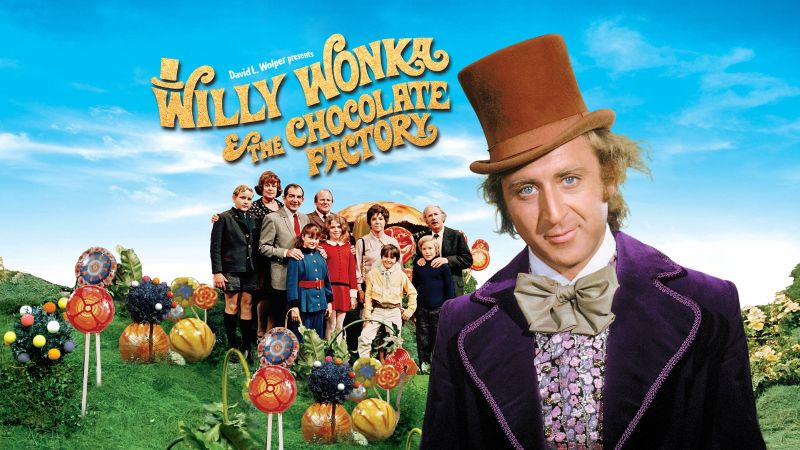
One point worth noting about how the film came to be made is that its entire $3 million budget was financed not by a film studio but by the food manufacturer Quaker Oats. Quaker Oats, which was planning to enter the confectionery business with a tie-in product called the “Wonka Bar,” provided the financing on the condition that the film be retitled from the novel’s own title to one foregrounding the protagonist’s employer, “Willy Wonka & the Chocolate Factory.” In effect, the film was conceived as a feature-length corporate advertisement wearing the form of a feature film — an origin that stands as an essential premise for any discussion of the film.
The film performed poorly at the box office on release. From the 1980s onward, however, repeated television broadcasts and the home video market drove a critical and popular reassessment, and the film today holds the status of a cult classic worldwide.
Trailer
Film Data
- Original Title: Willy Wonka & the Chocolate Factory
- Director: Mel Stuart
- Screenplay: Roald Dahl (with an uncredited rewrite by David Seltzer)
- Based on: Roald Dahl, “Charlie and the Chocolate Factory” (1964)
- Producers: Stan Margulies, David L. Wolper
- Production Companies: Wolper Pictures, Quaker Oats Company
- Distributor: Paramount Pictures
- Cinematography: Arthur Ibbetson
- Editing: David Saxon
- Music (Songs): Leslie Bricusse, Anthony Newley
- Music (Score): Walter Scharf
- Production Design: Harper Goff
- Special Effects: Logan R. Frazee
- Starring: Gene Wilder (Willy Wonka), Jack Albertson (Grandpa Joe), Peter Ostrum (Charlie Bucket), Roy Kinnear (Mr. Salt), Julie Dawn Cole (Veruca Salt), Denise Nickerson (Violet Beauregarde), Paris Themmen (Mike Teevee), Michael Bollner (Augustus Gloop), Diana Sowle (Mrs. Bucket), and others
- Release Date: June 30, 1971 (United States)
- Running Time: 100 minutes
- Country: United States
- Language: English
- Budget: $3 million
Plot Summary
Willy Wonka, the proprietor of a major confectionery company, is a figure of mystery who has kept his factory’s doors sealed shut for years — no one is known to have seen anyone enter or leave it. One day, Wonka announces that he has hidden five “Golden Tickets” inside his chocolate bars; whoever finds one will be granted a tour of the factory and a lifetime supply of chocolate.
Amid the frenzied worldwide scramble for tickets that follows, Charlie Bucket, a poor newspaper boy, happens to find the last of the five tickets in a chocolate bar bought with a coin he finds in the gutter. Charlie and his grandfather Joe accompany four other children — the gluttonous Augustus Gloop, the spoiled Veruca Salt, the gum-chewing Violet Beauregarde, and the television-obsessed Mike Teevee — and their respective guardians through the factory gates.
Inside, the tour reveals sights beyond imagination: a room with a river of chocolate, a garden overgrown with edible plants, and a laboratory lined with experimental inventions in progress. But as the tour proceeds, the children drop out one by one, each falling into a bizarre mishap brought on by a personal flaw — .gluttony, greed and entitlement, pride and vanity, or sloth and television addiction. In the end, only Charlie remains, and it is here that Wonka’s true intentions come to light.
Commentary
Production Background
The project was set in motion by producers David L. Wolper and Stan Margulies. According to the standard account, director Mel Stuart brought the idea of adapting the novel to Wolper, who in turn approached Quaker Oats about financing. Quaker Oats, which was looking to enter the confectionery market, agreed on the understanding that the film would function as a live-action commercial for a new product, the “Wonka Bar.” This is why the novel’s original title, “Charlie and the Chocolate Factory,” was changed to “Willy Wonka & the Chocolate Factory,” foregrounding Willy Wonka rather than the protagonist Charlie.
Dahl himself wrote the first draft of the screenplay, but David Seltzer subsequently carried out an extensive, uncredited rewrite that added musical numbers and altered the ending. Dahl was deeply unhappy with these changes — particularly the way the finished film shifted focus onto Wonka at the expense of the book, and the altered ending — and went on to publicly disown the completed film. This conflict stands as a characteristic instance of the friction that can arise between an original author and a film’s production team over interpretive control of the source material. During his lifetime, Dahl never authorized a film adaptation of the sequel novel, “Charlie and the Great Glass Elevator.”
Filming took place from August to November 1970 in and around Munich, West Germany.
Characteristics
Rather than functioning as a musical in the strict sense, the film places its musical numbers at key narrative junctures. The songs were written by Leslie Bricusse and Anthony Newley, with the score arranged and conducted by Walter Scharf. Among them, “Pure Imagination,” sung when Wonka first reveals the Chocolate Room to the children, has gone on to be quoted and covered repeatedly throughout popular culture. “The Candy Man,” meanwhile, became a number-one hit on the American charts in 1972 in a cover version by Sammy Davis Jr., achieving a recognition independent of the film itself.
Cinematography
The cinematographer was Arthur Ibbetson, who had previously worked on a number of films centered on child protagonists, including “Whistle Down the Wind” (1961) and “The Whistlers” (1970). The factory’s interior rooms were shot with wide-angle lenses to give an impression of space greater than what physically existed, and the Chocolate Room in particular uses warm lighting to visualize an almost excessive sweetness and the temptation toward overindulgence. By contrast, the scenes in which the children drop out use harder, shadow-emphasizing lighting, so that tone shifts dramatically from scene to scene even within the same sets.
The film’s most technically adventurous sequence is the “hallucinogenic tunnel” ride, in which the group travels through the factory by boat. Rapid zooms, strobing flashes of light, and montage-like fragments of imagery combine to deliberately disorient the viewer, breaking sharply from the pastoral visual grammar that has governed the film up to that point. As a sequence within a G-rated family film, its unusual intensity has repeatedly drawn comment, from the time of the film’s release through to today.
Filming Locations
Although the film never specifies where its story is set, the actual shoot took place in and around Munich, in the West German state of Bavaria. One reason cited for the choice of location is that it allowed the production to hold down costs considerably compared with filming in Los Angeles or New York.
The factory’s exterior was shot at the site of the Munich municipal gasworks (today Stadtwerke München), while the interior sets — the Chocolate Room, the Inventing Room, the hallucinogenic tunnel, and others — were built and filmed at Bavaria Studios in Geiselgasteig, near Grünwald. For the overhead shot late in the film, in which Wonka and Charlie’s glass elevator, the “Wonkavator,” bursts through the factory roof and flies off into the sky, the production used the townscape of the old Bavarian town of Nördlingen, known for its circular medieval old town enclosed by a city wall.
Scenes of Charlie’s paper route and the area around his home, meanwhile, were shot around the Schwabing district and Quellenstraße in Munich.
Special Effects
Special effects were handled by Logan R. Frazee. As a pre-CGI production, most of the film’s visual illusions were achieved through practical sets, optical compositing, and model work. The scene in which Augustus Gloop tumbles into the chocolate river and is sucked up a pipe was likewise achieved through practical stunt work.
Design and Creature Work
The golden-egg-laying geese that appear in the Golden Goose Room are a change from the novel, which instead features squirrels.
The Oompa-Loompas, described in the novel as having brown skin, were given a visually bold redesign for the film — orange-tinted skin and green, pompadour-style hair — and were played by ten actors of short stature, including Rusty Goffe, George Claydon, and Malcolm Dixon. This design has had a lasting influence on later screen adaptations, including the 2005 and 2023 versions.
Thematic Analysis
On its surface, the film’s central theme follows the form of an allegorical morality tale, in which vices such as gluttony and greed are punished in poetic-justice fashion while a humble, virtuous protagonist is rewarded. The four children’s downfalls are each tied to a distinct vice — gluttony (Augustus), selfishness (Veruca), poor manners (Violet), and an excessive fixation on television (Mike) — and the Oompa-Loompa songs that follow each mishap serve, each time, to spell out the moral in explicit terms. This structure is itself inherited from Dahl’s original novel, which follows the traditional framework of the didactic children’s tale in which good is rewarded and vice is punished.
Reading the film simply as a straightforward morality tale, however, requires some qualification once its production history is taken into account. As noted above, the film was commissioned by a confectionery manufacturer and carries, in substance, much of the character of a feature-length commercial. There is a self-reflexive tension built into the fact that “a story warning against excessive desire for chocolate and Golden Tickets” was itself produced to promote a candy brand. The film thus operates on two messages at once — the stimulation of consumer desire (a function the film itself performs commercially) and the on-screen punishment of that very desire.
The episode in which Mike Teevee drops out of the tour, meanwhile, can be read as a satire of television as a medium in its own right. The scene in which Mike’s body is shrunk and transmitted through “Wonkavision,” a teleportation device, can be interpreted as reflecting a contemporary cultural anxiety about children’s excessive absorption in television.
Release
The film was released in the United States by Paramount Pictures on June 30, 1971. Paramount retained the film’s theatrical rights until 1977, after which home video rights passed to Warner Bros.
Reception
Commercially, the film underperformed, earning only around $4 million against its $3 million budget in its first year — a performance that placed it around 53rd among the year’s domestic releases.
Peter Ostrum, who played Charlie, has recalled the contemporary critical response as “lukewarm at best.” His co-star Julie Dawn Cole, who played Veruca Salt, has likewise stated that the film was not a commercial success, running in theaters for only a few weeks before disappearing and being largely forgotten for years afterward.
Critically, the film found a degree of support even at the time of its release. Roger Ebert, then a young critic at the Chicago Sun-Times, gave the film a perfect rating and called it the finest film of its kind since “The Wizard of Oz.” At the same time, some contemporary commentators noted that the hallucinogenic tunnel sequence was unusually unsettling for a children’s film.
At the 1972 Academy Awards, the film received a nomination for Best Original Score, and Wilder was nominated for Best Actor in a Musical or Comedy at the 29th Golden Globe Awards; neither nomination resulted in a win.
From the 1980s onward, repeated television broadcasts and the spread of home video gradually built the film a cult following, and when Warner Bros. re-released it under its Family Entertainment division in 1996, it earned an additional $21 million. Critical opinion of the film today has shifted markedly from its reception on release, and later reassessments frequently credit the film with shaping the visual language of children’s fantasy cinema that followed it.
Historical Standing
In 2014, the film was selected by the Library of Congress for inclusion in the National Film Registry as a work deemed “culturally, historically, or aesthetically significant.” This marked the film’s formal recognition, in an official capacity, as a reference point within American film history — a striking reversal from its status as a commercial failure at the time of its release.
The film’s trajectory — from commercial failure to enduring cultural success — is also frequently cited as an example of how a film’s value cannot be reduced to its box-office performance at the moment of release alone.
Other Notable Topics
The Wonka Bar Product Launch
The “Wonka Bar,” conceived as the film’s tie-in product, was brought to market ahead of the film’s release in May 1971, but was soon withdrawn from shelves owing to a manufacturing flaw that caused it to melt easily even under proper storage conditions. Quaker Oats subsequently limited itself to releasing unrelated candy lines such as “Super Skrunch” and “Peanut Butter Oompas,” and the full launch of the “Wonka Bar” itself as originally intended was postponed until 1976. This episode shows that the film failed to function even as advertising in the manner originally planned, adding — ironically — a real-world commercial setback to the “dual structure of stimulating and punishing desire” discussed in the thematic analysis above. The Willy Wonka Candy Company was sold to Nestlé in 1988, and the “Wonka Bar” name has continued to see intermittent use as a product line under Nestlé since then.
The Quotation from Arthur O’Shaughnessy’s Poem
The line Wonka speaks while gripping Veruca Salt’s cheeks in the “lickable wallpaper” corridor — “We are the music makers, and we are the dreamers of dreams” — is a quotation from the opening of “Ode,” a poem published by Arthur O’Shaughnessy in 1874.
The electronic musician Richard D. James, known as Aphex Twin, sampled this line of Wonka’s dialogue for use in his track “We Are the Music Makers,” included on the album “Selected Ambient Works 85–92.”
Home Media
The film’s home media history is closely tied to its critical reassessment over time. On October 8, 1996, Hip-O Records (an imprint of MCA Records) released a “25th Anniversary Edition” of the soundtrack on CD.
On video, Warner Home Video released the film on Blu-ray in 2009, followed on November 1, 2011, by a 40th Anniversary Deluxe Edition (Blu-ray, DVD, and a bonus disc, along with items such as a Wonka Bar-shaped tin and scented pencils). A 4K UHD Blu-ray was released on June 29, 2021, to mark the film’s 50th anniversary; this release corrected an aspect-ratio error present on earlier Blu-ray editions (1.78:1), restoring the framing to 1.85:1, closer to the film’s theatrical presentation.
This edition also includes a roughly 31-minute documentary, “Pure Imagination: The Story of Willy Wonka and the Chocolate Factory,” featuring interviews with director Mel Stuart, producer David L. Wolper, Wilder himself, Oompa-Loompa performer Rusty Goffe, and several of the child actors.
Other Screen Adaptations
Charlie and the Chocolate Factory (2005)
Dahl’s novel has since been adapted into film once more. Tim Burton’s “Charlie and the Chocolate Factory” (2005), starring Johnny Depp, aimed for a more faithful adaptation of the novel and added new backstory for Wonka (including material involving his father, Dr. Wonka), though critical opinion of the film was mixed. That film’s decision to have a single actor, Deep Roy, play every Oompa-Loompa through digital compositing is frequently noted as a point of contrast with the 1971 film’s use of multiple performers.
Wonka (2023)
In 2023, “Wonka,” directed by Paul King and starring Timothée Chalamet, was released as a prequel centered on a young Willy Wonka. Rather than adapting the novel directly, the film is built around a largely original screenplay depicting Wonka’s early years entering the confectionery trade. Its filmmakers and star have publicly described the film as a “companion piece” continuous in setting with the 1971 film.
Search Links
Cross-Search for “Willy Wonka & the Chocolate Factory” on JustWatch
Search for “Willy Wonka & the Chocolate Factory” on Amazon.com
Plot (Spoilers)
The Golden Ticket Announcement
Charlie Bucket, a boy from a poor family, helps support his household with the meager income he earns delivering newspapers. Willy Wonka, the town’s confectionery manufacturer, has kept his factory’s doors closed for years — according to Grandpa Joe, because of rampant industrial espionage by rival confectioners seeking his recipes. One day, Wonka announces that he has hidden five “Golden Tickets” inside his chocolate bars, promising a factory tour and a lifetime supply of chocolate to whoever finds one.
Song 1: “The Candy Man”
The Worldwide Scramble for Tickets
Performed by Bill, the candy shop owner. An opening number in which Bill sings of the whole town’s obsession with Wonka’s candy, building anticipation for the frenzy to come.
A worldwide scramble for the tickets ensues. The first four are found by Augustus Gloop, a gluttonous German boy; Veruca Salt, a wealthy and spoiled English girl; Violet Beauregarde, an American girl who chews gum incessantly; and Mike Teevee, an American boy obsessed with television. At each announcement of a winner, a mysterious man — later revealed to be an agent of Wonka’s rival, Slugworth — appears and offers the winner money in exchange for smuggling out a sample of an experimental gumball from inside the factory, the “Everlasting Gobstopper.”
Charlie, too, opens a chocolate bar he receives on his birthday, but finds no ticket inside.
Song 2: “Cheer Up, Charlie”
Performed by Mrs. Bucket. A lullaby-like number in which Charlie’s mother gently consoles her son after his failure to find a Golden Ticket.
Charlie’s Ticket
News breaks that the fifth ticket has been found by a wealthy man in Paraguay, and Charlie’s hopes seem dashed. Some days later, however, Charlie buys a chocolate bar with a coin he finds in the gutter, and the last Golden Ticket turns out to be inside. At that very moment, the Paraguayan man’s ticket is revealed to be a forgery, confirming Charlie as the genuine fifth winner. Grandpa Joe, bedridden for years, leaps out of bed at the news and dances for joy with Charlie.
Song 3: “(I’ve Got a) Golden Ticket”
performed by Grandpa Joe and Charlie. A joyous number built around the cry, “Our family has gotten its own golden ticket (its own stroke of luck) too!”
The Tour Begins and the Contract
On the day of the tour, Charlie brings Grandpa Joe along as his guardian, joining the other four children and their families at the factory gates. Wonka makes his entrance limping on a cane, then tumbles into a forward roll and springs upright, putting the assembled group at ease.
Once inside, the group is brought before a contract spanning an entire wall, and Wonka requires each of the children to sign it. The print starts out large but grows smaller and smaller toward the bottom, ending in text too fine to be read even with a magnifying glass. The document is a liability waiver absolving Wonka of responsibility for any accident that might occur inside the factory, and the guardians balk at having their children sign without being able to read it in full. Wonka, however, states that no one may enter without signing, and Veruca — ignoring her father’s hesitation — is the first to seize the pen, with the other children following her lead.
The Chocolate Room
With the signing complete, the tour begins in a garden built around a river of chocolate, where Wonka sings a number celebrating the boundless possibilities of imagination.
Song 4: “Pure Imagination”
Performed by Willy Wonka. A number that stands as one of the film’s signatures: amid the pastoral garden and its river of chocolate, the tension of the preceding scenes momentarily dissolves into a dreamlike sense of wonder.
From here, the children drop out one by one, each undone by an accident rooted in a personal flaw, and each departure is followed by a cautionary song from the Oompa-Loompas — always set to the same tune (“Oompa Loompa Doompadee Doo”) but with new lyrics, spelling out the moral of the moment.
Augustus’s Downfall
Augustus leans too far over the edge of the chocolate river and falls in, jamming the suction pipe. As Augustus gets stuck, Wonka murmurs, “The suspense is terrible… I hope it’ll last” — one of the film’s most famous lines, and a neat encapsulation of Wonka’s mischievous wit. Augustus is soon swept up the pipe toward the fudge-making room. To his distraught mother, Wonka offers, in a mix of Latin and English, “Nil desperandum, my dear lady. Across the desert lies the promised land,” before piling on farewells in English, French, and German: “Goodbye, Mrs. Gloop. Adieu. Auf Wiedersehen. Gesundheit. Farewell.” Among these, “Gesundheit” is ordinarily what one says to someone who has just sneezed — roughly “bless you” in German — and is tossed in here as a joke.
Song 5: “Oompa Loompa (Augustus’s Song)”
Performed by the Oompa-Loompas. A number chastising Augustus’s gluttony and warning of what becomes of a child left to indulge such appetites unchecked.
The Hallucinogenic Tunnel
The remaining party boards a boat as Wonka invites them aboard in French — “Mesdames et messieurs, maintenant nous allons faire grand petit voyage par bateau. Voulez-vous entrer le Wonkatania?” (“Ladies and gentlemen, now we’re going to take a big little boat trip. Do you want to enter the Wonkatania?”) — and passes through the “hallucinogenic tunnel” to reach the next room. Wonka recites an unsettling poem, his delivery growing more frenzied by the moment, and the visual treatment turns psychedelic to match — breaking sharply from the film’s pastoral visual style up to this point.
The Inventing Room and Violet’s Downfall
On the far side of the tunnel, Wonka introduces the next room in German: “Meine Herrschaften, schenken Sie mir Ihre Aufmerksamkeit. Sie kommen jetzt in den interessantesten und gleichzeitig geheimsten Raum meiner Fabrik. Meine Damen und Herren: der Inventing Room” (“Ladies and gentlemen, please give me your attention. You now come into the most interesting room of my factory, the most secret room at the same time. Ladies and gentlemen: the Inventing Room”).
When Mr. Salt notices vats labeled “Butterscotch” and “Buttergin” and asks whether Wonka has “got a little something going on the side,” Wonka replies by quoting an Ogden Nash epigram: “Candy is dandy, but liquor is quicker.”
In this room, everyone is given an “Everlasting Gobstopper,” a candy said never to get any smaller, so that it can be eaten forever without running out. Violet, ignoring Wonka’s warning that his experimental “three-course dinner” gum is not yet ready, chews a piece anyway and swells up like a giant blueberry, turning violet — true to her name — before being wheeled off to the Juicing Room.
Song 6: “Oompa Loompa (Violet’s Song)”
Performed by the Oompa-Loompas. A number likening Violet’s habit of ceaseless gum-chewing to a cow’s cud-chewing, chastising her poor manners.
The Lickable Wallpaper Corridor
As the group leaves the Inventing Room and passes down a corridor lined with “lickable wallpaper,” Wonka proudly explains that the strawberries taste like strawberries and the snozzberries taste like snozzberries. When Veruca interjects, “Snozzberries? Who ever heard of a snozzberry?”, Wonka takes hold of her cheeks with both hands and, looking her in the eye, tells her: “We are the music makers, and we are the dreamers of dreams.”
The Fizzy Lifting Drinks Room
Charlie and Grandpa Joe fall behind the rest of the group and wander into a small room Wonka had specifically warned them not to touch. Inside is an experimental soft drink, “Fizzy Lifting Drinks,” and drinking it sends the pair floating up into the air like balloons. They rise nearly to the ceiling and come dangerously close to being pulled into a large ventilation fan before managing to burp the gas out of their systems and descend safely to the floor.
The Golden Goose Room and Veruca’s Downfall
In the Golden Goose Room, Veruca — captivated by a flock of geese that lay golden eggs — begins making one demand after another of her father. When Mr. Salt scoffs at the “Eggdicator” machine that sorts good eggs from bad, calling it “a lot of nonsense,” Wonka sings back, “A little nonsense now and then is relished by the wisest men” — a line, murmured almost as an aside, that is widely regarded as a succinct statement of his personal philosophy.
Song 7: “I Want It Now”
Performed by Veruca Salt. A number showcasing Veruca’s greed and sense of entitlement, as she demands the goose and anything else that catches her eye, right this instant. Immediately afterward, she tries to grab a goose for herself, loses her footing on a platform, and falls down a chute reserved for “bad eggs.”
Song 8: “Oompa Loompa (Veruca’s Song)”
Performed by the Oompa-Loompas. A number that lays the blame for a child’s sense of entitlement not on the child herself but on the parents who indulged her, directing its criticism at Veruca’s father rather than at her greed alone.
The Wonkamobile
Leaving the Golden Goose Room, the remaining party — now just Charlie and Mike, with their guardians — boards a vehicle called the “Wonkamobile,” which runs on an assortment of carbonated drinks. As it travels, the car sprays a great burst of foam from its rear, instantly covering the passengers from head to toe. The foam, however, is dried in an instant by a device called “Hsaw Aknow” (Wonka Wash spelled backward).
The Television Room and Mike’s Downfall
In the television testing room, Mike leaps into the Wonkavision device himself and is shrunk and transmitted inside a television screen.
Song 9: “Oompa Loompa (Mike’s Song)”
Performed by the Oompa-Loompas. A number warning that excessive television watching dulls the mind, urging children to turn off the television and read a book instead.
The Contract Is Voided and the Truth Revealed
Only Charlie and Grandpa Joe remain. When the tour ends, Wonka hurries them off and retreats to his office. Unsatisfied, Grandpa Joe follows Wonka with Charlie in tow to ask about the promised lifetime supply of chocolate. Wonka answers curtly that Charlie will not receive it, because he broke the rules. When Joe protests that they saw no such rules, Wonka flies into a sudden rage and produces the contract, citing Section 37B: it states that anyone who steals Fizzy Lifting Drinks and collides with the ceiling, necessitating its cleaning and sterilization, forfeits all rights under the agreement. “You get nothing!” Wonka declares. “You lose! Good day, sir!”
Joe, furious, calls Wonka “a crook, a cheat, and a swindler,” railing against him for building up a boy’s hopes only to crush them. He reveals that he had earlier been approached by Wonka’s rival Slugworth, and — as an act of revenge — urges Charlie to hand over his Gobstopper to Slugworth. Charlie, however, stops him, quietly takes the Gobstopper from his pocket, and sets it down on Wonka’s desk instead.
Wonka’s expression softens at the sight, and he murmurs, “So shines a good deed in a weary world.” It is then revealed that Wonka’s outburst and the announcement that the contract was void — along with the very existence of the man calling himself Slugworth — were all part of a final test of the children’s character, and that “Slugworth” was in fact an employee planted by Wonka himself (Mr. Wilkinson). Wonka tells Charlie that he alone has shown himself fit to inherit the whole of the factory, adding, in a catchphrase he repeats throughout the film, “We have so much time and so little to do. Strike that. Reverse it.” The two then board the glass elevator, the “Wonkavator.”
The Ending: The Wonkavator
The elevator bursts through the factory roof and soars into the sky, giving a sweeping view of the town below. Wonka explains that Charlie will now live at the factory with his family and take over the business, adding, in one of the film’s warmest and most memorable closing lines, “But Charlie, don’t forget what happened to the man who suddenly got everything he always wanted. … He lived happily ever after.” The film closes with the Wonkavator flying off over the rooftops of the town.
Over the end credits plays an orchestral arrangement of “Pure Imagination,” the song Wonka sings earlier in the film.