















































Overview
“Shoah” is a 1985 French documentary film directed by Claude Lanzmann. It portrays the reality of the Holocaust — the mass murder of European Jews carried out by Nazi Germany during the Second World War — solely through interviews with survivors, perpetrators (former SS officers), and witnesses (local Polish residents), without using any archival footage whatsoever.
The running time varies somewhat by version, but according to the running times listed for editions such as the Criterion Collection release, the film as a whole runs to roughly nine hours and twenty-six minutes (566 minutes).
Director, Screenwriter, Interviewer: Claude Lanzmann.
Production: Les Films Aleph, Historia Films. Supported by grants from the French Ministry of Culture.
Cinematography: Dominique Chapuis, Jimmy Glasberg, William Lubtchansky, Phil Gries, and others.
Editing: Ziva Postec (some sequences in the Treblinka material were edited by Anna Ruiz).
Languages: French, German, English, Polish, Hebrew, and Yiddish (see “Language and Interpretation” below for details).
Interpreters: Barbara Janicka interpreted from Polish into French; Francine Kaufmann served as Hebrew interpreter; Mrs. Apfelbaum served as Yiddish interpreter.
Distribution: New Yorker Films (United States).
Country: France.
Format: Shot on 16mm film, color, aspect ratio 1.37:1 (some sources list it as 1.33:1).
Trailer
Synopsis
The film has no dramatic “plot” in the conventional sense. Lanzmann travels through present-day Poland, visiting the sites of the former extermination camps at Chełmno, Sobibór, Treblinka, and Auschwitz-Birkenau, gathering testimony from survivors, former Nazi officials, and local residents who witnessed the events. The testimonies are not organized chronologically or geographically; instead, they are woven together through repetition and association, so that the past emerges through the present-day act of speaking. At the film’s center are the gas-van killings at Chełmno, the gas-chamber killings at Treblinka and Auschwitz-Birkenau, and the reality and uprising of the Warsaw Ghetto.
Commentary
Production Background
The film’s origins trace back to 1973, when Alouph Hareven, a senior official at the Israeli Ministry of Foreign Affairs, approached Lanzmann about making a film on the Holocaust. Lanzmann had just completed his previous film, “Why Israel” (“Pourquoi Israël,” 1973). The original terms called for a running time of about two hours and a production period of eighteen months, but Lanzmann is said to have accepted the commission while already aware that he would not be able to meet these conditions.
In practice, the production accumulated more than 350 hours of raw footage, and research took Lanzmann to more than a dozen countries. The Israeli government, the project’s original financial backer, reportedly withdrew its support as production dragged on, after which the film was sustained through grants from the French Ministry of Culture and various other funding arrangements. Editing alone took roughly five years, and the project as a whole, from conception to completion, spanned eleven to twelve years.
Lanzmann adhered strictly to a method that excluded archival footage, dramatic reenactment, and sentimental music, relying instead solely on direct interviews with witnesses and present-day footage of camp sites, railways, and forests. This was partly a practical necessity, given how little visual documentation of the extermination itself survives, but it was also an authorial choice: an attempt to render visible the absence itself — the erasure of the traces of the people who had once been there.
Among the film’s interview methods, the interview with former SS officer Franz Suchomel is especially well known. Because Suchomel refused to be filmed, Lanzmann promised not to film him and instead recorded the interview using a hidden camera. This method has itself become a subject of debate concerning the ethics of documentary filmmaking.
Structure
The film is divided into two parts, the “First Era” (“Première époque”) and the “Second Era” (“Deuxième époque”). According to the running times listed for editions such as the Criterion Collection release, the First Era runs to roughly four hours and thirty-three to thirty-four minutes, and the Second Era to roughly four hours and fifty-two to fifty-three minutes.
In theatrical screenings, home media releases, and broadcasts, each of these two parts is sometimes further divided into two, yielding a four-part structure (Parts One through Four).
Each sequence interweaves present-day landscapes — camp sites, forests, railway lines, rivers, villages, train stations — with interview footage. While each sequence centers on a particular camp or region, the film does not proceed chronologically; instead, it moves back and forth among the testimonies of multiple witnesses.
Language and Interpretation
The film’s linguistic structure is complex. Witnesses speak in Polish, German, English, Hebrew, and Yiddish, among other languages, accompanied by French subtitles (and, in some scenes, French-language narration).
Notably, Lanzmann himself converses directly, without an interpreter, in both German and English during interviews; an interpreter is used only for exchanges in Polish. As noted above, Polish-to-French interpretation was handled by Barbara Janicka, and the film includes scenes in which she can be seen performing this role.
Cinematography and Style
The cinematography is built around long takes of witnesses’ faces, interspersed with landscape shots of former camp sites, forests, railway tracks, and freight trains still running today. These landscapes serve, paradoxically, to bring into relief how little physical trace of the past events remains.
The witnesses fall broadly into three categories: Jewish survivors, the victims of the genocide; former Nazi officials, the perpetrators; and Polish witnesses and bystanders who lived near the camps. Lanzmann frequently presses his subjects with persistent, at times provocative, questioning, and continues interviews even when witnesses falter or are moved to tears (the interview with the barber Abraham Bomba is the best-known example of this approach).
Locations
Filming took place at numerous locations, including the sites of the former extermination camps at Chełmno, Sobibór, Treblinka, and Auschwitz-Birkenau; Warsaw; Łódź; the Ponary forest near Vilnius (in present-day Lithuania); Berlin; Munich; Wuppertal; Corfu (Greece); Israel; and the United States.
Thematic Analysis
The film’s central theme is the relationship between memory, testimony, and absence. As historian Raul Hilberg states within the film, the Nazi “Final Solution” is presented as a distinctive invention, one that arose from the repurposing of existing bureaucratic and transportation systems. Lanzmann himself is said to have conceived of the film not as a straightforward historical record, but as an attempt to show how the past continually returns to haunt the present.
Grounded in the idea that witnesses’ words are themselves historical evidence, the film is often discussed as a cinematic practice of oral history. At the same time, its degree of directorial intervention — including the guiding of interviews, the demand for repetition, and the use of a hidden camera — is also seen as setting it apart from documentary filmmaking in a purely observational sense.
Critics have debated the film’s depiction of Polish involvement and attitudes. Some historians have argued that the film gives insufficient attention to instances of Poles rescuing Jews, or to the severe suffering endured by Poles themselves under German occupation.
Release
The film had its French premiere in Paris on April 30, 1985. In West Germany, it was screened at the 1986 Berlin International Film Festival and subsequently broadcast on the West German television networks WDR and NDR, provoking a mixed reception.
Its theatrical run was commercially limited, but it is said to have reached wider audiences in later years through cable television and home video.
Major Awards and Critical Reception
Following its release, the film received numerous major film awards from around the world, including the International Federation of Film Critics (FIPRESCI) Prize at the Berlin International Film Festival, the New York Film Critics Circle Award for Best Nonfiction Film, and the British Academy Film Award (BAFTA) for Best Documentary. It was widely and highly acclaimed by critics and is frequently cited today as one of the most important documentary films ever made.
At the same time, as noted above, its reception in Poland was complex, and criticism of its depiction of Poles arose from the time of its release.
Historical Significance
Within the history of Holocaust cinema, the film is regarded as having established a testimony-centered methodology that dispenses with dramatic reenactment and archival footage. Lanzmann later became known for his critical stance toward films such as “Schindler’s List” (1993), which depict the Holocaust through dramatic reenactment, and this contrast is frequently invoked in discussions of the film’s methodological position.
Lanzmann subsequently produced several related films using unused material gathered during the making of “Shoah,” including “A Visitor from the Living” (“Un vivant qui passe,” 1997), “Sobibór, October 14, 1943, 4 p.m.” (2001), and “The Karski Report” (2010).
Home Media
Owing to its length, a full home-media release took many years to materialize after the film’s theatrical premiere. In the United States, it was released on VHS around 2000, followed by its first substantial home-video release, a four-disc DVD set from New Yorker Video, in October 2003. A 2K digital restoration from the original negative was carried out between 2012 and 2013, forming the basis for a three-disc Blu-ray (and six-disc DVD) release from the Criterion Collection in June 2013. This release also included the related films “A Visitor from the Living,” “Sobibór, October 14, 1943, 4 p.m.,” and “The Karski Report,” and remains the standard high-definition edition to this day. Digital distribution (via IFC Films) became available starting in 2021, and in September 2026, Criterion released a new edition (a four-disc Blu-ray set) including additional documentary material.
In Europe, a four-disc DVD set was released in France around 2001 by Why Not Productions and others, with releases based on the 2012 restoration following in the 2010s; a full-scale Blu-ray box set, however, did not appear until November 2025, from Carlotta Films. In the United Kingdom, a DVD was released by Eureka/Masters of Cinema in 2007, followed in January 2015 by a four-disc Blu-ray box set including the film and four related works, which contributed significantly to the wider availability of a high-quality edition. In Germany, DVD releases began appearing from the late 2000s onward, with Blu-ray editions, including restored versions, released from the 2010s onward by absolut MEDIEN and others.
In Japan, a digitally remastered version was released theatrically by Mermaid Films in 2015, followed by DVD and Blu-ray releases.
On the whole, theatrical screenings and television broadcasts (such as on PBS in the United States in 1987, and on TF1 in France, also in 1987) predominated through the late 1980s and 1990s, with home-video release delayed on account of the film’s length. Following the digital restoration around 2012, high-quality editions from Criterion and Masters of Cinema were rolled out worldwide, and deluxe sets including the related films became the standard format.
Search Links
Cross-Search for “Claude Lanzmann Shoah” on JustWatch
Search for “Claude Lanzmann Shoah” on Amazon.com
List of Interviewees
Jewish Survivors and Related Figures
- Simon Srebnik — Survivor of the Chełmno camp (brought back to Chełmno from Israel to give testimony on site)
- Mordechai Podchlebnik — Survivor of the Chełmno camp, former member of a Sonderkommando. Appeared as a prosecution witness at the trial of Adolf Eichmann (chief organizer of the deportations carried out as part of the extermination of the Jews) in Jerusalem (resides in Israel)
- Motke Zaïdl — Survivor of the Vilnius (Ponary) camp (resides in Israel; testifies in the Ben Shemen Forest)
- Hanna Zaïdl — Daughter of Motke Zaïdl (resides in Israel)
- Itzhak Dugin — Survivor of the Vilnius (Ponary) camp (testifies on site in the Ponary Forest)
- Richard Glazar — Survivor of the Treblinka camp (resides in Basel)
- Abraham Bomba — Survivor of the Treblinka camp, former Sonderkommando member and barber (resides in Israel)
- Paula Biren — Survivor of the Łódź Ghetto and the Auschwitz camp (resides in the United States)
- Rudolf Vrba — Former member of a Sonderkommando at Auschwitz, escapee (resides in the United States)
- Filip Müller — Former member of a Sonderkommando at Auschwitz
- Inge Deutschkron — Born in Berlin; survived by going into hiding (resides in Israel)
- Samuel Levy — Survivor from Corfu
- Moshe Mordo — Survivor from Corfu
- Armando Aaron — Representative of the Jewish community of Corfu
- Ruth Elias — Survivor of the Theresienstadt and Auschwitz camps (resides in Israel)
- Mrs. Gertrude Schneider and her mother — Survivors of the Warsaw Ghetto (reside in the United States)
- Simha Rotem (nom de guerre: Kazik) — Fighter in the Warsaw Ghetto Uprising (resides in Israel)
- Itzhak Zuckerman (nom de guerre: Antek) — Deputy commander of the Jewish Combat Organization (resides in Israel)
Polish Witnesses and Residents
- Jan Piwoński — Former assistant switchman at Sobibór station
- Mrs. Pietyra — Resident of Auschwitz
- Filipowicz — Resident of Auschwitz and Włodawa
- Falborski — Resident of Koło
- Czesław Borowi — Farmer from Treblinka
- Henryk Gawkowski — Former locomotive engineer from Treblinka
- Residents of Grabów — Present occupants of former Jewish homes
German Former Officials and Witnesses
- Franz Suchomel — Former SS Unterscharführer, served at the Treblinka camp
- Josef Oberhauser — Former SS Obersturmführer
- Franz Schalling — Former protective police officer, served at the Chełmno camp
- Mrs. Michelsohn — Widow of a former teacher at the German elementary school at Chełmno
- Alfred Spiess — Chief prosecutor at the 1960 Treblinka trial
- Walter Stier — Former Nazi Party member, former department head at the German National Railway (Reichsbahn)
- Dr. Franz Grassler — Former deputy to the Nazi civil administrator of the Warsaw Ghetto
Historians and Other Witnesses
- Raul Hilberg — Austrian-born Jewish historian, resides in the United States (Vermont)
- Jan Karski — Served as a courier for the Polish government-in-exile, maintaining contact with the resistance organization in Warsaw (resides in the United States)
Synopsis
What follows describes the content of the film in detail.
In some later home-media editions, a title card bearing an epigraph drawn from Isaiah 56:5 — “And I will give them an everlasting name” (“Et je donnerai un Nom impérissable”) — appears at the opening of both the First Era and the Second Era. This title card does not appear in the 1985 theatrical release.
First Era (Première Époque)
Part One
The film opens with the following caption concerning Chełmno:
The story begins in the present at Chełmno, on the Narew River, in Poland.
Forty-five miles northwest of Łódź, in the heart of a region that once had a large Jewish population, Chełmno was the place where Jews were first exterminated by gas, on Polish soil.
The extermination began on December 7, 1941. At Chełmno, four hundred thousand Jews were murdered in two separate periods: from December 1941 to the spring of 1943, and from June 1944 to January 1945.
But the method of killing remained constant throughout: the gas van. Of the four hundred thousand men, women, and children sent there, only two came out alive: Mordechai Podchlebnik and Simon Srebnik.
Srebnik, a survivor of the final period, was thirteen years old when he was sent to Chełmno. His father was killed before his eyes in the Łódź Ghetto; his mother died in the gas van at Chełmno.
The SS enrolled him in the “Jewish Sonderkommando,” the unit ordered to maintain the extermination camp, whose members were themselves ultimately destined to be killed.
On the night of January 18, 1945, two days before the arrival of the Soviet army, the Nazis shot all the remaining Sonderkommando Jews in the back of the head. Simon Srebnik was among them. But the bullet missed the vital centers of his brain.
(He was found by a Polish farmer and treated by a Soviet army doctor. A few months later, he traveled to Tel Aviv along with other survivors. Lanzmann found him in Israel at the age of forty-seven and persuaded him to return to Chełmno.)
The testimony of survivor Simon Srebnik, set against the site of the former Chełmno extermination camp, opens the film. Having returned to the village of Chełmno, Srebnik sings songs from the period — including the Polish popular song “Little White House” and a German military song — on the Ner River, and recounts his experience of burning bodies. Regarding Chełmno, a second survivor, Mordechai Podchlebnik, who resides in Israel, also testifies, speaking of how he had to forget in order to survive, and of having lived as though he were dead.
The testimony then turns to Ponary, the site of massacres near Vilnius (Vilna). In the Ben Shemen Forest in Israel, Motke Zaïdl (a survivor of the site; his daughter Hanna Zaïdl also resides in Israel) gives testimony, while Itzhak Dugin, who has actually returned to the Ponary Forest, speaks on site of his experience of digging up and burning the bodies of murdered Jews, including members of his own family.
The scene shifts to the site of the former Sobibór extermination camp, where Jan Piwoński, a former assistant switchman (Polish), testifies on site about the escape of Jewish prisoners and the rail line leading to the gas chambers.
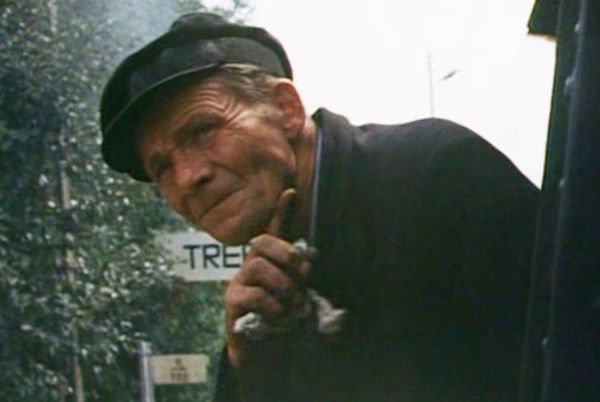
Regarding Treblinka, survivor Richard Glazar, who resides in Basel, speaks of the camp barracks and the burning of bodies, while Abraham Bomba, who resides in Israel, speaks of his work as a member of a Sonderkommando. On site, the local farmer Czesław Borowi and former locomotive engineer Henryk Gawkowski (both Polish) testify to their memories of watching the deportation trains, and of station staff giving water to the Jews being transported. Lanzmann has Gawkowski drive a steam locomotive once used for Jewish transports along the same route it once took toward Treblinka.
Regarding Auschwitz, Rudolf Vrba, a former Sonderkommando member who resides in the United States, speaks of his work on the ramp. Mrs. Pietyra and Filipowicz, residents of Auschwitz and Włodawa respectively, testify on site to the state of the former Jewish quarter and to the forced expulsion of Jews in 1940. Testimony from Falborski, a resident of Koło, is likewise included.
Regarding her experience of hiding underground in Berlin, Inge Deutschkron, who was born in Berlin and now resides in Israel, gives testimony.
This is followed by a hidden-camera interview that Lanzmann conducted with former SS Unterscharführer Franz Suchomel, whom he had invited to a hotel in Austria. Suchomel offers detailed testimony about the operational workings of Treblinka.
Part Two
Lanzmann visits a beer hall in Munich to make an unannounced approach to Josef Oberhauser, a former subordinate of SS officer Christian Wirth. In the beer hall, where Oberhauser now works, Lanzmann shows him a photograph of Wirth and attempts to draw out his memories of the Bełżec camp, but Oberhauser remains silent.
Testimony from Alfred Spiess, chief prosecutor at the 1960 Treblinka trial in Frankfurt, is also included, along with an outline of “Operation Reinhard.”
Filip Müller (a former Sonderkommando member) also testifies, and historian Raul Hilberg, who resides in the United States, analyzes the “Final Solution” as the logical outcome of the existing bureaucratic system.
This is followed by a hidden-camera interview with Franz Schalling (German), a former protective police officer.
Mordechai Podchlebnik testifies about the camp’s first period (the “era of the manor house”) and about the gas vans, while Mrs. Michelsohn, the widow of a former teacher at the German elementary school in Chełmno, recalls her memories of the time.
At the former synagogue in Grabów (now used as a furniture warehouse), Lanzmann reads aloud a letter that Rabbi Jacob Szulman sent to friends in Łódź on January 19, 1942. In interviews with residents of Grabów (Polish), they describe still living in homes once occupied by Jews.
At Chełmno, Simon Srebnik, a survivor of the camp’s second period (the “era of the church”), returns to the village and is surrounded by villagers. Falborski, a resident of Koło, testifies to having witnessed Jews killed by truck while being transported. Toward the end of the part, a classified document (dated June 1942) concerning technical modifications to the Chełmno vehicles (the gas vans) is introduced. Here, footage is inserted of a surviving Saurer truck driving through the Ruhr industrial region of Germany.
Second Era (Deuxième Époque)
Part Three
The hidden-camera interview with Franz Suchomel continues. Suchomel sings a song associated with the Sonderkommando and, pointing to a map of the Treblinka camp, describes in detail the procedure of the mass killings in the gas chambers and the state of the Jewish prisoners at the time.
Regarding Treblinka, Abraham Bomba, who resides in Israel, gives testimony. In a barbershop in Tel Aviv arranged by Lanzmann, Bomba cuts the hair of a customer (a friend from his hometown of Częstochowa) while recounting his experience of cutting the hair of Jewish women in the camp’s gas chamber, and the story of a fellow barber who embraced his wife and sister moments before they were sent to their deaths. Bomba falters partway through, but Lanzmann continues the interview. Franz Suchomel and Richard Glazar testify about the shooting of the elderly, the sick, and children in what was called the “infirmary” (“Lazarett”).
Regarding Auschwitz, Rudolf Vrba, who resides in the United States, testifies about the old and new ramps. Filip Müller also testifies about the process of gassing in the crematoria, and about an incident in which a Sonderkommando member, who had told a friend’s wife in the undressing room what awaited her, was thrown alive into the crematorium furnace.
The narrative then shifts to the Greek island of Corfu, where survivors Samuel Levy and Moshe Mordo, along with Armando Aaron, representative of the island’s Jewish community, speak of the circumstances of the deportation from the island and of the presence of informers.
A hidden-camera interview with Walter Stier, a former Nazi Party member and former department head at the German National Railway (Reichsbahn), addresses the operational details of running the deportation trains. Here it becomes clear that the Nazis referred to the deportation of Jews by the euphemism “resettlement” (“Umsiedlung”) in order to camouflage their policy of exterminating the Jews. Historian Raul Hilberg analyzes this transport system as a “transport of death.”
In the latter half of the part, the testimonies of Richard Glazar (who resides in Basel) and Filip Müller center on the planning of prisoner uprisings at Treblinka and Auschwitz, and the difficulties of carrying them out. Rudolf Vrba speaks about his contact with the resistance organization at Auschwitz I, and testifies about the divergence in goals between the strategies for Jewish survival within the camp and the resistance movement of the German political prisoners.
Part Four
The testimony of Ruth Elias, a survivor of the Theresienstadt and Auschwitz camps who resides in Israel, relates the circumstances of the “family camp” for Czech Jews. Rudolf Vrba testifies about how the Jews of the family camp were sent to the gas chambers after six months of quarantine, and about the outcome of his proposal that Fredy Hirsch, of the family camp, lead an uprising — a proposal that ended in Hirsch’s suicide by poison.
Filip Müller recounts the scene in which the Czech Jews of the family camp sang together in front of the gas chamber, and an episode in which he himself entered the gas chamber intending to die alongside his fellow countrymen, but was stopped from doing so.
Vrba testifies about his escape from Auschwitz in April 1944 together with his companion Wetzler, and their attempt to convey the truth of what was happening there to the outside world.
Jan Karski, a former courier for the Polish government-in-exile, who resides in the United States, speaks from his home in New York. Karski testifies to the horrors he witnessed on inspecting the Warsaw Ghetto — corpses in the street, starvation, a member of the Hitler Youth firing a gun — and recounts how he was asked by Jewish leaders to appeal to the international community on their behalf.
An interview with Dr. Franz Grassler, a former deputy to the Nazi civil administrator, touches on the diary of Adam Czerniaków, chairman of the Warsaw Ghetto Council. Historian Raul Hilberg discusses the contents of Czerniaków’s diary and the circumstances of his suicide on July 23, 1942, the day after the first deportation to Treblinka.
Following footage of Mrs. Gertrude Schneider, a survivor of the Warsaw Ghetto who resides in the United States, and her mother (in which Mrs. Schneider sings and her mother weeps), the course of the Warsaw Ghetto Uprising (which began on April 19, 1943) is explained through captions and testimony.
The following caption appears:
The Jewish Combat Organization was formally established in the Warsaw Ghetto on July 28, 1942.
The first wave of deportations to Treblinka was halted on September 30, 1942, leaving roughly sixty thousand Jews remaining in the ghetto.
Deportations resumed on January 18, 1943. Despite a shortage of weapons, members of the Combat Organization called for resistance and opened fire, catching the German forces off guard. The fighting lasted three days. Having suffered casualties, the Germans withdrew, and the Jews seized the weapons left behind. The deportations were halted.
The Germans now understood that there was no way to destroy the ghetto except by armed force.
Fighting began on the night of April 19, 1943 — the eve of Passover. It was the battle that would lead to the annihilation of the ghetto.
Simha Rotem (nom de guerre Kazik), a fighter in the uprising who resides in Israel, and Itzhak Zuckerman (nom de guerre Antek), deputy commander of the Jewish Combat Organization, also resident in Israel, recall their memories of the uprising — including the failure to obtain weapons — at the museum of the “Ghetto Fighters'” kibbutz in Israel.
The film closes on footage of a steam locomotive pulling a freight train.