




































































Overview
“Penthouse and Pavement” is the debut studio album by the British synth-pop band Heaven 17. It was released on 18 September 1981 by Virgin Records. The band’s name derives from a fictional band that appears in Anthony Burgess’s novel “A Clockwork Orange” (1962). The members are Martyn Ware and Ian Craig Marsh, who had left the Human League, and vocalist Glenn Gregory.
The album is divided into two parts: the “Pavement” side (a group of tracks with a strong funk influence) and the “Penthouse” side (a group of tracks based on pure electronic sound). The musical style is catchy, dance-oriented synth-pop / electro-funk, but the lyrics deal with political themes such as criticism of capitalism, warnings about nuclear war, and the arms race under the Cold War.
It spent 77 weeks on the UK Albums Chart, peaking at number 14, and received BPI gold certification (100,000 copies) in October 1982. Although the singles did not achieve major commercial success, the album maintained long-term support and has later been included in “1001 Albums You Must Hear Before You Die”, positioning it as an important work in the history of early 1980s synth-pop.
Background of Production
In 1980, Martyn Ware and Ian Craig Marsh, early members of the Human League, left the band due to differences in direction with Phil Oakey and others. They established the production company and musical project British Electric Foundation (B.E.F.) and put forward a concept of developing their musical activities within a business framework. They recruited their old acquaintance Glenn Gregory as vocalist and formed Heaven 17. It is said that they completed their debut single “(We Don’t Need This) Fascist Groove Thang” only about ten days after the formation.
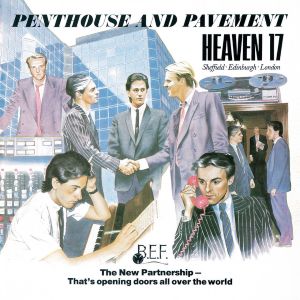
Recording was centred on the B.E.F.–Maison Rouge studio in Sheffield; at the same time, the Human League were working on their album “Dare” (1981) in the same studio. Work was also carried out at the Townhouse and The Garden in London. The cover is a painting by Ray Smith depicting the members in suits as businessmen, with logos such as “B.E.F. The New Partnership”. This was conceived as an ironic critique of the emerging yuppie culture and capitalist greed of the time, clearly showing the intention to present the band as a “brand”. The title “Penthouse and Pavement” was inspired by an advertisement in a business magazine and symbolises the class disparity between the penthouse (a luxury residence on the top floor of a building) of the wealthy and the pavement of the workers.
Production Methods
On this album the Linn LM-1 drum computer played an important role, enabling grooves based on realistic drum samples. Synthesizers used included the Roland Jupiter-4, Roland System 100 and Mini-Korg 700S, making use of the experience in electronic sound that Ware and Marsh had accumulated up to that point.
On the “Pavement” side, young session musician John Wilson, based in Sheffield, played bass, guitar and guitar synthesizer, introducing funk-style performance. This expanded the sound from the sparse, spacious electronic sound of the Human League era into a more organic, dance-floor-oriented one. The title track also features R&B-style female backing vocals by Josie James. Synthetic horns under the name “The Boys of Buddha” and acoustic piano (Steve Travell) on some tracks are also characteristic. Production was centred on the British Electric Foundation credit, with Richard Manwaring and others also involved.
Reception
At the time of release, the British music press generally rated the album highly. Paul Morley of NME wrote that it was “fabulous and it won’t deny your needs and you just put our faith in it because it is true”, and it was ranked number 5 in the magazine’s best albums of 1981. Dave Rimmer of Smash Hits described it as “This is often danceable, always intriguing and sometimes a whole lot more”, while Lynden Barber of Melody Maker positioned it as “some of the most enjoyable, inspiring and intelligent music you’re likely to hear this year” and as occupying “that rare space in contemporary pop reserved for true originals”.
Commercially, sales of the singles were held back by factors including a BBC ban (particularly the criticism of Reagan in “Fascist Groove Thang”), but the album itself achieved a long chart run and gold certification.
In later reappraisals, Dan LeRoy of AllMusic called it “one of the most accomplished debuts of the ’80s”, praising the combination of electropop with excellent melodies and the way Gregory delivered the left-wing political lyrics without striking an overly lofty posture.
Overall, the album has been re-recognised both in Britain and abroad as a work that expanded the boundaries of contemporary synth-pop through its fusion of political messages with dance music and its hybrid of funk and electronic sound.
Track Commentary
Side A (“Pavement”)
“(We Don’t Need This) Fascist Groove Thang”: The debut single. At a fast tempo of around 160 BPM, it layers the Linn LM-1 with multiple electronic rhythms to construct a jazzy, funky groove. The lyrics criticise Britain under the Thatcher government and the United States immediately after Reagan’s inauguration as president, warning of the rise of fascism and militarism. The BBC regarded the description of Reagan as a “fascist god in motion” as libellous and banned the track from airplay; it only reached number 45 on the charts, but as a declarative work that balanced politics and dance it determined the band’s direction. John Wilson’s bass and guitar add dynamism, and covers by acts such as LCD Soundsystem have appeared in later years.
“Penthouse and Pavement”: The title track. The influence of American R&B / funk is pronounced, with a slap-bass-like line and Josie James’s backing vocals being particularly striking. Through the contrast between “pavement” (the everyday life of workers) and “penthouse” (success and the wealthy), the lyrics depict class disparity and loss of self in capitalist society.
“Play to Win”: A track later released as a single. Sharp synth riffs and rhythmic programming support lyrics that imply the dangers of a competitive society. Taking the obsession with success and its risks as its theme, it condenses the album’s commercial and social themes.
“Soul Warfare”: Depicts capitalist manoeuvring as “soul warfare”. Steve Travell’s acoustic piano is added, and John Wilson’s guitar and bass give the track thickness. The contrast between electronic sound and funk groove is impressive.
Side B (“Penthouse”)
“Geisha Boys and Temple Girls”: An experimental track leaning toward electronic sound. It features the sophisticated synth textures typical of Heaven 17.
“Let’s All Make a Bomb”: A track satirising mutually assured destruction (MAD) under the Cold War. With the phrase “Take the M out of M.A.D. / Let’s all make a bomb”, it mocks the absurdity of nuclear weapons and the madness of the arms race. Beneath the bright synth melody and dance beat lies an apocalyptic irony.
“The Height of the Fighting (He-La-Hu)”: Later released as a single. A rhythmic track about the heightening of political and social conflict. Its structure, which relieves the combative tension with the catchy chorus “He-La-Hu”, is characteristic.
“Song with No Name”: One of the darkest and most introspective tracks on the album. It has a film-music atmosphere (influences of Ennio Morricone and others have been noted) and includes a reference to “The Man with No Name”, the character played by Clint Eastwood in the Dollars Trilogy. Themes of desire for fame and the destruction of careers are depicted with spacious electronic sound.
“We’re Going to Live for a Very Long Time”: A track satirising the self-satisfaction of successful people. On the original LP the sound continued into the run-off groove, with the phrase “For a very long time” looping.
Track Listing
Total length approximately 38:12 (based on the original LP; some timings differ slightly on reissues). All tracks written by Martyn Ware, Ian Craig Marsh and Glenn Gregory.
Pavement Side
- (We Don’t Need This) Fascist Groove Thang – 4:20
- Penthouse and Pavement – 6:23
- Play to Win – 3:37
- Soul Warfare – 5:04
Penthouse Side
- Geisha Boys and Temple Girls – 4:33
- Let’s All Make a Bomb – 4:03
- The Height of the Fighting – 3:01
- Song with No Name – 3:36
- We’re Going to Live for a Very Long Time – 3:15
Personnel
Heaven 17
- Glenn Gregory – lead vocals, backing vocals
- Martyn Ware – piano, synthesizers, Linn LM-1, percussion, backing vocals
- Ian Craig Marsh – synthesizers, saxophone, percussion
Session musicians
- John Wilson – guitar, guitar synthesizer, bass (1–4)
- Josie James – backing vocals (2)
- Steve Travell – acoustic piano (4)
- The Boys of Buddha – synthetic horns (credit name for the synthesizer horn parts)
Production
- British Electric Foundation – production, packaging design
- Richard Manwaring – co-production, engineering
- Bob Last – executive producer
- Peter Walsh – production assistant, engineering (some tracks)
- Steve Rance – engineering (some tracks)
- Ray Smith – cover painting
Streaming Services
Search Links
Search for “Heaven 17 Penthouse and Pavement” on Amazon.com
Search for “Heaven 17 Penthouse and Pavement” on Apple Music