






































































Overview
“News from Nowhere” is a novel published in 1890 by the English poet, crafts designer, and socialist William Morris. The original title is accompanied by the subtitle “An Epoch of Rest,” and further by “Being Some Chapters from a Utopian Romance.” It takes the form of a dream in which the narrator, after falling asleep following a discussion at a socialist meeting, awakens in early twenty-second-century England after a revolution and walks through a society without money, the state, or wage labor. It is known as a classic of utopian fiction.
At the center of the work lies the idea that labor is not toil but pleasure, and that the expression of that pleasure is art—namely, the principle of “labor = art = pleasure” and the unity of life and art (see the section “The Unity of Labor, Art, and Life”). This principle reworks, in the form of a concrete vision of daily life, the aesthetic theory and social critique that Morris had developed in lectures and essays from the late 1870s onward.
The novel was also written as Morris’s own reply to the centralized, industrial vision of socialism depicted in Edward Bellamy’s utopian novel “Looking Backward” (1888). Elements such as the longing for medieval handicraft, the attraction to the countryside, and the prospect of violent revolution have subsequently been criticized as romantic idealization or as optimism regarding technological and economic problems. At the same time, the work has been repeatedly reassessed in relation to ecological thought and the Arts and Crafts movement (see the sections “Reception” and “Influence”).
Biographical Sketch of the Author
William Morris (1834–1896) was born on 24 March 1834 in Walthamstow, Essex (now part of London), the son of a prosperous financier. At Exeter College, Oxford, he became acquainted with Edward Burne-Jones, who later became a painter and designer, and deepened his interest in the writings of John Ruskin and in the Middle Ages. He subsequently entered an architectural office and associated with Dante Gabriel Rossetti and other Pre-Raphaelite painters. In 1858 he published the poetry collection “The Defence of Guenevere and Other Poems,” and between 1868 and 1870 the long poem “The Earthly Paradise” established his reputation as a poet.
In 1859 he married Jane Burden and built the Red House, designed by the architect Philip Webb. Experience of decorating this house led him in 1861 to found Morris, Marshall, Faulkner & Co. The firm was reorganized in 1875 as Morris & Co. and produced and sold wallpapers, textiles, stained glass, furniture, and other goods. In 1877 he took part in the founding of the Society for the Protection of Ancient Buildings (SPAB).
After involvement in political agitation over the Eastern Question (the crisis of British intervention in the Russo-Turkish War) in the late 1870s, Morris joined the Democratic Federation (later the Social Democratic Federation) in 1883 and began to act as a socialist. At the end of 1884 he left the Federation and, together with Eleanor Marx and others, founded the Socialist League, editing its organ “Commonweal.” In 1890 he left the League amid internal disputes over policy. In his final years he established the Kelmscott Press in 1891 and completed the “Kelmscott Chaucer,” a collected edition of the works of Geoffrey Chaucer, in 1896. He died on 3 October 1896 at Hammersmith, London.
Publication History and Background
“News from Nowhere” was serialized in the Socialist League’s journal “Commonweal” from 11 January to 4 October 1890. The opening scene is set after a discussion at a League meeting about what would happen on the day after the revolution, reflecting the internal controversies of the organization that formed the background to the writing.
A major direct motive was opposition to Bellamy’s “Looking Backward.” Published in 1888, the work depicted a future society in which the state organized industry centrally and attracted wide attention in Britain and America. Morris reviewed it in “Commonweal” in 1889 and expressed strong dissatisfaction with its mechanical, centralized social vision. “News from Nowhere” is regarded as a narrative alternative to this social vision.
Before this work Morris had already experimented with a dream framework linking past and present in “A Dream of John Ball” (1888), which took the medieval English Peasants’ Revolt as its subject. Both works place greater emphasis on how socialism would transform people’s sense of everyday life than on socialist theory as such.
The Unity of Labor, Art, and Life
The principles of “News from Nowhere” were formed and presented in a series of lectures that Morris delivered from the late 1870s, prior to the novel. Representative titles include “The Lesser Arts” (1877), “The Beauty of Life” (1880), “Useful Work versus Useless Toil” (1884), and “Art and Socialism” (1884).
One starting-point was Ruskin’s “The Nature of Gothic” (volume 2 of “The Stones of Venice,” 1853). Ruskin regarded the free creative expression that medieval craftsmen could exercise in their handwork as the source of the beauty of Gothic architecture. Morris considered that modern industry had robbed workers of this freedom through division of labor and mechanical repetition; he later issued the essay with his own preface from the Kelmscott Press (1892).
A distinctive feature of Morris’s argument is the refusal to separate labor from art. He rejected the hierarchy between the “greater arts” (painting and sculpture) and the “lesser arts” (decoration and craft), and understood art as the expression of the pleasure human beings feel in their labor. Under capitalism, labor becomes toil undertaken for wages, products become cheap and shoddy commodities, and art is confined to a specialized sphere for the wealthy. This is what Morris called “useless toil.” Against it he set useful work accompanied by pleasure—work that allows reasonable rest, visible results, and enjoyment involving both body and mind.
In the England of the novel these principles appear as a concrete way of life. Money and private property have been abolished; people freely take what they need from markets and shops. In return they choose the work they prefer and find pleasure in it. Everything in daily life—buildings, clothing, utensils, bridges—possesses the beauty of handwork, and no distinction exists between artist and craftsman. Chapter 15, “On the Lack of Incentive to Labour in a Communist Society,” addresses precisely this point, arguing that if labor is pleasure rather than pain, neither compulsion nor reward is required.
Morris does not reject machinery outright. In the novel, unpleasant and painful tasks are performed by highly developed machines, while human beings devote themselves to creative and enjoyable work. As symbolized by the description of the Houses of Parliament being used as a manure store, institutions of government—parliament, law courts, prisons—have disappeared. The whole of life has been reorganized as the unity of labor, art, and living.
Bibliographical Information (English Original)
- Full title: “News from Nowhere; or, An Epoch of Rest: Being Some Chapters from a Utopian Romance”
- Composition: c. 1889–1890
- First publication (serial): “Commonweal,” 11 January–4 October 1890
- First book edition: Roberts Brothers (Boston), 1890 (issued without Morris’s authorization)
- British edition: Reeves and Turner (London), 1891 (incorporating Morris’s textual revisions)
- Kelmscott Press edition: 1892
- Structure: 32 chapters
History of Translation
The work was translated and introduced within socialist movements in various countries immediately after its publication. The first translation was into Dutch: an incomplete version by Frank van der Goes was serialized in the journal “Recht voor Allen” in 1891, and a complete book edition appeared in 1897. A German translation followed, serialized in “Die Neue Zeit” in 1892–93 (by Clara Steinitz and Natalie Liebknecht), and was later published in book form with a preface by Wilhelm Liebknecht. In French, extracts appeared in “La Société Nouvelle” in 1892, and a full translation by Pierre-Georges La Chesnais was published as a book in 1902. Translations into Russian and into other Central and Eastern European languages, including Polish, Italian, Bulgarian, and Serbian, also appeared by the early twentieth century.
While the work was read early on as a text of the socialist movement, from the later twentieth century onward it has also been reassessed in the contexts of craft and design history and environmental thought, and new translations and reprints have continued to appear in various countries.
Reception
Contemporary Reception and Relations with the Socialist Movement
At the time of publication opinion among socialists was divided. The society Morris depicts requires almost no planning by the state or direction by a party. This stands in contrast to the parliamentary and statist tendencies of the Social Democratic Federation and contains elements closer to anarchism. From a Marxist perspective it was sometimes regarded as idealism lacking theoretical foundation. Friedrich Engels, in a letter to Laura Lafargue (Marx’s second daughter) around 1886, described Morris as “a settled sentimental Socialist.”
The very idea of the “pleasure of labor” has also been a target of criticism. In the “Grundrisse” (1857–1858) Karl Marx rejected Charles Fourier’s notion of transforming labor into play, stating that “Labour cannot become play, as Fourier would like,” and arguing that truly free labor is also serious and intense effort. Morris’s conception differs from Fourier’s in envisaging handicraft involving the acquisition of skill and creativity rather than simple “labor as play.” Nevertheless, questions remain whether all labor can become pleasurable and whether unpleasant tasks can be entirely eliminated by mechanization.
Moreover, the problem of what and how much to produce and distribute in a society without money or prices is scarcely treated concretely in the text. From the standpoint of the twentieth-century economic calculation debate associated with Ludwig von Mises and Friedrich Hayek, this can be seen as its greatest weakness. Morris, however, offers not a blueprint of institutions but a vision of life that includes the transformation of people’s desires and values.
Relations with Romantic Idealism
The grounding of Morris’s social vision in a longing for medieval handicraft and the countryside has been criticized as romantic idealization. It is seen as an expression of nostalgia for what industrialization had destroyed, projected onto an ideal future.
Against this view, E. P. Thompson argued in “William Morris: Romantic to Revolutionary” (1955; revised edition 1977) that Morris moved from romantic cultural critique to a Marxist revolutionary outlook. In the postscript to the 1977 revised edition, drawing on Miguel Abensour, Thompson also interpreted Morris’s project as an “education of desire”—a re-education of the very forms of desirable wanting. Raymond Williams, in “Culture and Society” (1958), likewise positioned Morris as a figure who bridged romantic cultural critique and socialism.
The “great change” depicted in the novel (Chapter 17, “How the Change Came”) is narrated as a massacre in Trafalgar Square modeled on the Bloody Sunday events of 1887, followed by a general strike and civil war. While this presents a realistic prospect of violent revolution, the question of why the post-revolutionary society remains stable is answered only by an expectation of changes in human nature—a criticism that remains persistent.
Relations with Ecology
From the later twentieth century onward the novel has also been read as a precursor of ecological thought and green socialism. In the text the opposition between city and country is overcome: London is covered in greenery and the waters of the Thames are kept pure. Large-scale industrial zones have vanished and population is dispersed.
Caution is needed, however, in treating this as ecology in the modern scientific sense. Morris’s view of nature rests not on scientific ecology but on an aesthetic and pastoral sensibility. The countryside in the novel is a managed nature resembling a well-tended garden; ideas of wilderness or the conservation of ecosystems are weak. The “force” that powers the machines is never concretely explained, and questions of energy and resources remain suspended.
Relations with the Arts and Crafts Movement
“News from Nowhere” serves as a concentrated expression of Morris’s craft practice and thought and forms an ideological background to the Arts and Crafts movement. The name “Arts and Crafts,” however, derives from an exhibition society founded in 1887 and does not refer to a movement organized by Morris himself.
The most substantial criticism has been directed at the contradiction between Morris’s practice and his principles. High-quality hand-made products were necessarily expensive, and the customers of Morris & Co. were mainly the wealthy. Morris himself is said to have spoken self-mockingly of his work serving the luxury of the rich. While he envisioned a society that would open the pleasure of labor to all, his actual workshops were torn between handwork that gave joy to the workers and the production of luxury goods for the market.
Gender
In the novel legal constraints on marriage and marital relations have been abolished and free associations are affirmed. Yet the depiction of women mainly responsible for housework and cooking has been criticized from later feminist perspectives. Institutional sexual domination is rejected, but assumptions about gendered division of labor remain.
Influence
Morris’s ideas first exerted influence through the Arts and Crafts movement on architecture, craft, and design. The respect for handwork and the conception of designing the whole of life are said to have had an indirect effect on craft movements in Europe and America and later on the Bauhaus. In Japan, Yanagi Sōetsu’s Mingei movement referred to the thought of Ruskin and Morris and shared an emphasis on the connection between life and craft.
In political thought Morris has been cited as one source of an ethical, decentralized socialism that is not statist. The William Morris Society was founded in London in 1955 and continues research and commemoration. His daughter May Morris edited the twenty-four-volume “Collected Works of William Morris” (1910–1915).
In the lineage of utopian literature the novel established a prototype of decentralized, pastoral utopia against the centralized, technocratic type associated with Bellamy. It is frequently referred to in later environmental utopian fiction, ecological thought, and theories of degrowth.
Electronic Texts
The work is in the public domain, its copyright having expired, and the full English text is freely and officially available from the following major archive sites:
- Project Gutenberg:
- Marxists Internet Archive:
- Wikisource:
Search Link
Search for “William Morris News from Nowhere” on Amazon.com
Synopsis (Contains Spoilers)
Returning home from a meeting of the Socialist League, the narrator, wearied by discussion with comrades, falls asleep at his house in Hammersmith. The next morning he wakes feeling well and notices that the streets and houses look unfamiliar. Going outside, he finds the Thames clear and beautiful houses and gardens lining its banks. The time is the early twenty-second century (not specified in the text but generally taken to be around 2102); the narrator is called “Guest” in the story.
The waterman Dick welcomes Guest kindly and provides food and lodging without accepting money. Accompanied by Dick and his lover Clara, Guest tours the transformed London. In a shop near Piccadilly there is no exchange of money between customer and shopkeeper; fruit trees grow in Trafalgar Square and the Houses of Parliament serve as a manure store. In Bloomsbury the “golden dustman” Boffin, who handles refuse, lives in splendid clothes.
Guest learns about the organization of this society from Old Hammond, Dick’s great-grandfather. According to Hammond, there is no state or parliament; prisons and law courts have disappeared. Marriage has lost its legal constraints and people form free associations. Formal schooling does not exist; children learn while working and playing alongside adults. Unpleasant labor is performed by machines and people choose the work they prefer. Even without external incentives to labor, society is maintained because the work itself is a source of enjoyment, Hammond explains.
Hammond also recounts the history of the “Change.” In 1952 a federation of trade unions is formed and a general strike begins. A peaceful meeting in Trafalgar Square is fired upon by troops, leading to a massacre and then to civil war. The workers ultimately prevail, the old order is dismantled, and a new way of life begins. The following decades are described as a period in which the transformation of human desires themselves mattered more than material abundance.
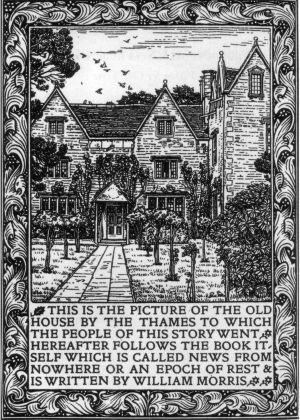
Afterwards Guest travels upstream on the Thames by boat with Dick and Clara. Near Runnymede they meet the young woman Ellen and her grandfather. Ellen takes a strong interest in the past, quickly senses that Guest has come from an earlier time, and is drawn to him. The party continues upriver and reaches an old house at Kelmscott (the site of Morris’s own actual residence). While sharing a meal with the people there, Guest feels himself gradually drawing away from this world.
Eventually he awakens in the familiar foggy Hammersmith of the late nineteenth century. Knowing that what he has seen was a dream, he reflects that whether it remains merely a dream depends on whether others can share the hope it embodies. The narrative closes with this prospect.