


































































Overview
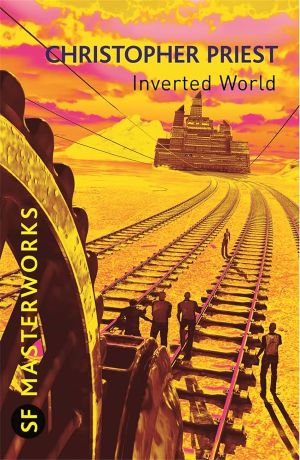
“Inverted World” is a science fiction novel by the British writer Christopher Priest, published in 1974. Set in a vast mobile city called “Earth” that constantly advances northward on rails, it depicts the physical and perceptual distortions of the world experienced by the city’s inhabitants and the “truth” that lies behind them, through a gradual shift in recognition. Combining hard SF world-building with themes of perception, cognition, and social enclosure, it is regarded as one of the significant achievements of postwar British science fiction.
The novel is structured around the conceit of a mobile city and the distortions of time, space, and the body that accompany movement in the north-south direction, gradually unsettling the reader’s own perceptions. Elements such as the strict control of information by the guild system, the “procurement” of women from outside to maintain the population, and the pursuit of the “optimum” that sustains the city’s existence function as the logic of a closed society. The final revelation of the truth is not merely an explanation of the setting but a questioning of how perception constitutes the world. It won the British Science Fiction Association (BSFA) Award for Best Novel in 1974 and was nominated for the Hugo Award the following year.
Plot Overview
The city “Earth” moves continuously northward on four rails at an average speed of about 0.1 miles per day. The work of laying track ahead and recovering and reusing the track behind supports the city’s very existence. Most of the inhabitants do not even know that the city is moving; knowledge of the outside world is restricted to the men of the guilds and is protected by a strict oath of secrecy. The protagonist, Helward Mann, reaches adulthood (“650 miles”) and, as an apprentice in the Future Surveyors’ guild, steps into the outside world, gradually learning the meaning of the “optimum” that the city pursues and the strange nature of the world itself. Through negotiations with external villages, experiences of temporal and spatial distortion, rising discontent within the city, and the appearance of a woman from outside, the narrative moves toward a transformation of recognition.
Author Biography
Christopher Mackenzie Priest (14 July 1943 – 2 February 2024) was born in Cheadle, Cheshire, England. After graduating from Cheadle Hulme School at the age of sixteen, he worked in accountancy and auditing while continuing to write, and made his debut in 1966 with the short story “The Run” in the science fiction magazine “Impulse.” He became a full-time writer in 1968 and was active in his early career under the influence of the British New Wave.
“Inverted World” is his third novel and is positioned as a work with a clear hard SF framework. In 1983 he was selected as one of Granta’s Best of Young British Novelists, and thereafter he continued to publish works thematically concerned with the instability of perception, memory, and reality, including “The Prestige” (1995, winner of the World Fantasy Award and adapted into a film directed by Christopher Nolan), “The Separation” (2002, winner of the BSFA Award and the Arthur C. Clarke Award), and “The Islanders” (2011). He won the BSFA Award for Best Novel four times and was a significant figure in British science fiction. He died on 2 February 2024 on the Isle of Bute, Scotland.
Publication History and Background
The basic premise of the work already appears in the short story “The Inverted World,” included in the 1973 anthology “New Writings in SF 22,” although the characters and plot differ from those of the novel. The novel was serialized in four parts in “Galaxy Science Fiction” from December 1973 to March 1974 and published in hardcover by Faber and Faber in the United Kingdom in May 1974. In the United States it was published by Harper & Row in June of the same year under the title “The Inverted World.”
In the early 1970s, British science fiction, having passed through the experimentalism of the New Wave, was seeking more epistemological and structural approaches. Priest combined the visually powerful image of a mobile city with the mathematical conceit of a hyperbolic world to thematize how perception constitutes reality. Elements such as the city’s guild system, the concealment of information, and unequal trade with the outside critically depict the mechanisms that maintain a closed community. The novel was later included in the SF Masterworks series and reissued in 2008 by New York Review Books with an afterword by John Clute.
Bibliographical Information (English Original)
- Original title: “Inverted World” (in some editions “The Inverted World”)
- First appearance: 1973–1974 (serialized in “Galaxy,” December 1973–March 1974)
- First book publication: Faber and Faber (London, May 1974), 256 pages, ISBN 0-571-10444-4
- First American publication: Harper & Row (New York, June 1974), “The Inverted World,” 310 pages
- Structure: Prologue and five parts. Parts One, Three, and Five are narrated in the first person by the protagonist Helward Mann; Part Two follows Helward in the third person; the prologue and Part Four center on Elizabeth Khan in the third person.
Translation Status
The French translation (by Bruno Martin, “Le monde inverti,” 1975) was the earliest to appear, followed by translations into Spanish, German, Italian, Dutch, and other European languages. The Japanese translation (by Hitoshi Yasuda) was first published in 1983.
Reception
From the time of its publication, the boldness of its conceit and the skill of its shift in recognition were highly praised. It won the BSFA Award for Best Novel in 1974 and was nominated for the Hugo Award for Best Novel in 1975. Paul Kincaid has described it as “one of the key works of postwar British science fiction,” highly valuing the originality of the “inverted world” idea and the effect of the final revelation. In “The Encyclopedia of Science Fiction” it is regarded as one of the most impressive pure science-fiction novels produced in Britain since the Second World War and is placed in the tradition of works dealing with the problem of perception and reality.
On the other hand, there have been criticisms that the explanation of the ending is somewhat convenient and that the characterization is abstract.
The representation of gender also requires reading in the context of the time of publication. The early 1970s was a period when second-wave feminism was gaining momentum and issues such as sex roles, the management of reproduction, and gender disparities in access to information and space were becoming social concerns. In the novel the guilds (organizations that monopolize access to the outside world and its secrets) are composed exclusively of men, and a system is depicted in which women are temporarily “procured” from external villages to take on reproductive roles because of the abnormally low rate of female births within the city. In the fact that Victoria resists her husband’s secrecy and the exclusion of women, and that Elizabeth relativizes the city’s logic from an external perspective, a partial reflection of contemporary challenges to sex roles can be discerned. However, the setting that positions women primarily as reproductive resources or as those excluded from information shares patriarchal premises often found in the science fiction of the period, and to modern readers it frequently appears as a limitation of its time.
Despite such criticisms and limitations, overall the work has established its reputation as an early representative work of Priest’s in the fusion of hard SF world-building and epistemological themes.
Characters
Helward Mann
The protagonist. Raised in the city’s crèche, he reaches adulthood at “650 miles.” He becomes an apprentice in the same Future Surveyors’ guild as his father and is involved in surveying the outside world, laying track, and negotiating with external inhabitants. Bound by the guild’s oath of secrecy, he experiences the distortions of the world on a journey south and suffers personal loss through the discrepancy in the passage of time. Even at the final revelation of the truth, he is depicted as a character who cannot easily abandon the worldview based on his own perceptions.
Victoria Lerouex
Helward’s wife. The daughter of the head of the Bridge-Builders’ guild, she has known Helward since their time in the crèche. After marriage she becomes dissatisfied that her husband will not speak of the secrets of the outside, and gradually comes to question the movement of the city itself. She later takes a leading position in the “Terminators,” the faction that demands that the city stop.
Elizabeth Khan
The central figure of the prologue and Part Four. A woman engaged in medical and relief work in an external village. Originally from England, she learns of the reality of the city’s trade, enters the city herself, and is reunited with Helward. She relativizes the city’s appearance and the perceptual distortions of its inhabitants, and ultimately plays the role of revealing the origin of the city and the true nature of the “optimum.”
Other Principal Characters
- Francis Destaine: The founder of the city. A particle physicist said to have discovered a new method of energy generation. His “Destaine’s Directive” serves as the operating principle of the city.
- Gelman Jase and other guild companions of Helward’s generation.
- The inhabitants of the external villages (the laborers called “tooks” and the women brought into the city through trade). They are indispensable to the city’s survival yet are placed in an unequal relationship.
Search Link
Search for “Christopher Priest Inverted World” on Amazon.com
Synopsis (with Spoilers)
The story begins from Elizabeth Khan’s point of view in the prologue. She carries out medical work in a devastated village while vaguely aware of the city’s existence.
The main narrative opens in the first person with Helward Mann: “I had reached the age of six hundred and fifty miles.” Leaving the crèche and reaching adulthood, Helward becomes an apprentice in the Future Surveyors’ guild and takes a strict oath of secrecy. The city “Earth” is a fortress-like structure approximately 1,500 feet long and about 200 feet high, with roughly seven levels, that moves slowly northward on four rails. Laying track ahead and recovering it from behind is everyday work; the Bridge-Builders’ guild overcomes terrain obstacles, the Traction guild moves the city, and the Barter guild procures labor and women from external villages. Within the city the birth of female children is extremely rare, and temporary relationships with external women are institutionalized to maintain the population. Most inhabitants do not even know that the city is moving, and knowledge of the outside is monopolized by the guildsmen.
Helward marries Victoria, the daughter of the head of the Bridge-Builders’ guild. At first they lead a happy married life, but his inability to speak of the secrets of the outside creates a rift. After completing his apprenticeship he is assigned the task of escorting three women south (“into the past”). There he experiences for the first time the strangeness of the world. As they proceed south the women’s bodies become shorter and wider, their voices change in pitch, and the landscape itself is compressed. He himself feels a force pulling him southward, and the flow of time differs greatly from that in the city. The short time he spends in the south corresponds to several years in the city. Upon his return he learns that the city has been attacked by external inhabitants, that many children (including his own son) have been killed, and that Victoria, believing him dead, has remarried.
Later, while surveying to the north (“into the future”), he experiences the opposite distortion—a world stretched vertically and compressed east-west. Time flows more quickly in the north. Through these experiences Helward comes to accept the official explanation that the city must continue to pursue the “optimum” or be swallowed by gravitational collapse to the south.
Meanwhile Elizabeth Khan continues her work in the village, witnesses the injustice of the city’s trade, and enters the city herself. To her eyes the city appears as nothing more than a distorted office block, and the shape of the sun differs from what the inhabitants describe. Reunited with Helward, she investigates the city’s workings and pursues research based on her external knowledge.
Within the city, the disclosure of information to the inhabitants after the attack results in the rise of the “Terminators,” who demand that the movement itself be stopped; Victoria takes their side. Ahead lies a vast body of water with no visible opposite shore, and the city faces a crisis.
In the final part Elizabeth reveals the truth to the citizens. After the collapse of civilization (the “Crash”), the particle physicist Francis Destaine discovered a new method of energy generation and conducted an experiment in China. The device (the translat generator) produces a self-sustaining field that distorts the perceptions of those within it, “showing” them a hyperbolic world. The city never left Earth; over approximately two hundred years (about 7,000 miles by the city’s measure) it has moved southward from the region of Scotland and has now reached the coast of Portugal. The “sea” ahead is the Atlantic Ocean, and the optimum is nothing more than a perceptual anchor created by the device. The effects of the device are also genetic and have caused the decline in the birth rate of female children.
Most of the inhabitants accept Elizabeth’s explanation, but Helward, relying on the distortions and the force he has experienced, cannot easily believe it. The narrative closes leaving Helward’s refusal of the transformation of recognition and the new choice facing the city—whether to stop the device and adapt to the outside world or to remain in the world of perception. Helward’s insistence functions not as mere obstinacy but as an indication of the limits of human beings for whom perception has constituted life itself.