














































Overview
“For How Much Longer Do We Tolerate Mass Murder?” is the second studio album by the English post-punk band The Pop Group, originally from Bristol.
While carrying forward the vocabulary of their previous album “Y” (1979), which combined post-punk with elements of funk, dub, free jazz and noise, this record pushes political messages and agitation to the forefront, resulting in a more aggressive work.
It consists of nine tracks with a total running time of approximately 32 minutes. It was released on 21 March 1980 by Rough Trade and Y Records.
Background to the Making
The Pop Group was formed in Bristol in 1977 around the vocals of Mark Stewart, with Gareth Sager and John Waddington on guitars, Dan Catsis on bass and Bruce Smith on drums. The band attracted attention as an embodiment of the musical and political radicalism that followed punk.
Their 1979 debut album “Y”, co-produced with the dub reggae producer Dennis Bovell, was highly regarded for its fusion of chaotic experimentalism and groove.
Recording for this album took place from 1979 to 1980 at Foel Studios in Llanfair Caereinion, Powys, Wales. The band produced the album themselves, while recording and mixing were handled jointly by the band and Dave Anderson, formerly of Amon Düül II and Hawkwind. Compared with the previous album, the dub elements were somewhat restrained in favour of sharper, tighter rhythms and a more raw sound.
The lyrics, set against the background of the nuclear arms race during the Cold War, address themes such as political oppression, economic inequality, poverty, hunger, the profit structures of war, the injustices of capitalism and the unfairness of the judicial system. The title “For How Much Longer Do We Tolerate Mass Murder?” is a call for us to recognise our own complicity in acts of cruelty.
At the time the band was actively involved in campaigns such as the Campaign for Nuclear Disarmament (CND) and aid for Cambodia, and this album stands as an extension of those activities.
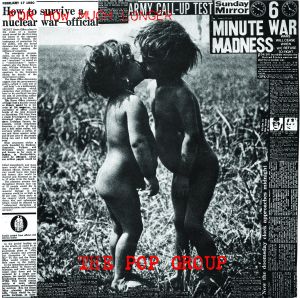
The cover uses the photograph “Gypsy Children Kissing, Esztergom, Hungary” (1917; also known as “Two Gypsies”) by the Hungarian-born photographer André Kertész. The original LP included collages of newspaper articles and posters that visually emphasised the threat of nuclear war and social crisis.
Characteristics
The musical foundation of this album is a guitar-driven rhythm section based on the late-1960s funk of James Brown. Onto this are layered free-jazz saxophone howls, dub-like spatial treatments, fragments of atonal guitar and environmental noise, producing a sound that, rather than remaining consistent, seems to convey the very process of order collapsing. In an article for “Fact” magazine (February 2016), the British writer, music critic and theorist Mark Fisher described the sonic image of this album as “the sound of a society falling apart”.
The vocals are closer to speeches, chanting and screams than to singing. Stewart’s voice does not carry melody but functions as a percussive element on the same level as the rhythm section.
Most of the tracks last between two and five minutes, concentrating collisions into short spans rather than extending repetitive grooves. This concision stands in contrast to the chaos of the previous album and succeeds in combining propagandistic clarity with experimental destructiveness.
The determination to force together political agitation and the groove of dance music is particularly distinctive even among the post-punk of the period, and it later influenced dance-punk and experimental electronic music. The coexistence of musical tension and political urgency forms the core of this album.
Reception and Evaluation
Upon release, critical opinion on the album was divided. Leading post-punk media such as “NME” tended to praise the mysterious and experimental aspects of the previous album while viewing the direct political content and dogmatic agitation of this record negatively. On the other hand, it reached number one on the UK Independent Chart and remained on the chart for a long period, indicating a certain degree of commercial support.
Retrospective evaluation has been consistently high. AllMusic stated that it “lacks the dubwise tone of Dennis Bovell’s production on Y, but the lean, blunt sound of this album connects with even greater ferocity”.
PopMatters awarded it 9 points, describing it as “Harsh, abrasive, uncompromising and wholly unique” and calling it “a genre-defining (and genre-defying) epic”.
The album was ranked 35th in the “50 Greatest Lost Albums” selected by “Uncut” magazine in 2004.
In 2016 “Record Collector” magazine wrote of the album that “the post-punk Bristolian radicals did actually succeed in synthesising something fierce, funky and fantastic from their unholy mash-up of Ornette Coleman, Funkadelic and heavyweight, Channel One-style dub.”
In the aforementioned “Fact” magazine article, Mark Fisher described the album’s “murky funk, free jazz squalls, dub diffraction, howls and shrieks” as “the sound of a society falling apart”, and also referred to its refusal of a binary choice between message and formal innovation, as well as the adjacency of pleasure and political consciousness.
CD Release History
In 1986 a CD was released in Japan by Rough Trade / Tokuma Japan as a two-in-one compilation coupled with the compilation album “We Are Time” (1980). This was the world’s first CD edition. In Japan, standalone CD editions of the album were also released by Rough Trade / TDK Core in 1994 and 1996.
These Japanese CD editions contain the same content as the original LP.
Outside Japan, a remastered CD was reissued in 2016 by the British label Freaks R Us (the first official CD release outside Japan), and digital distribution also began.
The “One Out of Many” Omission Issue
On the Freaks R Us edition, the original LP’s third track “One Out of Many” has been replaced by the single “We Are All Prostitutes” (1979). The official explanation is that this restores “We Are All Prostitutes”, which had been intended for the original album but was ultimately left off. However, because “One Out of Many” contains quotations of the lyrics from a song by The Last Poets (discussed below), critics and fans have suggested that rights issues may have been the reason for its omission. The Last Poets are credited with arrangements on “One Out of Many”, but they did not participate in the recording of this album.
Track Commentary
Side One
1. “Forces of Oppression”: A tight, aggressive funk number featuring sharp guitar riffs and a tense rhythm. Stewart’s vocals denounce the structures of political oppression.
2. “Feed the Hungry”: A track characterised by dub-like spatial processing and a hypnotic groove. Stewart’s vocals accuse human greed as the cause of hunger and poverty, while guitar and saxophone interweave in fragmentary fashion.
3. “One Out of Many”: A short piece lasting 1 minute 52 seconds. It quotes the lyrics of “E Pluribus Unum” (1972) by The Last Poets and takes as its theme the relationship between the collective and the individual, power and resistance. On the 2016 reissue and digital editions it has been replaced by “We Are All Prostitutes.”
4. “Blind Faith”: A rhythmically complex track incorporating Afro-funk elements. It is marked by intense interlocking guitars and dense percussion. The lyrics criticise blind faith and submission to authority.
5. “How Much Longer”: The lyrics address the profit structures of war and criticism of indifference. Echo-laden vocals, twisted grooves and spatial processing heighten the sense of urgency and anxiety.
Side Two
6. “Justice”: Characterised by a tight rhythm and sharp funk beat. It refers to the killings of activists such as Blair Peach and Kevin Gately and denounces violence exercised in the name of justice as well as judicial unfairness.
7. “There Are No Spectators”: A spacious track that brings the bassline and percussion to the fore. The influence of dub is strong. It argues that the very position of observing catastrophe from a distance is already part of the structure of perpetration.
8. “Communicate”: An experimental and intense piece in which free-jazz saxophone rages fiercely. The chaotic development itself embodies the breakdown of communication. The band’s improvisational quality and aggression are most pronounced here.
9. “Rob a Bank”: A short track that takes the injustices of capitalism as its theme and agitates for robbing a bank.
Track Listing
Running time: approximately 31 minutes 57 seconds (original edition).
- “Forces of Oppression” – 2:33
- “Feed the Hungry” – 4:15
- “One Out of Many” – 1:52
- “Blind Faith” – 4:03
- “How Much Longer” – 4:57
- “Justice” – 3:06
- “There Are No Spectators” – 4:13
- “Communicate” – 4:40
- “Rob a Bank” – 2:18
(On the 2016 reissue the third track is replaced by “We Are All Prostitutes”.)
Personnel
The Pop Group
- Mark Stewart – vocals, arrangements, recording
- John Waddington – guitar, arrangements, recording
- Gareth Sager – guitar, saxophone, arrangements, recording
- Dan Catsis – bass, arrangements, recording
- Bruce Smith – drums, percussion, arrangements, recording
Additional Musician
- The Last Poets – arrangements (“One Out of Many”)
Technical
- Produced by The Pop Group
- Recorded and mixed by Dave Anderson and The Pop Group
Streaming Services
Search Links
Search for “The Pop Group For How Much Longer Do We Tolerate Mass Murder” on Amazon.com
Search for “The Pop Group For How Much Longer Do We Tolerate Mass Murder” on Apple Music