






































































Overview
“Gravity” is a 2013 science fiction thriller directed by Alfonso Cuarón. It is a co-production between the United States and the United Kingdom.
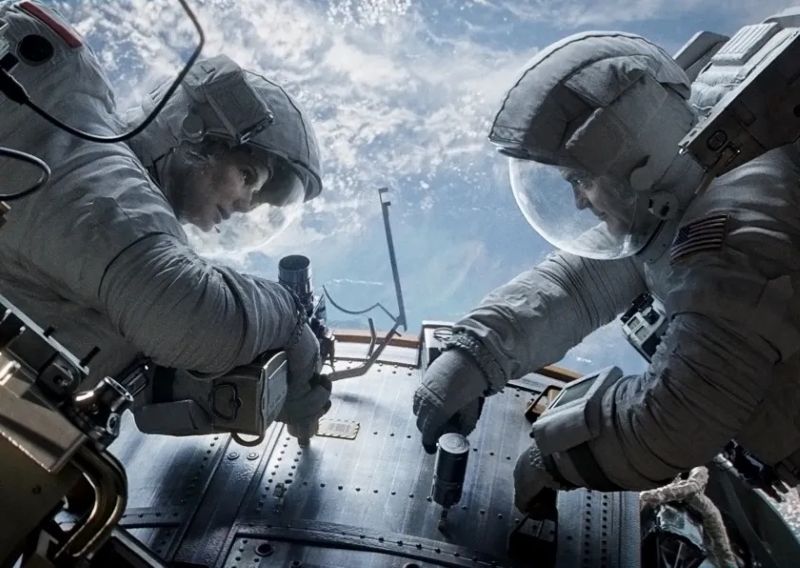
While working outside their spacecraft in low Earth orbit, the crew of a Space Shuttle mission is struck by a cloud of orbital debris from a destroyed satellite and left stranded in space. The film follows, almost in real time, medical engineer Dr. Ryan Stone and veteran astronaut Matt Kowalski as they try to return to Earth.
- Producers: Alfonso Cuarón, David Heyman.
- Production companies: Heyday Films, Esperanto Filmoj.
- Distributor: Warner Bros.
- Screenplay: Alfonso Cuarón, Jonás Cuarón.
- Cinematography: Emmanuel Lubezki.
- Editing: Alfonso Cuarón, Mark Sanger.
- Music: Steven Price.
- Visual effects: Framestore.
- Main cast: Sandra Bullock (Ryan Stone), George Clooney (Matt Kowalski), Ed Harris (voice of Mission Control in Houston), Orto Ignatiussen (Aningaaq).
- Language: English (with some Russian and Chinese in communications and on-screen displays).
- Running time: 91 minutes.
- Budget: approximately $100 million. Worldwide box office: approximately $723 million.
Trailer
Plot Overview
Roughly 600 kilometers above the Earth, Dr. Ryan Stone, on her first Shuttle mission, is repairing the Hubble Space Telescope together with astronaut Matt Kowalski and others.
During the work, debris from a Russian missile strike on one of the country’s own satellites spreads in a chain reaction and sweeps through the crew’s orbit at high speed. The Shuttle is wrecked and most of the crew are killed, leaving Stone and Kowalski as the only survivors.
With communications cut off, the two set out to reach the nearby International Space Station (ISS) and use the Soyuz escape craft left there to return to Earth. But the debris cloud is returning on a roughly 90-minute cycle, and their oxygen is running low.
Commentary
Production Background
The screenplay was co-written by Alfonso Cuarón and his son Jonás. Cuarón had already demonstrated a highly immersive style built on long takes in his previous film, “Children of Men” (2006), and “Gravity” can be seen as an extension of that work. Lubezki, who shot “Children of Men,” also served as cinematographer here.
The imagery the film demanded was difficult to achieve with existing techniques, and the project required a long development period before release.
Production and visual effects were centered in the United Kingdom, and the effects were created by the British company Framestore.
Cinematography and Visual Techniques
The film opens with a single take of roughly 13 minutes and is built around long shots throughout. These takes, however, were achieved by combining live-action footage with computer graphics; the film was not shot in real space or aboard real spacecraft. Most of the film’s space environments and vehicles are computer-generated, and the live-action photography consists mainly of the actors’ faces and upper bodies.
The actors’ faces were lit with a light box, a structure surrounded by LED panels. By projecting pre-rendered imagery, it reproduced the way light from the Earth and the Sun falls on a face.
The camera moves from exterior views of space into the point of view inside Stone’s helmet without a cut. The audience thus experiences the vast external vista and the confined subjective view as one continuous flow.
The film was designed for 3D and IMAX 3D presentation, with particular emphasis on the drift of objects in weightlessness and the sense of depth as debris approaches. For the IMAX release, digital remastering (DMR) enhanced the immersive effect of the giant screen and powerful sound. IMAX 3D screenings reportedly grossed more than $100 million worldwide, and these special formats contributed to the film’s success.
Sound and Music
As the opening on-screen text states, space has no medium to carry sound. The film portrays exterior scenes in near silence; sound reaches the audience only as vibrations transmitted through spacesuits and hulls, and through radio communications. Sound design was by Glenn Freemantle.
The score was composed by Steven Price. Its blend of electronic textures and orchestral writing is synchronized with the progress of the tense sequences.
Thematic Analysis
The film’s central themes are survival in extreme isolation and the rebirth of a person burdened by loss. Stone has lost her young daughter, and at the start of the story she approaches her work in a manner that seems detached from everyday life. The motifs of motherhood, loss, and rebirth run through the whole narrative.
Several scenes are often read in connection with images of birth and evolution: for example, the scene in which Stone floats curled up like a fetus inside the ISS, and the closing scene in which she emerges from the water onto the shore and stands up. These are frequently read as biological and mythic symbols of rebirth.
Release
The film had its world premiere on August 28, 2013, as the opening film of the 70th Venice International Film Festival. In the United States it opened on October 4, 2013, in 3D and IMAX 3D. In Japan it was released on December 13, 2013.
Reception
The film was widely praised for the innovation of its imagery and its immersive quality. From its release to the present, it has held roughly a 96% approval rating on Rotten Tomatoes and a weighted average of 96/100 on Metacritic.
Praise centered on how the combination of long takes and computer graphics lets the audience experience the sensation of drifting in weightlessness. The visual technology that obscures the boundary between live action and computer-generated imagery, the sound design built on near silence, and a structure that rests almost entirely on Bullock’s solo performance were all singled out.
At the 86th Academy Awards, the film received ten nominations, including Best Picture, Best Actress (Bullock), and Best Production Design, and won seven: Best Director, Best Cinematography, Best Film Editing, Best Original Score, Best Sound Editing, Best Sound Mixing, and Best Visual Effects.
At the British Academy Film Awards, it also won in several categories, including Outstanding British Film and Best Director.
Criticism
A number of scientific inaccuracies have been pointed out. Shortly after the film’s release, astrophysicist Neil deGrasse Tyson noted that the Hubble Space Telescope, the ISS, and the Chinese space station Tiangong appear close to one another in the same orbit, which is implausible. In reality, Hubble orbits at an altitude of roughly 540 kilometers and the ISS at roughly 400 kilometers, and their orbital inclinations differ greatly (about 51.6 degrees for the ISS and about 28.5 degrees for Hubble).
In addition, although the idea of a chain reaction of debris from a destroyed satellite (the so-called Kessler syndrome) is based on an actual theory, the film’s depiction of the debris cloud returning on a roughly 90-minute cycle along nearly the same orbit and repeatedly striking the crew is a simplification.
Regarding the scene in which Kowalski releases his tether, it has also been pointed out that in microgravity a slight force is enough to draw the two astronauts toward each other under the law of inertia, so there is little necessity for him to let go.
Furthermore, the film’s treatment of the Soyuz’s fuel and capabilities, and of how easily one can transfer between spacecraft, departs from real-world operations.
It should also be noted that the Space Shuttle program ended in 2011, and the mission designation shown in the film (STS-157) is fictional.
On the other hand, there is a defensive view that these scientific inaccuracies are deliberate dramatic liberties taken for the sake of the story and do not diminish the work’s value.
On the narrative side, some critics find the backstory of Stone’s deceased daughter sentimental and formulaic. Others find Kowalski’s cheerful characterization, the schematic quality of the symbolism suggesting rebirth, and the linear plot built around very few characters lacking relative to the level of the film’s visual achievement.
Home Media
Digital distribution began in stages from early February 2014, followed by physical releases.
In the United States, DVD, Blu-ray, and Blu-ray 3D editions (including combo packs) were released by Warner Home Video on February 25, 2014. Bonus features include the short film “Aningaaq,” the documentary “Collision Point: The Race to Clean Up Space” (narrated by Ed Harris) about space debris, and a shot-by-shot breakdown.
In the United Kingdom, similar DVD, Blu-ray, and Blu-ray 3D editions were released on March 3, 2014 (digital around March 2).
In Australia, DVD and Blu-ray editions were released around February 26, 2014.
In Japan, Warner Home Video released a 3D & 2D Blu-ray set and a Blu-ray & DVD set (first-pressing limited edition) on April 23, 2014. A standard Blu-ray/DVD edition (December 2014), a special edition (2015), and reissues followed. The bonus content is largely the same as the overseas editions, including the short film “Aningaaq” and behind-the-scenes footage of the production.
Subsequently, special editions, Dolby Atmos editions, Diamond Luxe editions, and other reissues have appeared in various countries. Digital and streaming versions also continue to be available.
Short Film “Aningaaq” (2013)
“Aningaaq” (2013), a short film directed by Jonás Cuarón, depicts the same radio exchange that Stone has in the main film, but from the side of Aningaaq, the man on the ground. It is also included as a home media bonus feature.
Search Links
Cross-Search for “Alfonso Cuarón Gravity” on JustWatch
Search for “Alfonso Cuarón Gravity” on Amazon.com
Detailed Synopsis (Spoilers)
The following text appears on screen at the start.
AT 600KM ABOVE PLANET EARTH
THE TEMPERATURE FLUCTUATES BETWEEN +258 AND -148 DEGREES FAHRENHEIT
THERE IS NOTHING TO CARRY SOUND
NO AIR PRESSURE
NO OXYGEN
LIFE IN SPACE IS IMPOSSIBLE
The title “GRAVITY” then appears.
The film begins with a long take of an exterior scene. The crew of the Space Shuttle Explorer is repairing the Hubble Space Telescope while communicating with Mission Control in Houston. Dr. Stone is installing a scanning system, while Shariff and Kowalski work alongside her. Kowalski chatters lightly, moving around on his jet pack and cracking jokes between tasks.
Houston then radios an order to halt the work and return to Earth at once. Russia has blown up one of its own satellites, and the fragments are spreading in a chain reaction. Communications, they are told, will soon be lost.
Soon afterward, the debris cloud arrives and Shariff is killed. Stone is torn from the robotic arm and tumbles at high speed through open space. Kowalski reaches her with his jet pack and rescues her, and the two return to the Shuttle. According to Houston’s warning, the main debris cloud will return in about 90 minutes.
When they recover Shariff’s body, they find that debris has pierced his face. The Explorer has suffered catastrophic damage, and the other crew members’ bodies remain aboard. Kowalski and Stone are the only survivors.
The two head for the ISS. To return to Earth, they will need the Soyuz. On the way, Stone reveals that her home is in Lake Zurich, Illinois, and that she had a daughter who died at the age of four. The oxygen in her tank is rapidly running down.
As they approach the ISS, Stone is attached to Kowalski by a tether, and Kowalski urges her to let go. Telling her to get home safely, he releases himself and drifts away into space.
Stone enters the ISS through the airlock. Kowalski had told her to use the Soyuz to reach the Chinese station.
Stone tries to reach Kowalski over the communication system, but there is no response. She is now the sole survivor of STS-157.
A fire breaks out in the ISS, and Stone hurries to detach the Soyuz. She has no more than seven minutes to get away. But the parachute lines are tangled and the Soyuz cannot separate. Stone goes outside to free the lines, but debris arrives. The ISS is smashed to pieces.
Stone returns to the Soyuz and heads for the Chinese station Tiangong. She fires the main engine, but it runs out of fuel and she is left adrift again. She calls for rescue over the radio, but she cannot communicate with Aningaaq, the man on the ground who answers. He responds by imitating a dog’s bark, while Stone talks one-sidedly about her fear of death. Over the radio, a lullaby and a baby’s cries can be heard.
Then, in a scene that could be either a dream or a hallucination, Kowalski taps on the window and enters the cabin. He suggests that Stone can use the Soyuz’s descent thrusters for propulsion and tells her to return alive. “Landing is the same as launching,” he says.
Stone wakes up and murmurs a message to Kowalski for her dead daughter. She asks him to tell a brown-haired girl named Sarah that her lost red shoes have been found.
Stone separates the orbital module and the propulsion module and uses the thrusters to head for Tiangong. She opens the hatch, enters the station, boards the spacecraft Shenzhou, and detaches it from Tiangong. The capsule falls toward Earth, and after atmospheric entry the parachute opens. Houston radios her.
The capsule lands and begins to sink in the water. Stone escapes from inside and swims toward the surface. At last she crawls up onto the shore, murmurs “Thank you,” and stands up.